

 News
News  Coin Information
  About us
  Customer Service


 Add as a preferred source on Google
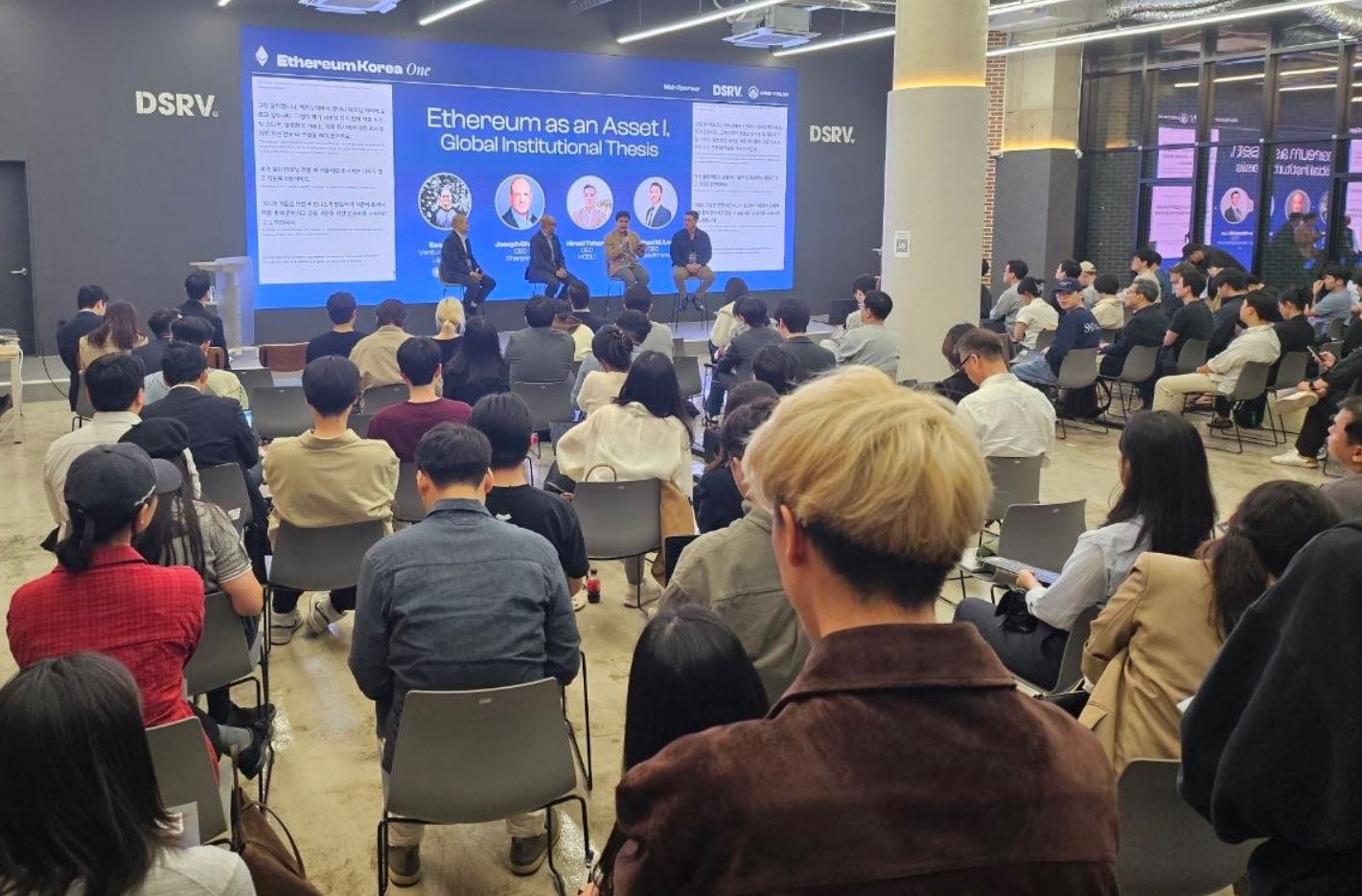
The Ethereum Korea Consortium has officially launched in Seoul, positioning itself as a bridge between domestic institutions and the global Ethereum ecosystem as Korean finance and web3 leaders signal a shift from being primarily a 'consumer market' to becoming an active contributor to open-source development and protocol adoption.
The consortium’s debut event, titled “Ethereum Korea One — Bridging Institutions and the Ethereum Ecosystem”, took place on Wednesday U.S. Eastern Time at DSRV’s headquarters in Seoul, drawing a full house of attendees from major Korean financial firms—including Mirae Asset Securities, KB Securities, Hanwha Investment & Securities, KakaoBank, and Toss—alongside representatives from the Ethereum Foundation and major layer-2 networks such as Arbitrum and Optimism.
The gathering is being read by the local industry as a coordinated attempt to formalize Ethereum-focused collaboration in Korea at a time when 'institutional demand' for blockchain infrastructure is increasingly centered around stablecoins, tokenized real-world assets (RWA), and compliance-ready settlement rails—areas where Ethereum (ETH) continues to dominate on liquidity and developer activity.
A recorded congratulatory message from Ethereum co-founder Vitalik Buterin opened the program. Buterin said the ecosystem is entering a period of structural change as layer-1 scalability upgrades, the maturation of zero-knowledge technology, and the rapid acceleration of AI reshape how Ethereum’s base layer and rollups should work together. He added that he is looking forward to what Korean individual developers, Ethereum-native companies, and newly participating institutions will build, framing the goal as creating “a more free, open, and secure financial ecosystem and internet.”
In the opening presentation, NonceClassic CEO Yoobin Kang offered a blunt diagnosis of Korea’s Ethereum footprint. Despite Korea’s status as a top-tier crypto market by trading activity and retail participation, Kang argued that the country has lagged in core development and meaningful open-source contribution—evidence, he said, that Korea has largely been 'consuming' Ethereum rather than helping build it.
Kang attributed the imbalance to four factors: an investment-centric market structure, developer dispersion toward local chains, prolonged regulatory uncertainty, and weak connective tissue to global protocols and governance communities. The consortium, he said, was created to correct those structural constraints by coordinating builders, infrastructure operators, and institutional onramps under one umbrella.
The Ethereum Korea Consortium launched with 10 participating organizations, grouped into four categories: ecosystem/community (NonceClassic, The Ticker is ETH, CryptoPlanet), infrastructure (Radius, Sunnyside Labs, NodeInfra), institutional bridge (DSRV, Wavebridge), and media/content (Four Pillars, Undefined Labs). Organizers said the group plans to allocate half of member sponsorship contributions to builder grants for the Ethereum ecosystem, and is targeting September for its first flagship conference.
DSRV CEO Byungyoon Seo delivered a keynote on Korea’s role in global Ethereum consensus, emphasizing Ethereum’s position as a foundational layer for the next generation of financial infrastructure. Seo said DSRV began in 2019 as a small developer study group focused on Ethereum code and has since grown into a top-ranked Ethereum validator globally. He also underscored Ethereum’s centrality to the stablecoin economy, noting that more than half of the roughly $320 billion in global stablecoin supply circulates on Ethereum and its extended stack—a metric many institutions view as a proxy for settlement preference and 'liquidity inflow'.
Seo highlighted DSRV’s work with the World Bank on a digital agriculture voucher system in Madagascar built on an Ethereum layer-2, framing it as an example of how rollups can deliver lower-cost transactions while inheriting Ethereum’s security and interoperability. The case, presented to a largely institutional audience, reflected a broader theme of the evening: Ethereum as a neutral, open platform increasingly packaged for enterprise-grade deployments rather than purely crypto-native applications.
Adrian Li of the Ethereum Foundation focused on why Ethereum remains a default choice for institutions and enterprises, citing its long uptime record, deep liquidity, and leadership in tokenized assets. Li argued that most onchain RWA liquidity still anchors to Ethereum, reinforced by its tooling maturity and the breadth of programmable standards in production.
Li also elevated forward-looking risks and research priorities that are gaining attention among large allocators. On 'post-quantum' security, he warned that advances in quantum computing could threaten today’s widely used ECDSA signature scheme within a 2–5 year horizon, and said Ethereum is among the few ecosystems investing serious resources into migration pathways and mitigation research. He pointed to Ethereum’s efforts around AI-agent payments and standards work—referencing initiatives such as ERC-7730—as well as the ecosystem’s focus on privacy-preserving cryptography, including zero-knowledge proofs (ZK), multi-party computation (MPC), and fully homomorphic encryption (FHE), which could help satisfy institutional privacy and compliance requirements without abandoning public-chain interoperability.
Li acknowledged criticism that the Ethereum Foundation has sometimes appeared distant in external engagement, and suggested that locally rooted organizations like the Ethereum Korea Consortium can play a key role in connecting builders with institutions and policymakers—describing that bridging function as aligned with Ethereum’s long-term trajectory.
The event’s agenda reflected the consortium’s institutional emphasis. Panels began with a global session on Ethereum as an asset, featuring Sharplink CEO Joseph Chalom, Parataxis Ethereum’s Michael M. Lee, and HODL1’s Hiroki Tahara, before shifting to Korea-focused discussions that included representatives from Mirae Asset Securities, KB Securities, KODA, KakaoBank, Toss, and Hanwha Investment & Securities. Topics spanned tokenized securities and RWA, stablecoin use cases, and real-world adoption pathways for regulated financial players.
The program was set to conclude with a closing keynote from Ethereum Foundation representative Luca Zanolini. DSRV and Arbitrum served as main sponsors, with Parataxis Ethereum and HODL1 participating as general sponsors—an arrangement that underscored the event’s intent to connect Korean capital markets to the broader rollup-centric Ethereum roadmap.
For Korean crypto markets, the consortium’s formation marks a bid to translate strong domestic interest into sustained contribution—through grants, coordination, and institutional education—at a moment when Ethereum’s influence is increasingly measured not just in market capitalization, but in how effectively it underwrites stablecoin settlement, tokenized assets, and emerging machine-to-machine payment rails.







Comment 0