

 News
News  Coin Information
  About us
  Customer Service


 Add as a preferred source on Google
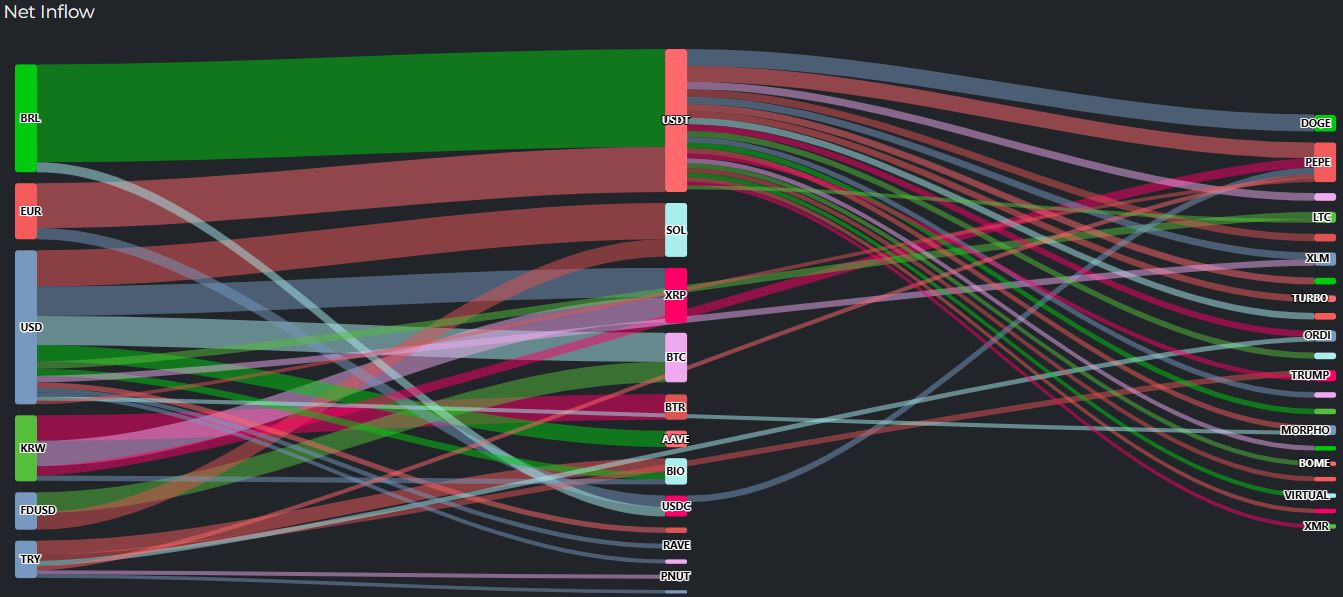
Capital rotated out of major cryptocurrencies over the past several hours, with traders shifting into stablecoins and cash while selectively redeploying into a handful of altcoins—signs of a more 'defensive move' amid near-term uncertainty.
According to Cryptometer data compiled as of 11:30 a.m. KST on Wednesday (2:30 a.m. UTC), fiat inflows into the crypto market over the prior five hours were led by the U.S. dollar (USD) at $4.57 million, followed by the Brazilian real (BRL) at $3.20 million, the South Korean won (KRW) at $1.94 million, the euro (EUR) at $1.68 million, and the Turkish lira (TRY) at $1.10 million.
Stablecoins also drew attention as part of the rotation. Tether (USDT) recorded an initial inflow of $4.24 million before being dispersed across multiple cryptocurrencies, suggesting traders used USDT as a short-term parking asset before re-entering risk positions. First Digital USD (FDUSD) saw $1.12 million in inflows, split primarily between Bitcoin (BTC) and Solana (SOL).
On a token-by-token basis, the largest net inflows during the window went to XRP (XRP) at $1.62 million, Solana (SOL) at $1.59 million, Bitcoin (BTC) at $1.48 million, and Pepe (PEPE) at $1.18 million. Additional inflows were observed in BIO at $787,000, BTR at $758,000, USD Coin (USDC) at $631,000, Dogecoin (DOGE) at $502,000, and Aave (AAVE) at $482,000.
Despite pockets of buying, the broader flow picture leaned risk-off. Over the same five-hour period, outflows were concentrated in Bitcoin (BTC) at $7.84 million and Ethereum (ETH) at $7.80 million, alongside Solana (SOL) at $1.81 million, XRP (XRP) at $1.39 million, and gold-backed token Pax Gold (PAXG) at $1.36 million—indicating widespread 'sell pressure' across both large caps and select hedging assets.
Where that capital went provides the clearest signal of market posture: Tether (USDT) absorbed $14.48 million and USD Coin (USDC) drew $4.76 million, reinforcing stablecoins’ role as the primary refuge during short-term de-risking. At the same time, investors also cashed out into fiat, with conversions totaling $5.25 million into USD, $1.47 million into EUR, $2.13 million into KRW, and roughly $786,000 into TRY.
Overall, the data suggests traders are reducing exposure to core assets like BTC and ETH while maintaining flexibility through stablecoins, then selectively allocating to liquid altcoins. If these patterns persist, they could indicate a market waiting for a clearer catalyst—either macro-driven or crypto-specific—before committing to a more directional move.
🔎 Market Interpretation
- Risk-off rotation: Over a ~5-hour window, traders reduced exposure to major risk assets (notably BTC and ETH) and shifted funds into stablecoins and fiat, signaling a defensive stance amid near-term uncertainty.
- Stablecoins as the primary shelter: USDT absorbed $14.48M and USDC drew $4.76M, indicating capital sought low-volatility parking rather than immediate re-risking.
- Choppy, two-way flows in liquid names: While some tokens showed net inflows (e.g., XRP, SOL, BTC, PEPE), simultaneous large outflows from BTC and ETH suggest distribution and repositioning rather than broad-based accumulation.
- Fiat conversions reinforce caution: Meaningful conversions into USD, EUR, KRW, and TRY imply some participants preferred reducing crypto exposure outright, not only rotating within crypto.
- Waiting-for-catalyst behavior: The pattern fits a market preserving optionality—holding stablecoins/fiat while selectively reallocating to liquid altcoins—pending a clearer macro or crypto-specific trigger.
💡 Strategic Points
- Watch stablecoin inflows as a sentiment gauge: Elevated USDT/USDC net inflows often coincide with heightened uncertainty and can precede either renewed risk-on deployment or deeper drawdowns.
- BTC/ETH outflows matter most for direction: Net outflows of roughly $7.8M each over a short window suggest near-term caution; sustained outflows may pressure market beta.
- Selective alt exposure favors liquidity: Net inflows concentrated in highly tradable assets (XRP, SOL, DOGE, AAVE) imply traders prefer names with tight spreads and fast exit options.
- Interpret USDT “inflow then dispersion” carefully: USDT’s initial inflow (~$4.24M) followed by distribution suggests temporary parking; if subsequent deployment slows, risk-off may intensify.
- Cross-currency inflows hint at regional participation: Notable BRL and KRW inflows suggest regional demand; if those flows reverse quickly, volatility may spike around local trading hours.
- Scenario cues to monitor:
- Risk-on confirmation: Stablecoin balances fall while BTC/ETH net inflows turn positive and broaden to mid-caps.
- Risk-off continuation: Stablecoin and fiat conversions remain elevated while BTC/ETH outflows persist.
- Rotation trade: BTC/ETH flat to down, while a narrow set of liquid alts keep receiving incremental inflows.
📘 Glossary
- Risk-off / Defensive move: Shifting from volatile assets into safer holdings (stablecoins or fiat) to reduce exposure.
- Stablecoin: A cryptoasset designed to track a stable value (typically 1 USD), e.g., USDT, USDC, FDUSD.
- Fiat inflow/outflow: Net movement of government-issued currency into/out of crypto markets via exchanges/ramps.
- Net inflow / Net outflow: Total buying minus selling (or inbound minus outbound flows) for a given asset over a period.
- Parking asset: A temporary holding (often stablecoins) used to wait out volatility before redeploying.
- Liquid altcoins: Non-BTC/ETH tokens with high trading volume and easier entry/exit (e.g., XRP, SOL, DOGE).
- Sell pressure: Persistent selling activity that can push prices down unless matched by demand.
- Catalyst: An event (macro data, policy decision, regulation, ETF/flow news, protocol updates) that drives a directional move.



















Comment 0