

 News
News  Coin Information
  About us
  Customer Service


 Add as a preferred source on Google

Ripple is accelerating its push into Asia through a new collaboration with Singapore’s financial authorities, adding fresh momentum to expectations of deeper 'institutional adoption' even as XRP (XRP) continues to trade in a fragile downtrend. Market attention is now converging on a looming U.S. Securities and Exchange Commission (SEC) deadline on Thursday ET, which is widely viewed as the next major catalyst for XRP’s near-term direction.
On Wednesday ET, Ripple said it will participate in the Monetary Authority of Singapore (MAS)-led BLOOM initiative alongside blockchain firm Unloq, launching a pilot focused on automating trade finance settlement using the XRP Ledger. The project aims to enable near-instant payment finality once predefined conditions—such as confirmation of shipment—are met, replacing processes that typically take days due to document checks and correspondent bank transfers.
A notable element of the pilot is the use of Ripple’s institutional stablecoin, RLUSD, which the company has been positioning as a tool for cross-border settlement between regulated entities. By testing within an MAS-supported sandbox framework, Ripple is seeking to validate real-world workflows under a supervised environment—an approach that could lower future compliance friction and make it easier to expand partnerships with banks and payment providers across the region.
The market reaction was immediate. Following the announcement, XRP’s daily trading volume jumped from roughly $2.1 billion to $3.6 billion, according to figures cited in the Korean report. Ripple’s Asia narrative also gained additional traction after the company outlined plans tied to building payment infrastructure in Australia, reinforcing expectations that on-chain settlement tools could gain wider commercial usage beyond pilot programs.
Ripple President Monica Long has been increasingly explicit about the company’s timeline. In a recent interview referenced in the report, Long said she expects 2026 to be the year when broad-based 'institutional adoption' takes hold. She pointed to RLUSD’s growth trajectory, progress on regulatory permissions—including a trust bank charter from the U.S. Office of the Comptroller of the Currency (OCC)—and partnerships that connect Ripple’s payment rails to hundreds of banks across dozens of countries.
Ripple has also been testing RLUSD in Japan and South Korea, with plans to expand across Southeast Asia and the Middle East. Analysts generally view MAS sandbox validation as strategically important: while it does not guarantee regulatory approval elsewhere, it can serve as a credible proof point for large financial institutions that are reluctant to deploy blockchain settlement without clear oversight and controls.
Separately, the XRP Ledger has drawn community attention after transaction fees spiked amid heavier network activity. According to Ripple’s chief technology officer, the increase was triggered by a dynamic fee mechanism designed to preserve network stability during congestion—suggesting higher utilization rather than a structural malfunction. The report attributed the rise in on-chain activity to increased RLUSD-related settlement experiments and growing DeFi activity on the XRP Ledger.
Despite these constructive fundamentals, XRP’s price action remains under pressure. As of Wednesday afternoon ET, XRP was hovering around $1.38, down roughly 2.4% over 24 hours and about 5.7% on the week, according to the report. Technicians continue to flag resistance in the $1.46–$1.50 zone; repeated failures to reclaim that range have left XRP in a bearish market structure, with some traders warning that a further slide toward $1.09—or even $0.87—cannot be ruled out if sentiment deteriorates.
XRP’s market capitalization stood near $84.9 billion, keeping it ranked fifth among crypto assets. However, 24-hour trading volume was reported around $1.9 billion, down about 9.7% day over day—an indication that buyers have yet to show sustained conviction despite headline-driven bursts of activity.
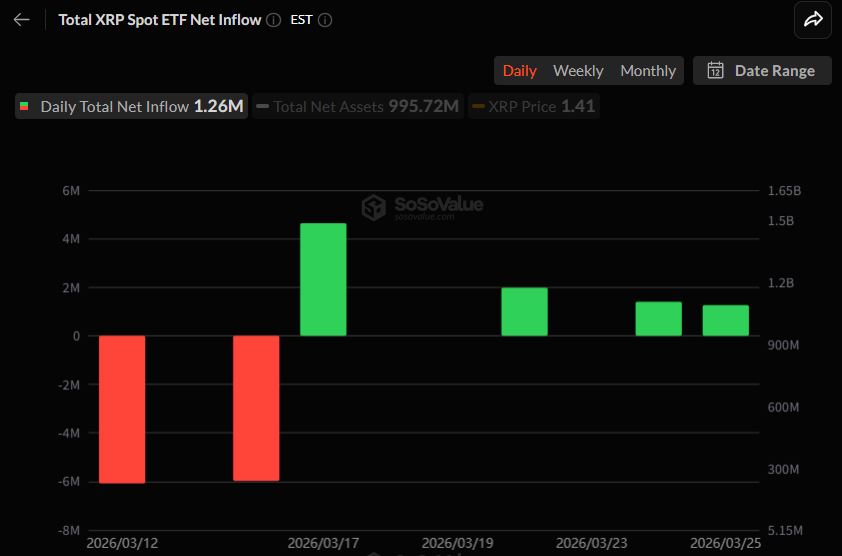
Institutional positioning remains a key question mark. The report noted that XRP spot ETFs recorded inflows of roughly $636,000 last week—marking a first positive week of flows—yet that figure is small relative to cumulative March outflows of about $31 million. The muted demand contrasts sharply with the far larger allocations seen in Bitcoin (BTC) and Ethereum (ETH) ETF products, underscoring lingering caution among professional allocators.
While Ripple’s long-running legal dispute with the SEC has largely stabilized, investors continue to weigh residual uncertainties around XRP’s regulatory treatment in the U.S. Against that backdrop, even incremental ETF inflows may be interpreted less as a decisive shift and more as a tentative probe for liquidity.
Adding to near-term complexity, Binance said it has restricted transfers into isolated margin accounts for the XRP/BNB pair, allowing movement primarily for debt repayment purposes. The measure appears aimed at curbing excessive leverage and reducing liquidation risk during volatility. Still, some market participants view such restrictions as a potential liquidity constraint, particularly during event-driven swings.
The next major focal point is the SEC’s decision window expected Thursday ET regarding an XRP-related ETF. An approval could revive expectations of broader 'liquidity inflow' and improve market narrative around XRP’s investability, while a rejection or delay may amplify uncertainty and invite renewed selling pressure. Market watchers also emphasize the symbolic dimension: an ETF green light would not settle every regulatory debate, but it could materially shift perceptions about XRP’s status in mainstream financial channels.
For now, Ripple is building real-world validation through Asian pilots and regulatory sandboxes, but XRP’s price remains caught between improving adoption signals and skepticism over sustained institutional demand. The SEC’s decision and the measurable outcomes from MAS-linked pilots are likely to be decisive in shaping XRP’s next phase—both in market structure and in credibility with traditional finance.
🔎 Market Interpretation
- Adoption headline vs. price weakness: Ripple’s MAS-backed BLOOM pilot and expanding Asia strategy improved the fundamental narrative, but XRP remains in a fragile downtrend, showing that macro/regulatory catalysts still dominate price discovery.
- Event risk is concentrated on the SEC deadline (Thursday ET): The market is treating the SEC decision window on an XRP-related ETF as the primary near-term catalyst—potentially overriding positive pilot developments.
- Liquidity is inconsistent: Announcement-driven volume temporarily surged (reported jump from ~$2.1B to ~$3.6B), yet later 24-hour volume was cited lower (~$1.9B, down ~9.7% day/day), implying short-lived participation rather than sustained accumulation.
- Institutional demand remains tentative: XRP spot ETF flows turned slightly positive last week (+~$636K) but are small versus prior March outflows (~$31M), suggesting professional allocators are still cautious compared with BTC/ETH products.
- Network activity uptick isn’t framed as a failure: XRPL fee spikes were attributed to a dynamic fee mechanism during congestion (stability feature), consistent with higher usage from RLUSD experiments and DeFi activity rather than a structural breakdown.
💡 Strategic Points
- Why MAS matters: Running the RLUSD/XRPL trade-finance settlement pilot inside an MAS-supported sandbox can serve as a compliance credibility signal for banks—lowering perceived rollout risk even if it doesn’t automatically transfer to other jurisdictions.
- RLUSD as the institutional wedge: Using Ripple’s institutional stablecoin for regulated cross-border settlement reframes Ripple’s pitch away from speculative token demand and toward operational benefits (near-instant finality once conditions like shipment confirmation are met).
- Watch measurable pilot KPIs: Key proof points likely include settlement time reduction (days → near-instant), operational error rates, reconciliation costs, and ease of integration with existing trade-finance workflows.
- Technical levels to monitor: Resistance remains in the $1.46–$1.50 range; repeated failure to reclaim it leaves bearish structure intact. Downside risk levels highlighted by traders include ~$1.09 and ~$0.87 if sentiment worsens.
- Derivatives/leverage constraints are a secondary variable: Binance restricting transfers into isolated margin accounts for XRP/BNB (primarily for debt repayment) may reduce leverage-driven volatility, but could also be perceived as a liquidity constraint during sharp moves.
- Scenario framework for Thursday:
- Approval: could improve “investability” perception, invite incremental liquidity inflow, and strengthen narrative alignment between pilots (utility) and market access (ETF).
- Delay/Rejection: likely elevates regulatory uncertainty, risks renewed selling pressure, and keeps institutional allocations subdued.
- Medium-term timeline messaging: Ripple leadership signaling “institutional adoption” by 2026 sets expectations; however, the market is currently demanding nearer-term triggers (ETF outcome, concrete pilot results) to validate that path.
📘 Glossary
- MAS (Monetary Authority of Singapore): Singapore’s central bank and primary financial regulator, known for structured innovation programs and supervised testing environments.
- BLOOM initiative: An MAS-led program framework referenced in the article; here it hosts a pilot exploring blockchain-based automation for trade-finance settlement.
- Regulatory sandbox: A controlled environment where firms test financial products/services with regulatory oversight to evaluate compliance, controls, and consumer/market risk.
- XRP Ledger (XRPL): A public blockchain network associated with XRP, used for payments and settlement; includes dynamic fees to maintain stability under congestion.
- RLUSD: Ripple’s institutional stablecoin (as described), positioned for regulated cross-border settlement between entities rather than retail speculation.
- Payment finality: The point at which a transaction becomes irreversible and fully settled—critical in trade finance where conditional triggers (e.g., shipment confirmation) govern releases.
- Trade finance settlement: The completion of payment and document reconciliation processes supporting international trade; traditionally slow due to document checks and multiple banking intermediaries.
- Dynamic fee mechanism: A network feature that raises transaction costs during congestion to prioritize network health and reduce spam, often interpreted as a utilization signal.
- Spot ETF flows: Net money moving into/out of exchange-traded funds that hold the underlying asset (or track it closely), used as a proxy for institutional demand.
- Isolated margin: A leverage setup where margin is dedicated to a specific trading pair/position; restrictions can reduce forced liquidations but may also curb trading flexibility.



















Comment 0