

 News
News  Coin Information
  About us
  Customer Service




Jeremy Grantham, the co-founder of investment firm GMO and a veteran market strategist known for accurately warning about the 2000 dot-com crash and the 2008 global financial crisis, has renewed his criticism of Bitcoin (BTC), describing the world's largest cryptocurrency as a "useless, speculative mechanism" that could steadily lose relevance over the coming decades.
Grantham argued that Bitcoin fails to meet the fundamental characteristics of a reliable financial asset. According to him, the cryptocurrency does not generate income, lacks stable value, and has yet to establish itself as a practical medium of exchange for everyday transactions.
One of Grantham's strongest criticisms was directed at Bitcoin's proof-of-work (PoW) consensus mechanism. He claimed the vast amount of energy consumed to validate transactions delivers little or no meaningful economic benefit to society. In his view, the computational effort required to secure the Bitcoin network creates unnecessary costs rather than productive value.
Grantham summarized his stance by saying, "Proof of unnecessary work shouldn't be worth a bucket of warm spit, and it will not be."
The investor also questioned Bitcoin's usefulness as a currency. He noted that consumers rarely use BTC for routine purchases, while businesses and financial institutions generally avoid settling large commercial transactions with the digital asset. Without widespread transactional adoption, he believes Bitcoin cannot fulfill the role of money.
In addition, Grantham dismissed Bitcoin's reputation as a store of value. Unlike stocks that can produce dividends or companies that generate earnings and cash flow, Bitcoin offers no yield or intrinsic income. As a result, he argued that investors have no fundamental basis for determining its fair value, leaving its price driven largely by speculation.
Grantham's comments attract attention because of his long history of identifying major financial bubbles before they burst. He warned investors ahead of the dot-com collapse in 2000 and predicted the U.S. housing market crash that triggered the 2008 financial crisis. More recently, he has cautioned that artificial intelligence-related stocks could also be in bubble territory, suggesting U.S. equities could face significant downside.
Despite his respected track record, Grantham has not always been accurate in terms of timing. His 2021 warning about an "epic bubble" in U.S. stocks came well before markets reached their eventual correction in 2022, highlighting that even successful macro forecasts can materialize later than expected.
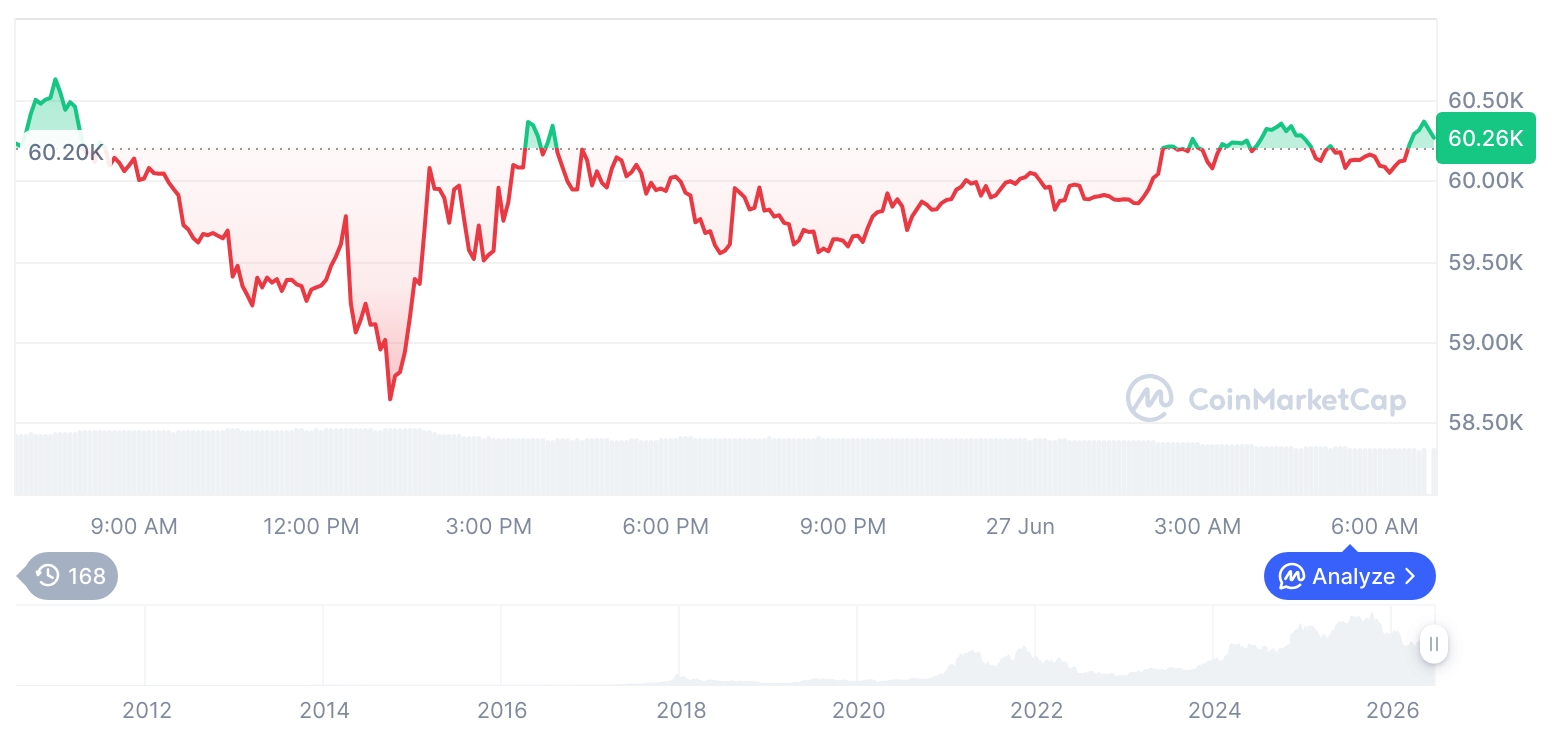
His latest Bitcoin outlook comes as the cryptocurrency trades around $60,500, a sharp decline from its record high above $126,000 reached in late 2025. Investor sentiment has also weakened, with U.S. spot Bitcoin exchange-traded funds (ETFs) recording approximately $6.35 billion in net outflows over the past 30 days through mid-June, signaling reduced institutional demand.
The debate over Bitcoin's long-term value has also intensified amid rising investment in artificial intelligence. Coinbase CEO Brian Armstrong previously noted that growing AI infrastructure spending is influencing capital allocation across technology and digital asset markets, potentially affecting cryptocurrency investment flows.
Grantham is not the only prominent Bitcoin skeptic. Economist Peter Schiff has consistently argued that Bitcoin lacks intrinsic value and remains unsuitable as a long-term investment or monetary asset.
Whether Bitcoin can maintain key technical support levels during the third quarter of 2026 may provide further evidence for either supporters or critics. Grantham believes any decline is unlikely to happen overnight, instead predicting a gradual erosion in Bitcoin's relevance and value over many years as investors reassess its long-term utility.














Comment 0