
 Add as a preferred source on Google
Kaito Tops Upbit ‘Greed’ Index as Trading Volume Surges Despite Flat Price
Kaito led Upbit’s greed index with high trading volume despite unchanged prices, signaling concentrated market attention without a breakout.



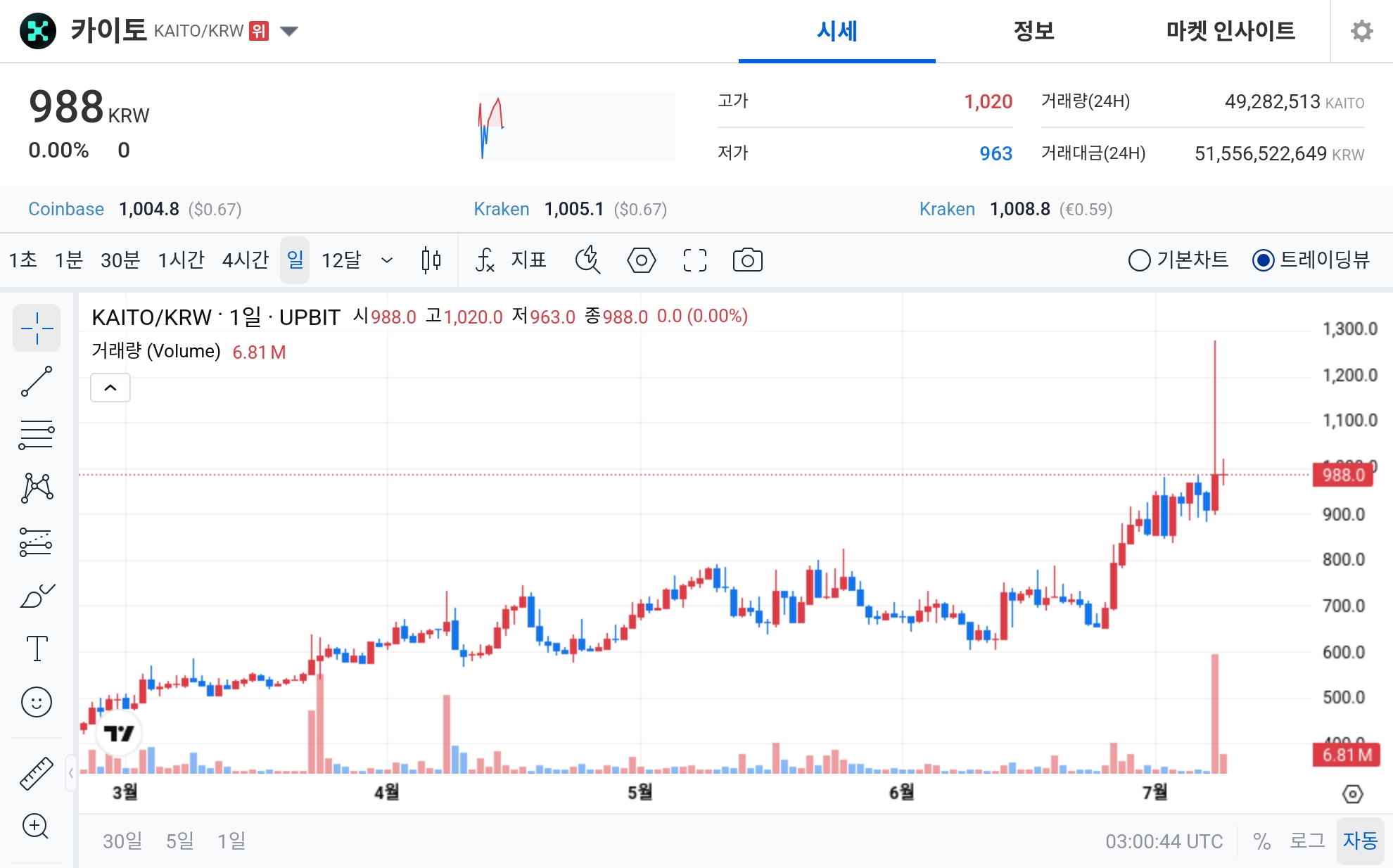
Kaito (KAITO) climbed to the top of Upbit’s crypto ‘fear and greed’ leaderboard on Wednesday ET, posting the highest ‘greed’ reading among tracked tokens even as its price ended the session flat—an illustration of how sentiment and liquidity can concentrate in a single name without an immediate breakout.
On Upbit’s KRW market, KAITO changed hands at 988 won, unchanged on the day (0.00%). It traded between an intraday high of 1,020 won and a low of 963 won. Despite the lack of net price movement, 24-hour turnover reached about 51.56 billion won (KRW 51,556,522,649), keeping the token among the market’s most actively traded names by notional volume.
Price action showed a push higher during the session that failed to hold into the close. After rallying to 1,020 won, KAITO settled back near its opening level, leaving an upper wick on the daily candle—often read by traders as a sign that buyers stepped in but met ‘profit-taking’ supply at higher levels. The unchanged open and close, alongside a zero daily change, suggested the move was more consistent with a pause or consolidation phase than a continuation of a sharp rally.
In Upbit’s ‘greed’ rankings, KAITO led with a reading of 77. It was followed by Pyth Network (PYTH) at 65, Uniswap (UNI) at 62, Safe (SAFE) at 61, and AWE (AWE) at 60. At the other end of the spectrum, tokens registering the most intense ‘fear’ included Infinite (IN) and Adventure Gold (AGLD), both at 15, with ZKPass (ZKP) at 18, Moonbirds (BIRB) at 19, and Bonk (BONK) at 23—highlighting how risk appetite can diverge sharply across assets even within the same venue.
Broader majors were mixed to weaker over the same window in the KRW market. Bitcoin (BTC) fell 0.81% to 92,162,000 won, XRP (XRP) slipped 0.61% to 1,618 won, and Ethereum (ETH) declined 1.08% to 2,576,000 won. Tether (USDT) was flat around 1,493 won. UNI stood out among the high-greed cohort, rising 0.90% to 4,944 won.
While KAITO traded in a tight band around 986–988 won late in the session, the surge in turnover and top placement on the sentiment gauge indicated sustained short-term attention. Whether that ‘liquidity inflow’ translates into a directional move may depend on whether buyers can absorb overhead selling pressure that emerged near the 1,020 won area.
Article Summary by TokenPost.ai
🔎 Market Interpretation
- KAITO topped Upbit’s fear-and-greed leaderboard with a “greed” score of 77, signaling strong trader attention and risk-on positioning despite a flat daily close.
- Price ended unchanged at 988 KRW after an intraday run to 1,020 KRW and a pullback to 963 KRW, implying demand existed but met meaningful supply near the day’s highs.
- 24-hour turnover (~51.56B KRW) remained elevated, showing liquidity concentration in KAITO even without a net breakout—often a setup for either continuation or a liquidity-driven fade.
- The daily candle structure (upper wick with open≈close) suggests profit-taking/overhead resistance around 1,020 KRW and a consolidation tone rather than a clean trend extension.
- Sentiment dispersion on Upbit was pronounced: “greed” clustered in a few names (KAITO, PYTH, UNI, SAFE, AWE), while “fear” was concentrated in others (IN, AGLD, ZKP, BIRB, BONK).
- Broader majors in the KRW market were slightly weaker (BTC, ETH, XRP down), indicating KAITO’s attention was more idiosyncratic than market-wide.
💡 Strategic Points
- Key resistance to monitor: ~1,020 KRW (area where selling pressure emerged). A sustained break/hold above may indicate buyers are absorbing supply.
- Key support zone: ~963 KRW (intraday low). Repeated tests or a breakdown could signal the “greed” reading is not translating into durable demand.
- Watch volume-quality signals: high turnover with flat price can reflect two-way action (distribution or accumulation). Confirmation typically comes from a higher close with strong volume or a failed retest after a spike.
- Candle/structure cue: an upper wick after a push higher often implies late-session selling; traders commonly look for follow-through (next-day strength) before treating the high as a breakout.
- Relative-rotation check: compare KAITO’s behavior with other high-greed assets (PYTH/UNI/SAFE/AWE). If KAITO lags while peers advance, attention may rotate away.
- Macro overlay: with majors slightly down, a KAITO move may require fresh marginal buyers rather than relying on broad market tailwinds.
📘 Glossary
- Fear and Greed Index (exchange leaderboard): a sentiment indicator ranking assets by perceived risk appetite/enthusiasm; higher values imply “greed,” lower values imply “fear.”
- Greed Reading: a high sentiment score suggesting traders are optimistic and more willing to take risk; can precede breakouts or become contrarian if overheated.
- Turnover (Notional Volume): total traded value over a period (here, KRW), used to gauge liquidity and intensity of participation.
- KRW Market: trading pairs quoted in South Korean won on Upbit.
- Intraday High/Low: the highest and lowest traded prices during the session.
- Upper Wick (Candlestick): the thin line above the candle body showing price traded higher but failed to hold; often interpreted as rejection at higher levels.
- Profit-taking Supply/Overhead Resistance: selling pressure that appears as holders lock in gains near a prior high, making upward progress harder.
- Consolidation: a phase where price moves sideways in a range as buyers and sellers balance before a potential next directional move.
- Liquidity Inflow: increased trading activity/participation that can enable larger moves, but does not guarantee direction without net buying pressure.