

 News
News  Coin Information
  About us
  Customer Service


 Add as a preferred source on Google
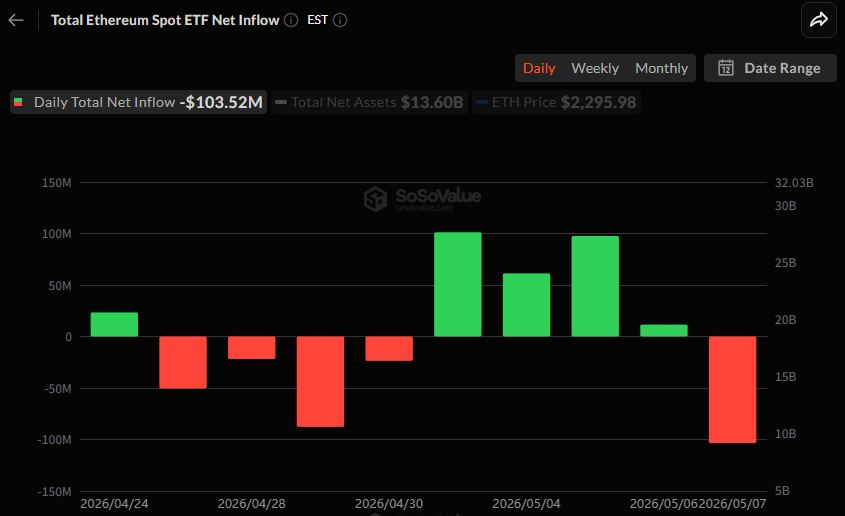
U.S. spot Ethereum (ETH) exchange-traded funds swung back to net outflows on May 7, halting a four-session streak of inflows and signaling a pause in ‘risk appetite’ for ETH exposure through regulated wrappers.
Data compiled by SosoValue showed the U.S. spot Ethereum ETF segment posted $103.52 million in net daily outflows on May 7 ET. The reversal ended net inflows recorded across the prior four trading days, while cumulative net inflows for the spot Ethereum ETF market stood at $12.08 billion.
Notably, none of the 10 listed spot Ethereum ETFs recorded net inflows on the day. Outflows were concentrated in five funds: Fidelity’s Fidelity Ethereum Fund ($FETH) saw $62.26 million leave, while BlackRock’s iShares Ethereum Trust ($ETHA) posted $26.31 million in outflows. Grayscale’s Grayscale Ethereum Trust ($ETHE) lost $8.38 million, Grayscale’s Grayscale Ethereum Mini Trust ($ETH) shed $3.70 million, and 21Shares’ 21Shares Core Ethereum ETF ($TETH) reported $2.86 million in net redemptions. The remaining products were flat.
Total trading volume across spot Ethereum ETFs reached $524.39 million, reflecting continued secondary-market activity even as primary-market flows turned negative. By product, BlackRock’s $ETHA led turnover with $328.75 million traded, followed by Grayscale’s $ETH at $57.77 million and Grayscale’s $ETHE at $48.46 million.
Collectively, the sector’s net assets stood at approximately $13.6 billion—about 4.94% of Ethereum’s total market capitalization—underscoring the growing footprint of ETF vehicles in ETH market structure. By assets under management, BlackRock’s $ETHA remained the largest at roughly $7.3 billion, followed by Grayscale’s $ETH at $2.09 billion and $ETHE at $1.86 billion.
The shift to outflows suggests institutional positioning is becoming more selective amid broader crypto market uncertainty, with ETF flows increasingly serving as a real-time barometer for ‘liquidity inflow’ and marginal demand. Whether the pullback proves short-lived will likely depend on near-term ETH price action, macro conditions, and expectations around U.S. regulatory policy toward crypto markets.





















Comment 0