
 Add as a preferred source on Google
Bitcoin, Ethereum See Over $680 Million Net Outflows as Capital Shifts to Stablecoins
Bitcoin and Ethereum recorded major net outflows while stablecoins like USDT and USDC جذب inflows, signaling a defensive market shift toward capital preservation.



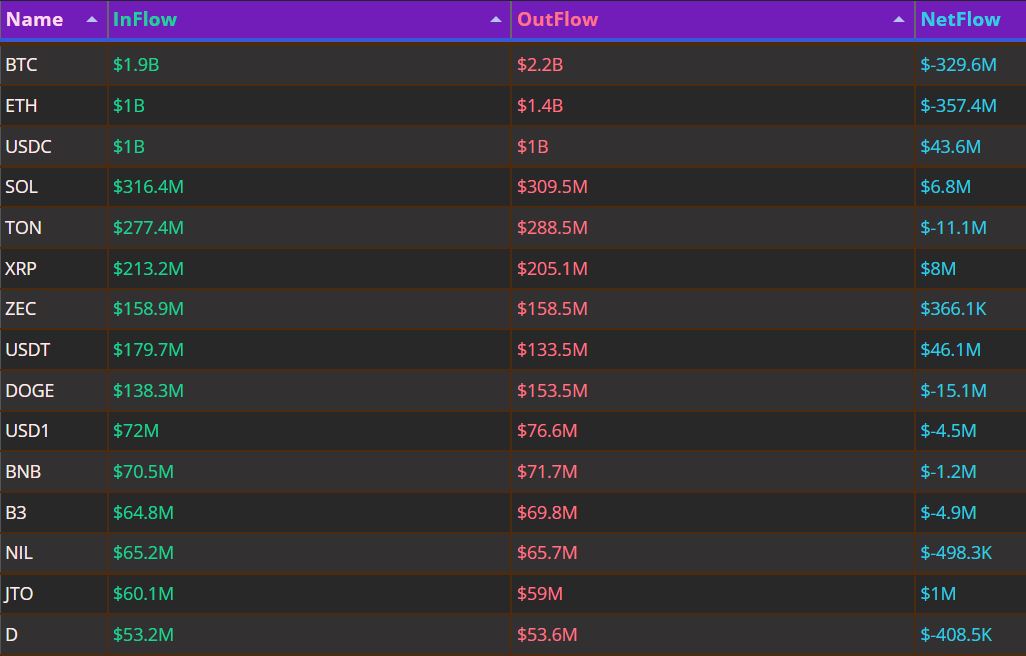
Capital rotated into 'stablecoins' and 'wrapped assets' over the past 24 hours, while the two largest cryptocurrencies—Bitcoin (BTC) and Ethereum (ETH)—saw sizeable net outflows, underscoring a defensive shift in positioning amid shifting market liquidity.
According to Cryptometer data as of Thursday 03:35 UTC, Bitcoin (BTC) recorded approximately $1.9 billion in inflows and $2.2 billion in outflows over the prior 24 hours, resulting in a net outflow of $329.6 million. Ethereum (ETH) posted $1.0 billion in inflows versus $1.4 billion in outflows, for a net outflow of $357.4 million—making it the largest net outflow among major assets in the period.
Risk-sensitive altcoins also showed signs of capital leaving the market. Dogecoin (DOGE) logged a net outflow of $15.1 million, while NOT and Toncoin (TON) saw net outflows of $11.7 million and $11.1 million, respectively, suggesting traders reduced exposure outside the large-cap complex as well.
In contrast, stablecoins attracted fresh capital. Tether (USDT) registered $179.7 million in inflows and $133.5 million in outflows, producing a net inflow of $46.1 million. USD Coin (USDC) also posted a net inflow of $43.6 million. The strongest inflow was concentrated in Wrapped Beacon ETH (WBETH), which led all tracked assets with a net inflow of $51.5 million—an outcome often associated with 'yield strategies' or exchange-linked wrapped products as traders seek flexibility without fully increasing spot ETH exposure.
Among other notable movers, XRP (XRP) posted a net inflow of $8.0 million, Solana (SOL) added $6.8 million, and JTO recorded $1.0 million in net inflows. Meanwhile, USD1 saw a net outflow of $4.5 million, B3 posted a net outflow of $4.9 million, and NIL recorded a net outflow of about $498,300.
Ranked by net flows over the last 24 hours, the top five inflows were WBETH ($51.5 million), USDT ($46.1 million), USDC ($43.6 million), XRP (XRP, $8.0 million), and Solana (SOL, $6.8 million). The top five outflows were Ethereum (ETH, -$357.4 million), Bitcoin (BTC, -$329.6 million), Dogecoin (DOGE, -$15.1 million), NOT (-$11.7 million), and Toncoin (TON, -$11.1 million).
The divergence—heavy net outflows in BTC and ETH alongside steady stablecoin and wrapped-asset inflows—signals a market leaning toward 'capital preservation' and tactical positioning. If the pattern persists, it could point to traders keeping dry powder on-chain while limiting directional exposure until clearer catalysts emerge.
Article Summary by TokenPost.ai
🔎 Market Interpretation
Defensive rotation is visible: Over the last 24 hours, capital moved out of major risk assets—Ethereum (-$357.4M) and Bitcoin (-$329.6M)—and into stablecoins and wrapped/yield-linked assets, signaling near-term caution.
Liquidity preference over directional bets: Net inflows into USDT (+$46.1M) and USDC (+$43.6M) suggest traders are raising cash-like exposure, likely preparing for volatility or waiting for clearer catalysts.
Yield-seeking with reduced spot risk: WBETH (+$51.5M) led all assets in net inflows, consistent with strategies that maintain ETH-related exposure while prioritizing flexibility, exchange utility, or yield mechanisms rather than pure spot accumulation.
Broader risk-off tone: Outflows in DOGE (-$15.1M), NOT (-$11.7M), and TON (-$11.1M) indicate risk-sensitive altcoins were also trimmed, reinforcing a market-wide reduction in speculative exposure.
Selective strength remains: Smaller positive flows into XRP (+$8.0M) and SOL (+$6.8M) suggest some rotation into select large-cap alternatives, though not enough to offset the overall defensive stance.
💡 Strategic Points
Watch stablecoin inflow persistence: Continued USDT/USDC net inflows often indicate sidelined capital (“dry powder”) that can quickly rotate into risk assets if a catalyst appears—or remain defensive if uncertainty rises.
Monitor BTC/ETH net flow reversal: A sustained return to net inflows for BTC/ETH would be a clearer risk-on confirmation than isolated altcoin inflows.
WBETH inflows can be a positioning tell: Rising wrapped-ETH inflows may reflect demand for yield + liquidity rather than conviction in spot ETH upside; interpret it as “cautious participation,” not necessarily bullish spot accumulation.
Altcoin outflows imply beta reduction: Continued net outflows in high-volatility coins (e.g., DOGE/NOT/TON) typically align with lower leverage appetite and can precede broader market consolidation.
Consider a two-scenario read:
Risk-off continuation: Stablecoins keep gaining, BTC/ETH keep bleeding → traders prioritize preservation; rallies may fade.
Dry-powder deployment: Stablecoin inflows stay high but BTC/ETH outflows slow/reverse → sidelined capital may be preparing to buy dips.
📘 Glossary
Net inflow / net outflow: The difference between total inflows and total outflows over a period; positive = more capital entering, negative = more leaving.
Stablecoin: A crypto asset designed to track a stable value (commonly USD), e.g., USDT and USDC, often used as a parking asset during uncertainty.
Wrapped asset: A tokenized representation of another asset (often held/custodied or structured by an issuer) that enables use across platforms, trading pairs, or yield products.
WBETH (Wrapped Beacon ETH): A wrapped ETH-related token commonly associated with exchange-linked or yield-oriented strategies, used to maintain ETH exposure with additional utility.
Capital rotation: Shifting funds from one asset type to another (e.g., from BTC/ETH to stablecoins) based on risk appetite, liquidity, or expected returns.
Dry powder: Capital held in liquid or low-volatility form (often stablecoins) ready to deploy when opportunities emerge.
Directional exposure: Portfolio positioning that benefits primarily from price moving up or down (e.g., holding spot BTC for upside).
Risk-on / risk-off: Market regimes where traders favor higher-risk assets (risk-on) or safer/liquid assets (risk-off).