

 News
News  Coin Information
  About us
  Customer Service


 Add as a preferred source on Google
Decentralized exchange (DEX) markets saw another sharp bout of meme-coin-style volatility over the past 24 hours, with NeoPepe (NeoPepe/USDT) surging 148% while OXL (OXL/USDT) plunged nearly 78%, highlighting how quickly liquidity can rotate across smaller on-chain tokens.
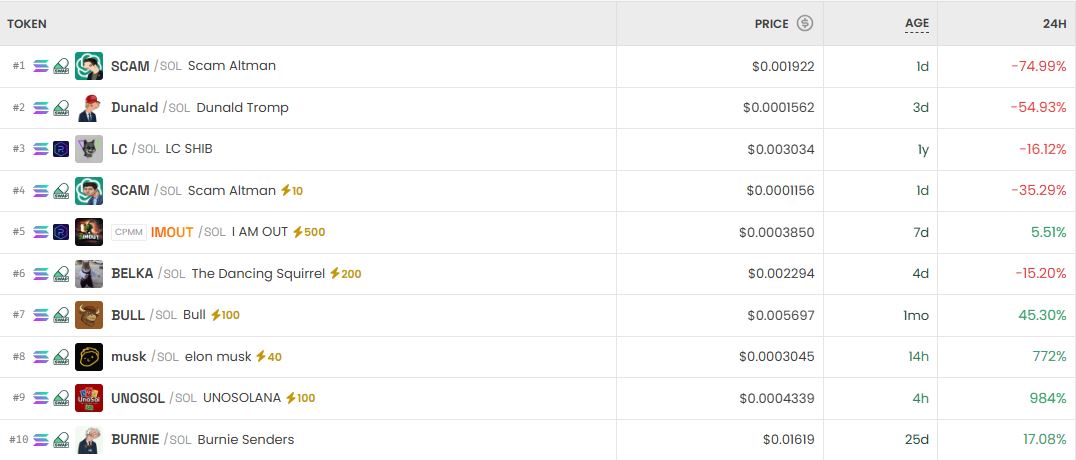
According to DEX Screener data compiled as of April 27 (UTC), the most-watched trending pairs were concentrated on Solana-based markets, where rapid token launches and thin order books often amplify price swings. The top trending pair was SCAM (SCAM/SOL), trading at $0.001940 and down 74% on the day. Dunald (Dunald/SOL) ranked second, falling 54% to $0.0001562, while LC (LC/SOL) placed third, down 16% at $0.003034.
Among tokens meeting higher activity thresholds—at least $100,000 in volume and $250,000 in liquidity—the largest gainer was NeoPepe (NeoPepe/USDT), up 148% over 24 hours. CAS (CAS/VIRTUAL) followed with a 122% rise, and TET (TET/WETH), labeled as the Tectum Emission Token, gained 94%.
On the downside, OXL (OXL/USDT) recorded the steepest drop, sliding 77% in 24 hours. BELIEF (BELIEF/SOL) declined 41%, and Punch (Punch/SOL) fell 28%, underlining the fragility of sentiment in lower-cap DEX pairs where price discovery is frequently driven by momentum rather than fundamentals.
In terms of raw turnover, quq (quq/USDT) led DEX volume rankings with approximately $395.8 million traded over the past day. WETH (WETH/USDC) followed at around $128.6 million, while cbBTC (cbBTC/USDC) posted roughly $81.4 million. High-volume stablecoin and blue-chip wrapped-asset pairs continued to account for a significant share of overall activity, even as attention clustered around fast-moving microcaps.
Transaction counts painted a different picture, reflecting retail-heavy bursts of swapping activity. LGNS (LGNS/DAI) topped the list with about 1,296,667 transactions, followed by babyai16z (babyai16z/SOL) with about 847,374, and PFP (PFP/SOL) with about 269,518.
Across the broader market, total DEX volume over the last 24 hours reached about $17.79 billion, with approximately 38.68 million transactions recorded. The figures underscore the continued appeal of DEX venues, where users can trade directly from self-custodied wallets via smart contracts—often without deposits—while accepting the trade-off of heightened volatility and rapid risk repricing, particularly during meme-coin-driven bursts of speculation.
🔎 Market Interpretation
- Meme-coin volatility dominated DEX action: In the last 24 hours, NeoPepe (NeoPepe/USDT) rallied +148% while OXL (OXL/USDT) fell nearly -78%, underscoring fast liquidity rotation and extreme dispersion among small-cap on-chain tokens.
- Solana pairs led “trending” attention: The most-watched pairs were heavily concentrated on Solana, where rapid launches and thin liquidity often exaggerate moves. Top trending included SCAM (SCAM/SOL) -74%, Dunald (Dunald/SOL) -54%, and LC (LC/SOL) -16%.
- Activity-screened gainers still showed outsized moves: Even among tokens meeting higher thresholds (≥ $100k volume and ≥ $250k liquidity), the leaders posted triple-digit gains: NeoPepe +148%, CAS (CAS/VIRTUAL) +122%, and TET (TET/WETH) +94%.
- Losses signal fragile sentiment and momentum-driven pricing: Biggest decliners—OXL -77%, BELIEF (BELIEF/SOL) -41%, Punch (Punch/SOL) -28%—illustrate how quickly risk reprices in lower-cap DEX pairs with shallow books.
- “Where volume is” vs “where attention is” diverged: While microcaps were trending, turnover was led by larger pairs—quq (quq/USDT) about $395.8M, WETH (WETH/USDC) about $128.6M, cbBTC (cbBTC/USDC) about $81.4M—showing blue-chip/stablecoin rails still dominate aggregate flow.
- Retail intensity showed up in transaction counts: LGNS (LGNS/DAI) posted about 1.30M transactions, babyai16z (babyai16z/SOL) about 847k, and PFP (PFP/SOL) about 270k, suggesting high-frequency small-ticket swapping typical of speculative bursts.
- Market-wide DEX usage remained high: Total DEX volume reached about $17.79B with about 38.68M transactions in 24 hours, reinforcing DEX appeal for self-custodied trading despite volatility.
💡 Strategic Points
- Distinguish “trending” from “tradable”: Trending Solana microcaps can move aggressively on small liquidity. Cross-check liquidity depth, price impact, and slippage tolerance before sizing positions.
- Use activity thresholds as a basic safety filter: Tokens meeting higher volume/liquidity screens (e.g., ≥$100k volume and ≥$250k liquidity) can still be volatile, but are generally less fragile than ultra-thin pairs.
- Watch for liquidity rotation signals: The simultaneous presence of triple-digit gainers and 70%+ losers suggests liquidity is rotating rapidly. Consider avoiding “chasing” late-stage spikes when spreads widen and order books thin.
- Track two dashboards for context:
- Turnover leaders (e.g., WETH/USDC, cbBTC/USDC) indicate broader market risk appetite and routing activity.
- Transaction leaders (high swap counts) can flag retail-driven mania—but also potential congestion, MEV pressure, and higher execution costs.
- Risk controls for meme-coin-driven conditions: Prefer smaller position sizing, pre-defined exit rules, and conservative slippage. Expect quick repricing, especially when momentum fades and liquidity providers pull.
- Operational awareness: DEX convenience (self-custody, no deposits) comes with execution risks—front-running/MEV, sudden liquidity removal, and smart-contract/token risks—particularly in newly launched tokens.
📘 Glossary
- DEX (Decentralized Exchange): A crypto exchange run by smart contracts where users trade directly from self-custodied wallets.
- Trending pair: A token pair receiving elevated attention/activity on analytics platforms; does not necessarily imply deep liquidity or safety.
- Liquidity: Capital available in a pool/order book enabling trades with lower price impact; thin liquidity can amplify volatility.
- Volume (turnover): Total value traded over a period (e.g., 24h); high volume can indicate broad participation or heavy routing.
- Transaction count: Number of swaps/trades executed; high counts often reflect retail-heavy activity and smaller average trade sizes.
- Price impact: How much the execution price moves due to trade size relative to liquidity; critical for microcaps.
- Slippage: Difference between expected and executed price; typically higher in volatile, low-liquidity markets.
- Wrapped assets (e.g., WETH, cbBTC): Tokenized representations of major assets used on-chain for trading and liquidity provisioning.
- Momentum-driven price discovery: Price formation primarily driven by short-term buying/selling pressure rather than fundamentals.
- MEV (Maximal Extractable Value): Value extracted by reordering/inserting transactions (often by bots/validators), potentially worsening user execution.














Comment 0