

 News
News  Coin Information
  About us
  Customer Service


 Add as a preferred source on Google

Crypto Telegram communities swung between memecoin-style exuberance and macro caution this week, as traders amplified a bullish narrative around BULLA ($BULLA) while simultaneously circulating headlines that U.S. inflation came in above expectations.
The shift in tone was captured by TokenPost’s KOL Index—compiled using DataMaxiPlus’ community analytics—which tracks high-engagement Telegram posts to gauge short-term investor sentiment. The latest readout showed attention clustering around five themes: aggressive dip-buying calls for $BULLA, fears of ‘short liquidations’ fueling price acceleration, rapid sharing of CPI surprises, a viral summary of South Korea’s so-called “National Growth Fund” product terms, and a side debate over whether a widely shared column appeared to be written by AI.
$BULLA hype builds around ‘short squeeze’ storytelling
In one of the most active channels, repeated posts such as “Adding more #BULLA” and “#BULLA just got started” helped concentrate attention on the token’s near-term price action. The most circulated messages pointed to a specific buy zone—below 0.008—encouraging staggered entries and framing the move as a familiar technical setup.
Alongside that, traders shared claims that a similar pattern in the past delivered “1000%+” gains, while others argued that shorts would be “liquidated one by one,” implying a cascading squeeze. The combination of price targets described as “still far away” and screenshots of buy confirmations reinforced a momentum-driven feedback loop typical of fast-moving altcoin trades.
CPI ‘beat’ ripples through risk sentiment
Running in parallel, several communities circulated brief flash updates saying both headline CPI and core CPI exceeded expectations. While the posts were thin on details, the takeaway was clear: hotter inflation could keep monetary policy tighter for longer.
Rather than precise market forecasts, the dominant reaction was event-driven—comments such as “CPI comes in high today” and “the U.S. will raise rates” reflected a defensive posture toward risk assets, including crypto and equities. The split-screen dynamic—altcoin optimism on one side and macro unease on the other—underscored how quickly crypto sentiment can fragment when headline data hits.
South Korea’s “National Growth Fund” summary goes viral
In another thread of attention, a popular Korean-language channel circulated a condensed breakdown of a policy-linked investment product widely referenced as the “National Growth Fund.” The post highlighted a subscription window and scale, eligibility tied to income conditions, and a five-year lockup, along with mentions of tax benefits such as income deductions and separate taxation.
The summary also claimed partial government burden-sharing for certain losses, and emphasized contribution caps—phrases like “up to 100 million won per year” and “in short: prepare 100 million won” spread rapidly. The engagement signaled that, even during volatile market conditions, practical explanations of policy and product terms can compete with price chatter for mindshare.
AI-authorship ‘tells’ spark a parallel debate
Beyond trading and macro, some channels fixated on whether a circulated column had been generated by AI. Users pointed to stylistic markers—numbered lists, long em dashes, and formulaic contrast structures akin to “Of course A is not the case. However, B…”—as evidence.
The discussion broadened into a more general phenomenon: the growing tendency for communities to “audit” the authenticity of information sources, even when unrelated to market calls. In the attention economy of crypto chatrooms, the ability to identify AI-generated text has itself become a shareable form of content.
Airdrops and event playbooks remain evergreen
As usual, action-oriented posts also ranked highly. Channels shared step-by-step guides for airdrops and campaigns, including references to Citrea, peaq, and MEMELAND, with details such as estimated rewards, mission schedules, referral mechanics, and checklists for verifying cashbacks. These posts tended to perform well because they translate directly into immediate user actions.
“New cycle” narrative fuels positioning anxiety
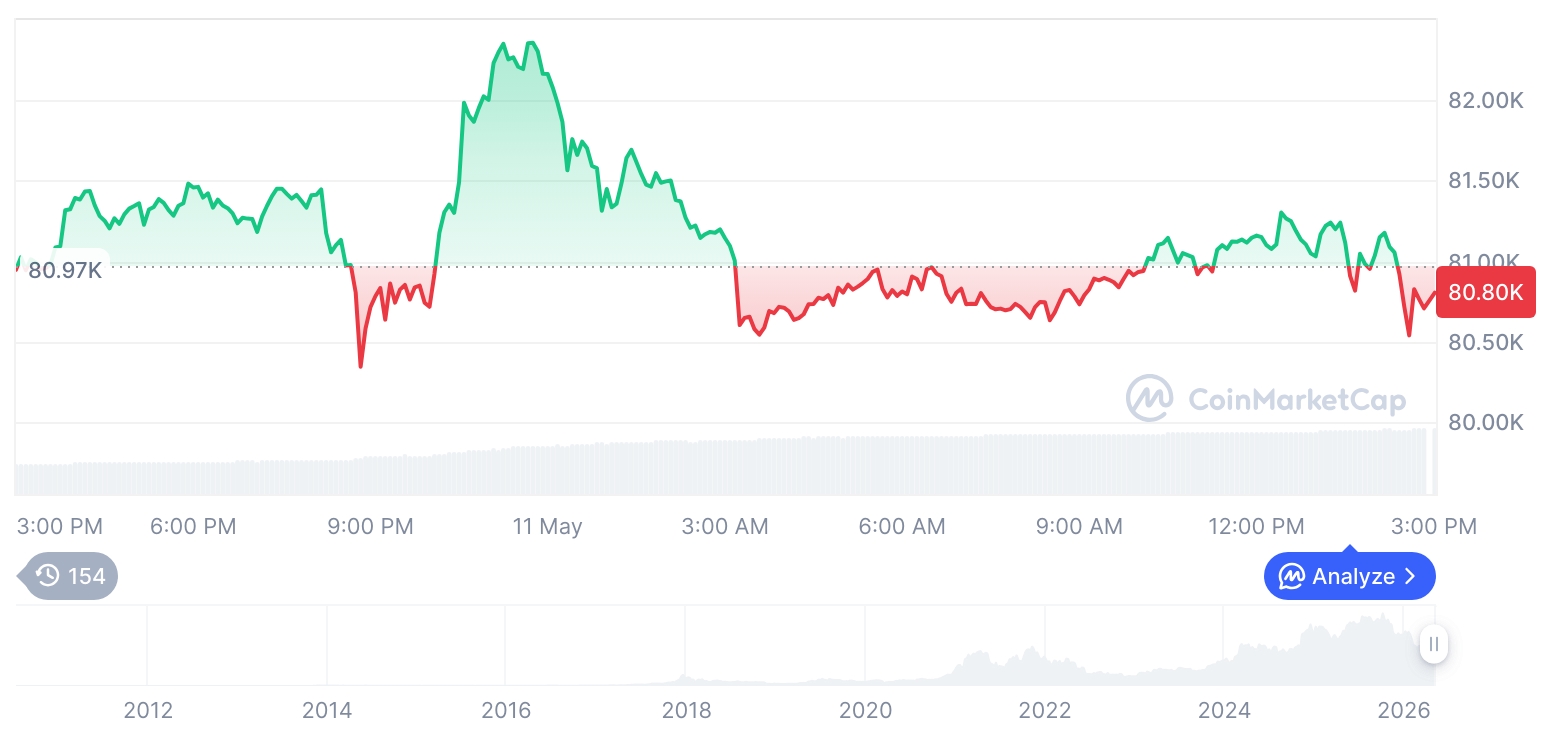
Finally, one widely circulated personal note captured the psychological churn behind the charts. After Bitcoin (BTC) crossed $80,000, the author said they planned to catalog statements from commentators declaring the traditional “four-year cycle” “over” in favor of a ‘new cycle’ thesis—suggesting an intent to track accountability if the narrative shifts again.
The post also described nearly selling an entire swing position before deciding to keep a portion, reflecting the tension between conviction and caution when market narratives change. Mentions of prominent crypto voices—such as Arthur Hayes—highlighted how influencer commentary continues to shape, and sometimes destabilize, community positioning.
Overall, the KOL Index snapshot suggests Telegram sentiment is being pulled in multiple directions: speculative enthusiasm around $BULLA’s potential upside and ‘short liquidation’ storylines, renewed macro vigilance after CPI surprises, heightened interest in local policy-linked financial products, and persistent demand for actionable airdrop information. The common thread was speed—channels prioritized rapidly relaying high-engagement claims and summaries rather than making definitive price calls.
🔎 Market Interpretation
{"sentiment_snapshot":[{"theme":"Memecoin-style risk-on vs macro risk-off split","detail":"Telegram sentiment bifurcated: aggressive $BULLA momentum posts and ‘short squeeze’ language ran alongside cautionary CPI headlines implying tighter-for-longer U.S. policy."},{"theme":"$BULLA narrative engine: dip-buying + liquidation cascade","detail":"High-engagement posts clustered around a specific buy zone (below 0.008), staggered entries, and claims of shorts being ‘liquidated one by one,’ reinforcing a reflexive, momentum-driven feedback loop."},{"theme":"Macro headline sensitivity","detail":"CPI ‘above expectations’ updates spread quickly despite low detail, prompting defensive positioning talk (rates up, risk assets pressured). This shows how headline/data shocks can rapidly fragment crypto chatroom conviction."},{"theme":"Attention rotates to practical policy information","detail":"A viral Korean summary of a ‘National Growth Fund’ product (eligibility, subscription window, five-year lock-up, tax features, caps) competed directly with token price chatter—useful, actionable information can outperform pure speculation in engagement."},{"theme":"Information-authenticity becomes tradable attention","detail":"A parallel debate emerged around whether a popular column was AI-written, reflecting a growing ‘source-auditing’ culture where credibility checks themselves become viral content."},{"theme":"Evergreen engagement: airdrop playbooks","detail":"Step-by-step airdrop/campaign guides (Citrea, peaq, MEMELAND) ranked highly because they convert immediately into user actions (missions, referrals, cashback verification)."},{"theme":"Cycle uncertainty drives positioning anxiety","detail":"BTC above $80k revived ‘new cycle’ vs ‘four-year cycle’ arguments; traders expressed hesitation (partial profit-taking vs holding), showing narrative shifts can destabilize positioning even in bullish regimes."}]}
💡 Strategic Points
{"actionable_takeaways":[{"title":"Separate ‘story momentum’ from market structure","points":["Treat ‘short squeeze’ claims as hypotheses; confirm with open interest, funding rates, liquidation heatmaps, and borrow availability rather than screenshots or repeated slogans.","A defined ‘buy zone’ (e.g., <0.008) can turn into a crowding signal—plan entries/exits assuming volatility and slippage increase as the level goes viral."]},{"title":"CPI headlines: trade the reaction, not the headline","points":["When posts lack details, check actual CPI components (core services, shelter, revisions) and the near-term rates path (Fed funds futures) before changing crypto exposure.","If CPI surprises hot, consider reducing leverage, tightening stop policies, or hedging beta (BTC/ETH) while keeping optionality for idiosyncratic alt moves."]},{"title":"Use policy-product virality as a liquidity/behavior indicator","points":["Viral product summaries can signal retail attention shifting toward yield/tax-advantaged vehicles; this may affect local risk appetite and crypto inflows/outflows.","Verify terms from official sources (lockups, loss-sharing language, taxation rules) before acting—crowd summaries compress nuance."]},{"title":"Operational alpha: airdrop guides are ‘time-to-execution’ trades","points":["Prioritize tasks by expected value and time cost; track deadlines, mission schedules, and wallet hygiene to reduce sybil/ban risk.","Avoid chasing every campaign; focus on reputable teams and clearly defined eligibility rules."]},{"title":"Narrative risk management in ‘new cycle’ regimes","points":["When cycle frameworks are contested, size positions based on volatility and liquidity, not conviction headlines.","Document thesis triggers (what would invalidate the squeeze, the macro pivot, or the cycle claim) to avoid impulsive flips amid influencer-driven swings."]}]}
📘 Glossary
{"terms":[{"term":"KOL Index","definition":"A sentiment/attention gauge built from high-engagement posts by key opinion leaders (KOLs) in Telegram communities, used to infer short-term investor focus."},{"term":"Dip-buying","definition":"Purchasing after a price drop with the expectation of a rebound; often amplifies momentum when many participants target the same level."},{"term":"Short squeeze / short liquidation","definition":"A move higher that forces short sellers to close positions (buy back), potentially accelerating price as liquidations cascade."},{"term":"Buy zone (<0.008)","definition":"A commonly shared price area where traders plan to accumulate; when widely publicized it can become crowded and volatile."},{"term":"CPI / Core CPI","definition":"Consumer Price Index measures inflation; Core CPI excludes food and energy and is closely watched for underlying inflation trends."},{"term":"Tighter-for-longer","definition":"Market expectation that interest rates may stay elevated for an extended period, typically pressuring risk assets."},{"term":"National Growth Fund (as referenced)","definition":"A policy-linked investment product discussed in Korean channels, described as having eligibility conditions, contribution caps, tax treatment, and a multi-year lockup."},{"term":"Lock-up period","definition":"A required holding period during which funds cannot be withdrawn without restrictions; reduces liquidity for investors."},{"term":"Airdrop","definition":"Distribution of tokens to users, often based on completing tasks or prior on-chain activity; communities share playbooks to maximize eligibility."},{"term":"Four-year cycle / new cycle thesis","definition":"Competing frameworks for crypto market timing: a historically observed multi-year pattern vs the claim that structural changes have altered or replaced it."},{"term":"AI-authorship tells","definition":"Stylistic patterns (formulaic contrasts, numbered lists, long dashes) some users use to suspect AI-generated writing; not definitive without provenance checks."}]}















Comment 0