

 News
News  Coin Information
  About us
  Customer Service


 Add as a preferred source on Google

Signals of a shifting U.S. regulatory posture, fresh momentum in spot crypto ETFs, and escalating geopolitical risk in the Middle East shaped market attention over the past 24 hours—offering a mix of bullish catalysts and macro-driven caution for digital asset investors.
SEC Chair Paul Atkins says ‘regulation by enforcement’ is over
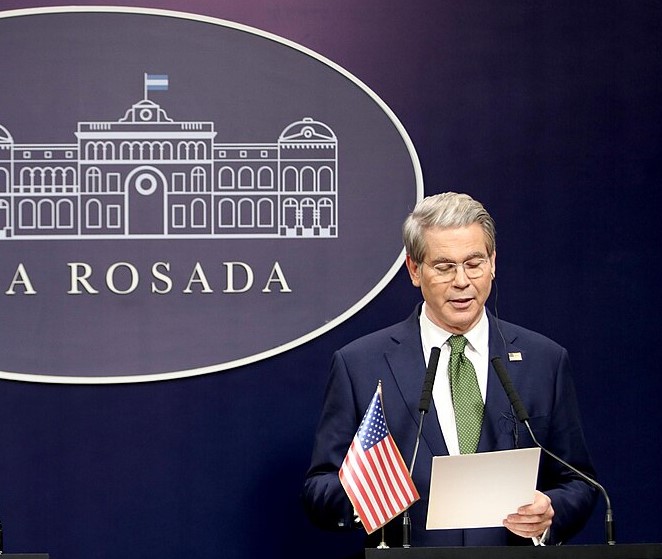
U.S. Securities and Exchange Commission (SEC) Chair Paul Atkins said the agency has ended what the industry has long criticized as ‘regulation by enforcement’ for crypto, according to a post shared on X by Watcher.Guru on Sunday ET, April 20.
While the SEC has not yet published a detailed policy framework alongside the remark, the statement is being read as a directional shift away from headline-driven sanctions and toward clearer rulemaking and standardized guidance. For market participants, the significance is less about immediate legal relief and more about the prospect of regulatory ‘clarity’—a key variable for exchange listings, token issuer compliance strategies, and institutional product expansion in the U.S.
The crypto sector has repeatedly argued that enforcement-led actions created uncertainty by setting de facto standards through litigation rather than transparent rulemaking. Atkins’ comment, if reflected in future SEC actions, could improve broad risk sentiment across major assets—particularly those most exposed to U.S. market structure questions.
Charles Schwab plans direct Bitcoin trading in coming weeks
Charles Schwab said it plans to launch a direct Bitcoin (BTC) trading service within the next few weeks, according to a post circulated by Bitcoin Magazine on X. The firm also released educational content focused on Bitcoin and risk management.
With roughly $12 trillion in assets under management, Charles Schwab’s entry into spot BTC trading would further narrow the gap between traditional brokerage platforms and crypto-native venues. Analysts generally view such moves as supportive of long-term ‘liquidity inflow’ by making spot exposure easier for retail and advisory clients who prefer regulated brokerage rails over offshore exchanges.
U.S. spot Bitcoin ETFs extend inflow streak as IBIT leads
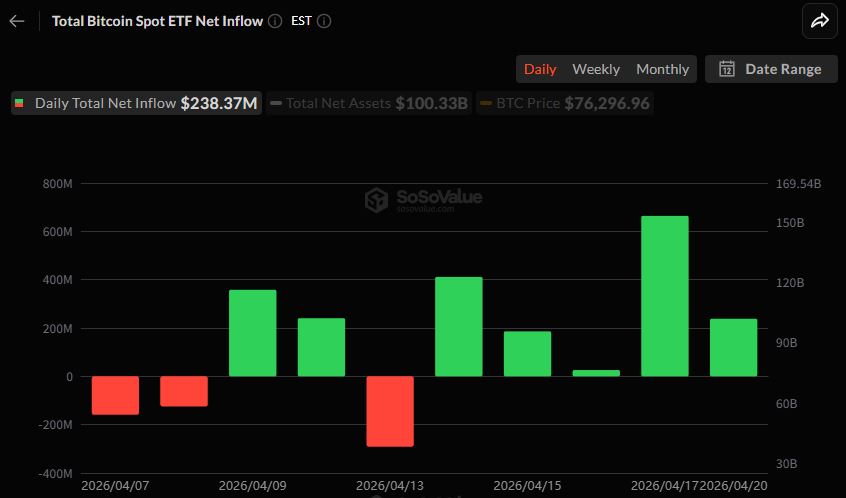
U.S. spot Bitcoin ETFs collectively recorded $238 million in net inflows on Sunday ET, April 20, marking five consecutive trading days of net additions, according to SoSoValue data cited by PANews.
BlackRock’s iShares Bitcoin Trust (IBIT) led daily inflows with $256 million, bringing its cumulative net inflow to approximately $64.889 billion. Morgan Stanley’s MSBT added about $8.10 million, lifting its cumulative net inflow to roughly $110 million.
Grayscale’s Bitcoin Trust (GBTC) continued to see net redemptions, posting $24.94 million in net outflows on the day. GBTC’s cumulative net outflow reached around $26.181 billion.
SoSoValue data put total net assets across spot BTC ETFs at about $103.29 billion, equivalent to roughly 6.57% of Bitcoin’s total market capitalization. Cumulative net inflows stood near $57.978 billion. ETF flow trends are widely tracked as a proxy for ‘institutional demand’ and the durability of spot-driven buying pressure.
Middle East tensions raise macro volatility as Trump warns on Hormuz
President Trump said the likelihood of extending the ceasefire with Iran is very low and that the Strait of Hormuz will not be reopened until an agreement is signed, according to Odaily. Trump added that the ceasefire is expected to end Wednesday night Washington time.
The Strait of Hormuz is a critical artery for global oil shipments, and market participants typically treat any disruption risk as a catalyst for higher energy prices and broader risk-asset volatility—conditions that can spill over into crypto through shifts in dollar liquidity expectations and risk appetite.
In a related development, Kuwait declared force majeure on certain crude and refined product shipments after disruptions prevented some vessels from entering the Persian Gulf, according to reporting attributed to Charles Kennedy. The announcement underscores how rapidly logistics constraints can translate into supply uncertainty when the region’s security environment deteriorates.
DeFi losses top $600 million in three weeks; TVL drops 25%
The DeFi sector has suffered more than $600 million in losses from security incidents over the past three weeks, while total value locked (TVL) fell 25% to $82.4 billion, according to Wu Blockchain.
The report attributed a notable portion of recent stress to a roughly $292 million KelpDAO bridge hack, which accelerated outflows and pressured confidence. TVL—a measure of capital deposited in DeFi protocols—is frequently used as a barometer of ecosystem trust and on-chain liquidity, making sustained declines a key concern for protocol teams and investors alike.
Arbitrum freezes 30,766 ETH tied to KelpDAO attack
Arbitrum said it executed an emergency freeze on approximately 30,766 ETH linked to the KelpDAO incident, announcing the action on X. Odaily reported that Arbitrum’s Security Council acted on attacker identity information provided by law enforcement, moving the funds into an intermediary freeze wallet in a way designed to avoid impacting unrelated on-chain states or regular users.
As of 11:26 p.m. ET on April 20, the funds had been transferred to a controlled address, and the original address could no longer access them. Any future disposition of the assets will be determined through Arbitrum governance procedures and coordination among relevant parties.
Deutsche Bank survey: U.S. crypto adoption rebounds to 12% as ETF inflows recover
A Deutsche Bank retail investor survey found U.S. crypto adoption rebounded to 12% in March from 7% in February, nearing levels last seen around July 2025, according to CoinDesk via PANews. Over the same period, Bitcoin ETFs recorded roughly $1.3 billion in net inflows, reinforcing the view that institutional participation has stabilized after earlier volatility.
Despite the adoption uptick, expectations for Bitcoin’s price trajectory remained cautious. About 19% of U.S. respondents predicted BTC would trade between $20,000 and $60,000 by the end of 2026, while 13% expected it to fall below $20,000. Only around 3% projected prices above $120,000.
Bitcoin remained the dominant holding among crypto investors, with roughly 70% reporting BTC exposure—well ahead of holdings in stablecoins such as Tether (USDT) and USD Coin (USDC). Looking ahead, 69% of U.S. respondents named Bitcoin as their preferred crypto asset, even as gold and the S&P 500 remained more favored across broader portfolio choices. The survey also noted that while crypto ownership is still concentrated among men and higher-income households, participation among women and lower-income groups is gradually rising.
U.S. spot XRP ETFs post modest daily inflow
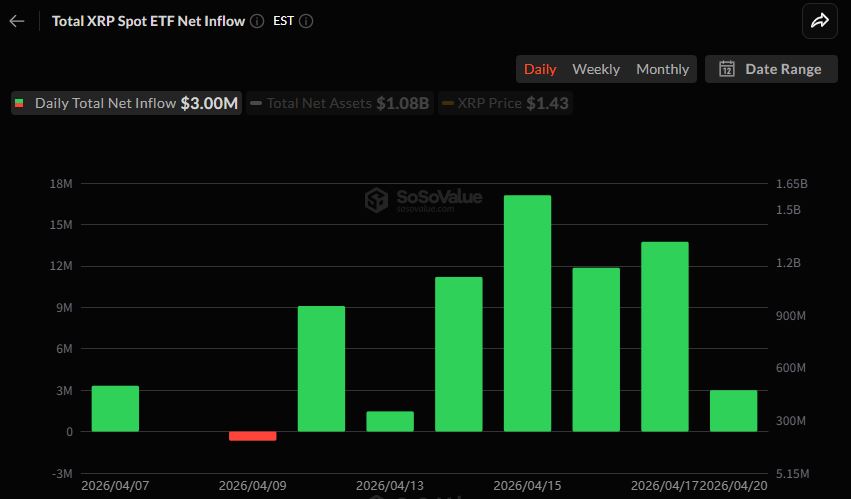
U.S. spot XRP ETFs registered $2.997 million in net inflows over the prior trading day, led by Grayscale’s XRP Trust ETF (GXRP) and Franklin’s XRP ETF (XRPZ), according to SoSoValue data cited by PANews.
GXRP posted $2.220 million in daily net inflows, bringing cumulative net inflows to about $121 million. XRPZ added roughly $777,100, with cumulative inflows reported at around $345 million. Total net assets across spot XRP ETFs stood near $1.076 billion, with cumulative net inflows of about $1.278 billion.
OCBC and Lion Global plan tokenized gold fund on Ethereum and Solana
Singapore’s Oversea-Chinese Banking Corporation (OCBC) and its asset management arm Lion Global Investors plan to launch a tokenized physical-gold fund product, the ‘GOLDX Token,’ on Ethereum (ETH) and Solana (SOL), according to Odaily.
OCBC is expected to support the token issuance structure, while Lion Global Investors will provide the underlying fund investment framework and governance design. The initiative fits a broader push by traditional institutions into real-world asset tokenization, as banks and asset managers test how blockchain rails can streamline issuance, settlement, and investor access to commodities exposure.
Across markets, the day’s developments reinforced a familiar crypto dynamic: constructive signals on regulation and institutional access can lift sentiment, but macro shocks—especially those tied to energy corridors like Hormuz—remain a persistent source of volatility that can quickly dominate short-term price action.


















Comment 0