

 News
News  Coin Information
  About us
  Customer Service


 Add as a preferred source on Google

Several on-chain and market data points on Thursday highlighted how institutional flows, miner balance sheets, and DeFi security incidents are shaping crypto sentiment, with fresh attention on large exchange withdrawals, ETF demand, and a sudden rotation into Bitcoin-native 'BRC-20' tokens.
BlackRock-linked wallets show sizable Coinbase outflows
On-chain monitoring cited by PANews and Onchain Lens indicated that BlackRock-associated addresses withdrew 3,899 Bitcoin (BTC) and 839 Ethereum (ETH) from Coinbase ($COIN) over an eight-hour window. The transfers were valued at roughly $289.9 million for BTC and $1.95 million for ETH at the time of reporting.
Large withdrawals from centralized exchanges are often interpreted as moves into 'long-term custody' or operational reallocations rather than immediate selling pressure. However, the data is attribution-based and requires additional confirmation regarding ultimate ownership and the purpose of the transfers, as exchange-related wallet labeling can be imperfect.
Solana spot ETF inflows concentrate in Bitwise product
In the exchange-traded product market, U.S. Solana (SOL) spot ETFs recorded a combined $15.5 million in net inflows on Wednesday U.S. Eastern Time (ET), according to Odaily. The inflows were concentrated entirely in the Bitwise Solana Staking ETF (BSOL), which brought its cumulative net inflow to $808 million.
Odaily reported the SOL spot ETF category held total net assets of about $892 million, with a net asset ratio of 1.73%. Historical cumulative net inflows were listed at approximately $997 million. The one-day inflow is being read by traders as a gauge of 'institutional demand' for Solana exposure, particularly as staking-linked structures compete for yield-seeking allocation.
Public miners accelerate BTC sales as economics tighten
A separate report cited by PANews, referencing Cointelegraph, said publicly listed Bitcoin mining firms—including MARA Holdings ($MARA), CleanSpark ($CLSK), Riot Platforms ($RIOT), Cango ($CANG), Core Scientific ($CORZ), and Bitdeer Technologies ($BTDR)—sold more than 32,000 BTC in the first quarter of 2026. That figure exceeds the group’s total sales for all of 2025, underscoring a sharp shift in treasury behavior.
The selling comes amid worsening mining profitability. Industry metrics show hashprice—revenue per unit of hashrate—has fallen below $35 per PH/s per day, and around the $33 level roughly 20% of mining operators are estimated to be operating at a loss. Rising network hashrate, reduced block rewards following the post-halving regime, and macro uncertainty have compounded pressure on miners’ cash flows.
CryptoQuant data cited in the report showed miners’ aggregate BTC holdings slipping to about 1.8 million BTC from roughly 1.86 million at the end of 2023. CoinShares reportedly warned that without a significant rebound in Bitcoin’s price, higher-cost operators could exit the market in greater numbers through the first half of 2026. In contrast, Bitcoin-treasury firms such as Strategy have continued to add BTC, highlighting a growing divergence between leveraged producers and long-duration holders.
Rhea Finance exploited; Tether freezes funds
Security firm CertiK said Rhea Finance, a NEAR ecosystem DeFi protocol, suffered an exploit involving 'fake token contract' deployments, resulting in approximately $7.6 million in losses. The attacker allegedly created multiple counterfeit token contracts and seeded newly created liquidity pools, a maneuver believed to have manipulated the protocol’s oracle and validation layers.
In a related development, Tether said it froze 3.29 million USDT linked to the hacker address. Tether CEO Paolo Ardoino disclosed the action on X, saying the issuer treated the incident seriously. The freezing highlights the continuing debate over stablecoin 'freeze controls'—a mechanism that can aid recovery efforts but also underscores the centralized intervention capabilities built into some fiat-backed tokens.
Circle faces reported class-action pressure tied to Drift incident
Wu Blockchain reported Thursday that Circle, the issuer of USDC, is facing a class-action lawsuit connected to the Drift Protocol hack, citing Cointelegraph. Details of the claims and the amount sought were not provided in the summarized report, but any legal escalation involving a major stablecoin issuer can reverberate through DeFi risk assessments and broader market confidence in stablecoin settlement rails.
U.S. government-linked BTC moves to Coinbase Prime raise eyebrows
Separately, an address associated with the U.S. government transferred roughly $606,000 worth of BTC to Coinbase Prime, according to Odaily, citing Arkham monitoring. The coins were reportedly traced to assets seized from Bitfinex hacking defendant Ilya Lichtenstein. Market participants often treat government-related transfers to exchanges as potential pre-sale signals, though an exchange deposit alone does not confirm liquidation.
BRC-20 tokens surge as speculative appetite returns to Bitcoin-native assets
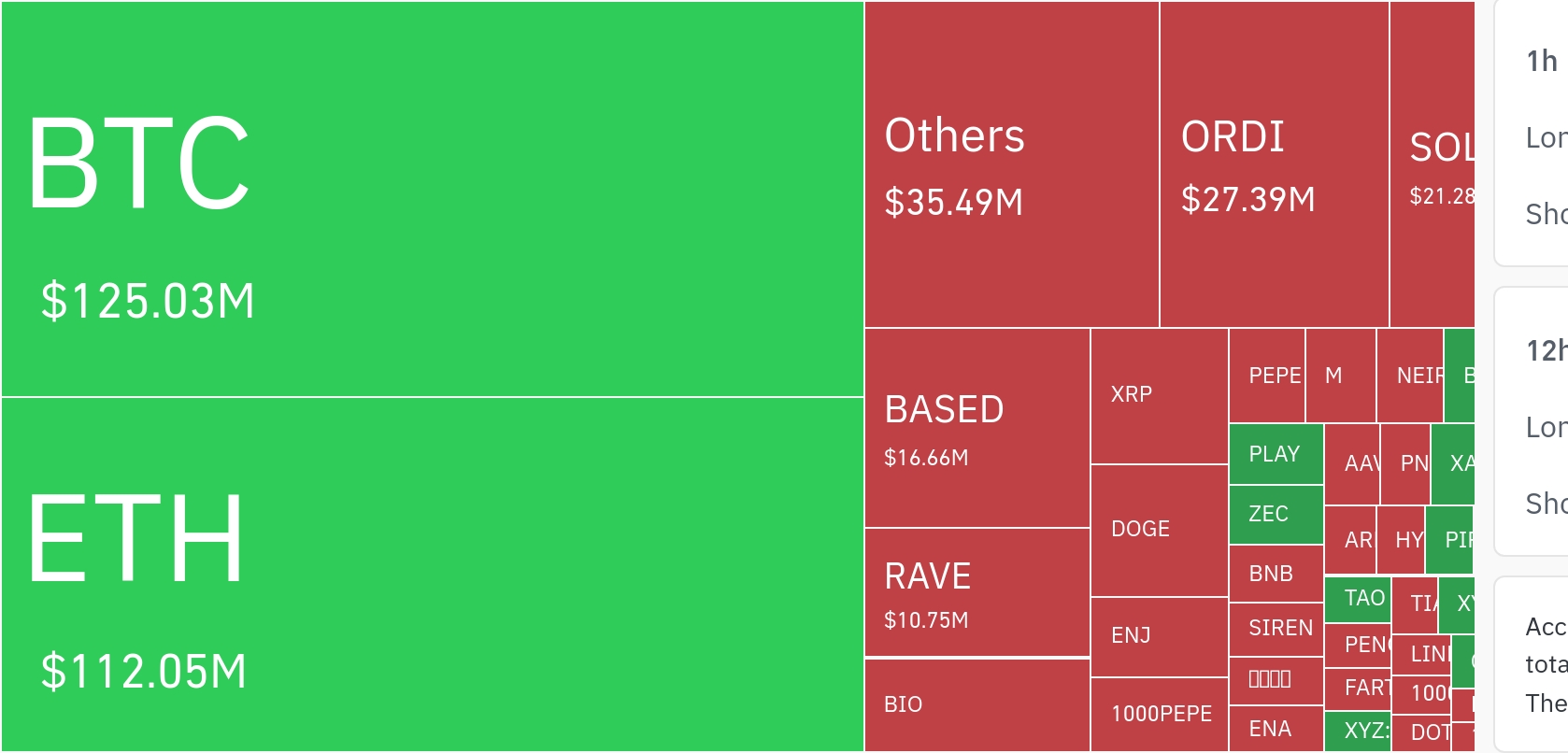
In more speculative corners of the market, the BRC-20 sector rallied sharply, according to CoinGecko data cited by Odaily. The segment’s market capitalization rose above $237 million, while 24-hour trading volume reached about $1.6 billion—an unusually high turnover level relative to the sector’s size.
Among the biggest movers, MUBI surged 398.9% to $0.001429, while ORDI climbed 144.7% to $9.15. Other tokens also posted large gains, including SATS (+60.8%), TURT (+36.6%), and 1000SATS (+59.8%). ORDI briefly topped $8.5 on OKX and was later quoted around $8.2, with Odaily reporting an intraday gain exceeding 191% at one point.
BRC-20 is a token standard that leverages Bitcoin’s inscription-based mechanics, and sharp rallies in the category are typically read as a proxy for short-term 'risk-on' sentiment tied to the broader Bitcoin ecosystem rather than fundamentals.
AKE supply migration to Binance Alpha coincides with steep drawdown
PANews also flagged heavy AKE token movement: over the last four days, about 12.3 billion AKE—roughly 55% of circulating supply and valued around $8.67 million—was transferred via four wallets to Binance Alpha. On-chain analyst Eugene suggested the flow may have contributed to AKE’s sharp reversal after a spike to $0.00158, followed by a 65% drop.
Trading activity surged as the transfers began. Daily volume reportedly jumped from about $2 million to $34 million, a pattern traders often associate with elevated distribution risk, liquidity shocks, or rapid repositioning by a small number of large holders.
Across these developments, the day’s data underscored a familiar crypto dynamic: while institutional products and custody flows can steady long-term narratives, near-term price action remains highly sensitive to miner capitulation signals, exploit-driven risk repricing in DeFi, and fast-moving pockets of speculation such as BRC-20 tokens.






















Comment 0