

 News
News  Coin Information
  About us
  Customer Service


 Add as a preferred source on Google
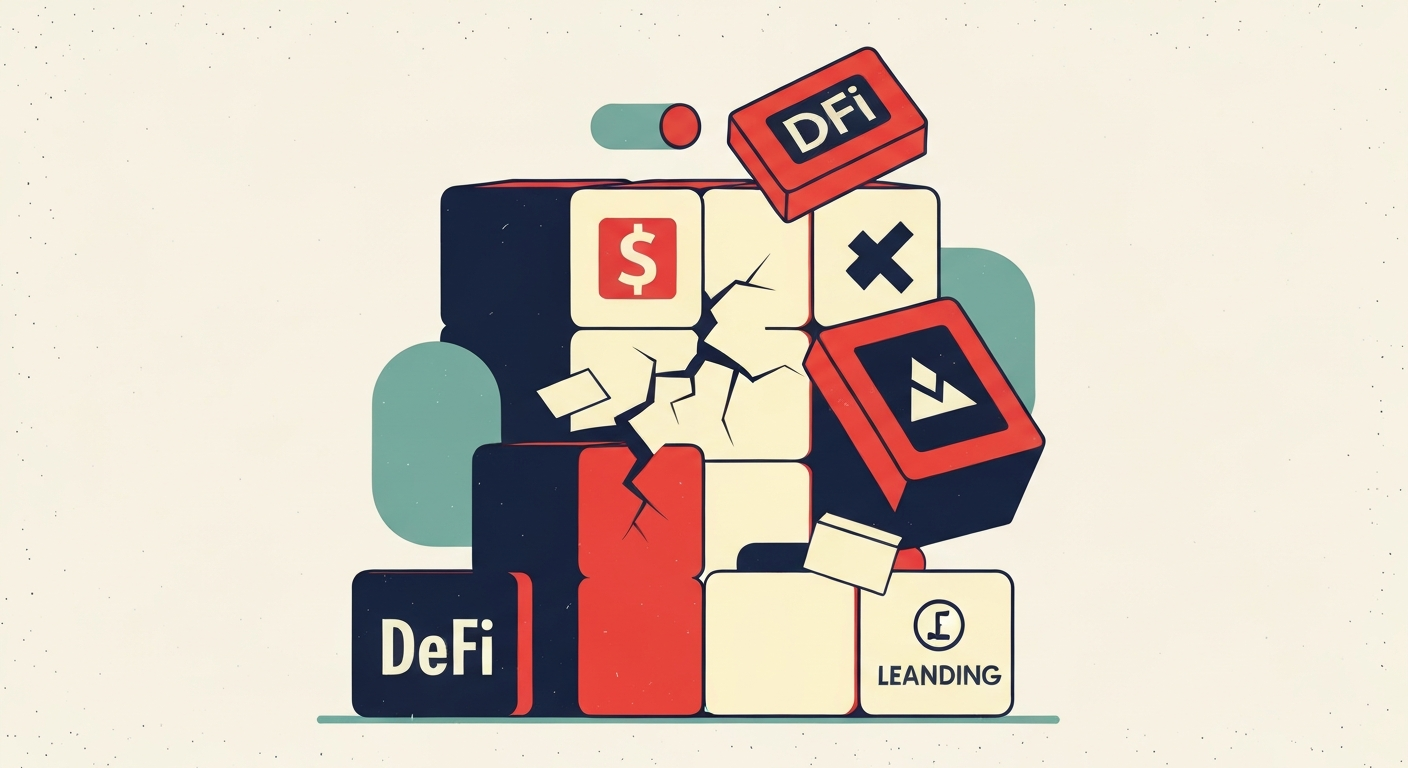
The shutdown of DeFi lending protocol Zerolend is being read less as a shock event and more as another sign that the sector has moved from early optimism into a tougher phase of 'reality testing'—one where weak business models are quietly removed and resilient ones consolidate.
Zerolend halted operations in February after roughly three years, citing deteriorating profitability, elevated hacking risk, and the challenges of maintaining activity across 'inactive' chains. The decision fits a broader pattern seen through 2025 and early 2026, as several DeFi teams have shifted from expansion narratives to capital preservation. DeFi derivatives protocol Polynomial has also paused operations temporarily while restructuring around user fund protection, underscoring the more cautious posture that has settled over the market.
On the surface, the headline metric looks grim. Total value locked (TVL)—the aggregate capital deposited into DeFi protocols—fell sharply from around $167 billion in October 2025 to roughly $100 billion by February 2026. The pace of the decline suggests that a meaningful portion of speculative liquidity has exited, particularly from incentive-driven pools reliant on token emissions to stay competitive.
Yet the data points to capital rotation rather than a blanket collapse. Stablecoin market capitalization has continued to climb, crossing $300 billion, indicating that liquidity has not disappeared so much as migrated from high-volatility tokens toward 'low-volatility' instruments with clearer real-world utility. That shift aligns with a risk-off environment: traders and long-term holders alike appear to be prioritizing cash-like onchain exposure over directional bets.
Institutional behavior adds nuance to the narrative. Large asset manager Apollo’s investment in Morpho has been cited in the market as an example of longer-horizon capital selectively backing protocols viewed as efficient and sustainable. The implication is not that institutions are broadly embracing DeFi, but that they are willing to underwrite specific infrastructures when governance, risk controls, and revenue mechanics appear robust.
The Zerolend episode also resurfaced long-running structural issues the industry has yet to resolve. The first is 'security'. Smart contracts are transparent by design, but transparency does not equate to safety; even heavily audited code can harbor exploitable flaws, and a single vulnerability can erase years of trust in minutes. The second is 'governance'. While decentralization is often a selling point, voting power in many protocols still concentrates among large token holders, leaving everyday users exposed not only to market risk but also to decision-making risk. The third is regulation. Europe has introduced partial frameworks through MiCA, but DeFi still sits in a gray area in many jurisdictions. In the U.S., policy direction remains politically sensitive and subject to shifts in Washington, and the question of how—or whether—to apply KYC standards to decentralized systems remains unsettled.
Ironically, the same bearish conditions that pressure speculative DeFi are also when certain use cases can look most practical. For long-term holders who want liquidity without selling, overcollateralized borrowing can function as a straightforward tool. Protocols such as Aave (AAVE) allow users to deposit crypto collateral and borrow stablecoins, with rates in some market conditions dipping below 5%. Key parameters—collateral ratios and liquidation thresholds—are typically specified in advance, making the mechanism comparatively predictable.
That predictability does not eliminate risk. Rapid price declines can still trigger automated liquidations, and leveraged strategies built on top of DeFi loans can amplify the damage. But unlike opaque offchain credit, the rules are generally 'transparent' and executed algorithmically, which is part of why DeFi lending continues to retain relevance even as broader sentiment cools.
What the market appears to be filtering most aggressively is the difference between 'subsidized growth' and genuine demand. Protocols that relied on token rewards to attract transient liquidity have tended to weaken quickly as yields compress and users become more selective. By contrast, projects with clearer fee-based revenue, stronger risk frameworks, and credible institutional relationships are in a better position to build share during the shakeout.
Adoption remains the swing factor. For DeFi to broaden beyond sophisticated users, it needs both improved financial literacy around onchain risk and better user experience. Recent moves by centralized exchanges such as Coinbase ($COIN) and Kraken to integrate DeFi-like functionality are being interpreted as attempts to narrow that gap—bringing onchain services closer to mainstream workflows while reducing some of the operational friction that has historically limited participation.
In that sense, Zerolend’s closure is being framed by many market observers as part of an industry 'consolidation' phase rather than a sign of systemic failure. As speculative excess is stripped out, the protocols that remain will be those able to defend security, withstand liquidity cycles, and align incentives with durable usage—criteria that could shape the next chapter of decentralized finance.
🔎 Market Interpretation
- Zerolend’s shutdown signals “reality testing,” not systemic collapse: The closure is framed as a shakeout where weaker DeFi business models exit and stronger protocols consolidate.
- DeFi TVL drawdown reflects liquidity leaving incentive farms: TVL dropped from ~$167B (Oct 2025) to ~$100B (Feb 2026), implying speculative and emissions-driven capital pulled back sharply.
- Capital rotated toward safer onchain exposure: Stablecoin market cap rose above ~$300B, suggesting liquidity migrated from volatile tokens into cash-like instruments rather than fully exiting crypto.
- Institutions are selective, not broadly bullish: Apollo’s reported investment in Morpho is interpreted as targeted backing of protocols with sustainable revenue, governance, and risk controls.
- Bear markets amplify practical DeFi utility: Overcollateralized borrowing (e.g., Aave) can remain attractive for holders needing liquidity without selling—sometimes at sub-5% rates—despite ongoing liquidation risk.
- Sector’s key filter is demand quality: Markets are distinguishing “subsidized growth” (token rewards) from durable usage (fee revenue, robust risk frameworks, credible counterparties).
💡 Strategic Points
- Prioritize security as a first-order risk: Even audited smart contracts can fail; protocol selection should weigh security track record, audit depth, bug bounties, and incident response readiness.
- Assess governance concentration: Token-holder voting can centralize control; users should evaluate who can change risk parameters (collateral factors, listings, treasury use) and how quickly.
- Focus on sustainable cash flows: Prefer lending/derivatives venues that can sustain operations via fees/spreads rather than relying on ongoing token emissions to maintain TVL.
- Understand liquidation mechanics before borrowing: Overcollateralized loans provide transparency, but rapid drawdowns can trigger automated liquidations—stress-test collateral ratios and liquidation thresholds.
- Monitor regulatory trajectory: MiCA provides partial clarity in Europe, while U.S. direction and DeFi-KYC expectations remain uncertain; compliance risk can affect access, listings, and protocol interfaces.
- Expect consolidation and “flight to quality”: Protocols likely to gain share are those that survive liquidity cycles, maintain conservative risk parameters, and demonstrate operational resilience.
- Watch CEX-to-DeFi integration as an adoption catalyst: Coinbase and Kraken integrating DeFi-like functionality may reduce UX friction and broaden participation, potentially boosting select onchain venues.
📘 Glossary
- DeFi (Decentralized Finance): Financial services delivered via smart contracts on blockchains, without traditional intermediaries.
- Lending protocol: A DeFi application where users supply assets to earn yield and borrowers take loans—typically overcollateralized.
- Total Value Locked (TVL): Total capital deposited into DeFi protocols (supplied collateral, liquidity, and locked assets), often used as a scale/traction proxy.
- Stablecoin: A token designed to track a stable value (often 1 USD), used for payments, settlement, and risk reduction onchain.
- Token emissions / incentive-driven pools: Protocol rewards paid in tokens to attract liquidity; can create transient TVL that leaves when rewards decline.
- Overcollateralized borrowing: Loan model requiring collateral value to exceed borrowed amount, reducing lender risk but increasing liquidation risk for borrowers.
- Collateral ratio / liquidation threshold: Risk parameters defining how much can be borrowed and the point at which collateral is liquidated to repay a loan.
- Liquidation: Automated sale of collateral when its value falls below required thresholds, used to keep lending pools solvent.
- Governance: The process (often token voting) by which protocol parameters and upgrades are decided; may be concentrated among large holders.
- Smart contract security: The discipline of preventing exploitable bugs in onchain code; transparency does not guarantee safety even with audits.
- MiCA (Markets in Crypto-Assets): EU regulatory framework covering parts of the crypto market; DeFi treatment remains incomplete/partial.
- KYC (Know Your Customer): Identity verification standards; applying KYC to decentralized systems remains an unresolved policy debate.
- Consolidation phase: Market period where weaker projects exit and stronger ones gain share, often after speculative excess is reduced.



















Comment 0