

 News
News  Coin Information
  About us
  Customer Service


 Add as a preferred source on Google
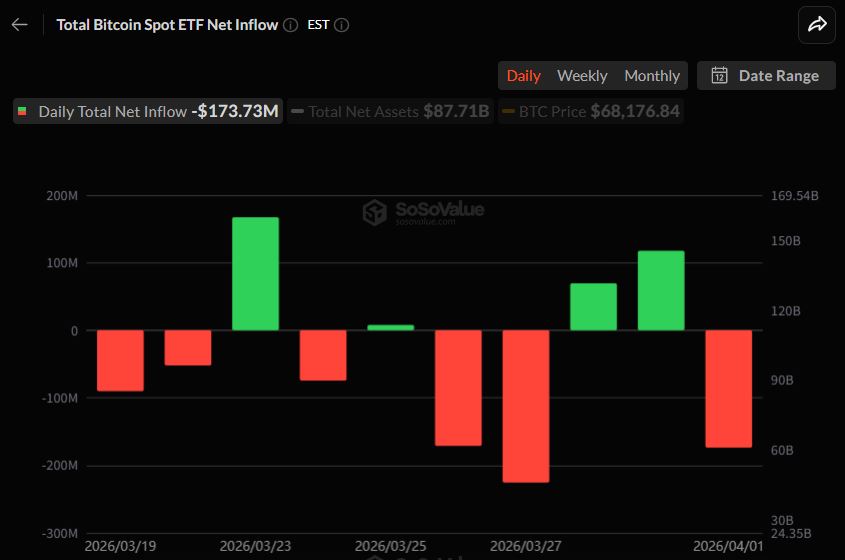
US spot Bitcoin (BTC) exchange-traded funds (ETFs) swung back to net outflows on Tuesday ET, signaling a short-term cooling in demand after two consecutive sessions of inflows and adding to a risk-on/risk-off tone across digital asset markets.
According to data compiled by Sosovalue, the 12 spot Bitcoin ETFs recorded a combined daily net outflow of $173.73 million on April 1 ET. The reversal comes after a brief two-day streak of net inflows, highlighting how sensitive ETF demand remains to shifts in macro expectations, crypto volatility, and tactical positioning by large allocators.
Outflows were concentrated in the largest and most liquid products. BlackRock’s iShares Bitcoin Trust (IBIT) posted $86.52 million in net redemptions, while Fidelity’s Wise Origin Bitcoin Fund (FBTC) saw $78.64 million exit. Grayscale Bitcoin Trust (GBTC) recorded $13.26 million in outflows, and Bitwise Bitcoin ETF (BITB) lost $5.55 million. Grayscale’s Mini Bitcoin Trust was the only fund to register net inflows, adding $10.25 million, while the remaining ETFs were flat on the day.
Despite the net redemption print, trading activity remained elevated. Total spot Bitcoin ETF turnover reached $2.11 billion on the session, led by IBIT with $1.33 billion in volume, followed by FBTC at $321.6 million and GBTC at $136.07 million. Market participants often view heavy volume during outflow days as a sign of active rebalancing—potentially reflecting hedging, rotation between products, or short-term de-risking rather than a broad withdrawal of long-term capital.
Cumulatively, spot Bitcoin ETFs have attracted $55.95 billion in net inflows since launch, Sosovalue data showed, underscoring that the longer-term trend remains positive even as day-to-day flows fluctuate. Total net assets across the category stood at $87.71 billion, equivalent to roughly 6.43% of Bitcoin’s total market capitalization.
By assets under management, IBIT remained the clear leader at $53.31 billion, followed by FBTC at $12.74 billion and GBTC at $10.53 billion. The concentration in the top products continues to shape flow dynamics, as reallocations among the largest funds can meaningfully move the headline daily numbers.
The return to net outflows is likely to keep investor attention on whether ETF demand can stabilize amid shifting market narratives. For now, the data suggests a market that is still drawing substantial cumulative capital, but one where near-term 'liquidity' and 'risk appetite' can change quickly.
🔎 Market Interpretation
- Flow reversal signals near-term cooling: US spot Bitcoin ETFs flipped back to -$173.73M net outflows (Apr 1 ET) after two days of inflows, implying demand is currently tactical and macro-sensitive rather than one-way.
- Outflows concentrated in bellwether funds: Redemptions were led by IBIT (-$86.52M) and FBTC (-$78.64M), suggesting that the most liquid venues are being used for fast risk reduction and positioning changes.
- High volume + outflows implies rebalancing, not capitulation: Despite net outflows, ETF turnover stayed elevated at $2.11B, a pattern often consistent with hedging, rotation, or de-risking rather than broad long-term abandonment.
- Long-term trend remains constructive: Since launch, cumulative net inflows are still $55.95B, with total category assets at $87.71B (~6.43% of BTC market cap), indicating structural adoption even amid daily volatility.
- Concentration amplifies headline flow swings: With IBIT AUM $53.31B dwarfing peers (FBTC $12.74B, GBTC $10.53B), reallocations among top funds can materially distort day-to-day net flow prints.
💡 Strategic Points
- Watch “flow + volume” together: Outflows accompanied by heavy volume can indicate rotation between issuers or short-term hedging; outflows with low volume can look more like reduced participation.
- Identify whether selling is broad or concentrated: This session’s redemptions were mainly in IBIT/FBTC, while Grayscale’s Mini Bitcoin Trust was the only inflow (+$10.25M). A broader multi-fund outflow would be a stronger risk-off signal.
- Use concentration to interpret market intent: Because IBIT and FBTC are highly liquid, they often act as liquidity sleeves for institutions—flows may reflect portfolio rebalancing (e.g., reducing beta) more than a shift in long-term BTC conviction.
- Contextualize daily noise with cumulative adoption: The category’s large cumulative net inflows ($55.95B) suggest that structural demand is intact; near-term pullbacks may represent position trimming rather than trend reversal.
- Key near-term monitoring set: (1) consecutive days of outflows vs. one-off prints, (2) whether outflows spread beyond top funds, (3) BTC volatility and macro headlines that can quickly shift risk appetite.
📘 Glossary
- Spot Bitcoin ETF: An exchange-traded fund designed to track Bitcoin’s price by holding Bitcoin directly (rather than futures).
- Net inflow/outflow: The day’s net capital moving into/out of a fund after creations and redemptions; positive means more shares created than redeemed.
- Redemption: The process where authorized participants exchange ETF shares for the underlying assets/cash, typically reflecting outflows.
- Turnover / trading volume: Total dollar value traded in the ETF shares during the session; high volume can reflect active repositioning even if net flows are negative.
- AUM (Assets Under Management): Total market value of assets held by a fund; used to gauge fund size and influence on market flow dynamics.
- Risk-on / risk-off: A market regime descriptor—risk-on favors higher-volatility assets (crypto, equities); risk-off shifts toward safer assets (cash, bonds).
- Macro expectations: Investor outlook on interest rates, inflation, growth, and policy—factors that often drive risk appetite and liquidity conditions.




















Comment 0