

 News
News  Coin Information
  About us
  Customer Service


 Add as a preferred source on Google
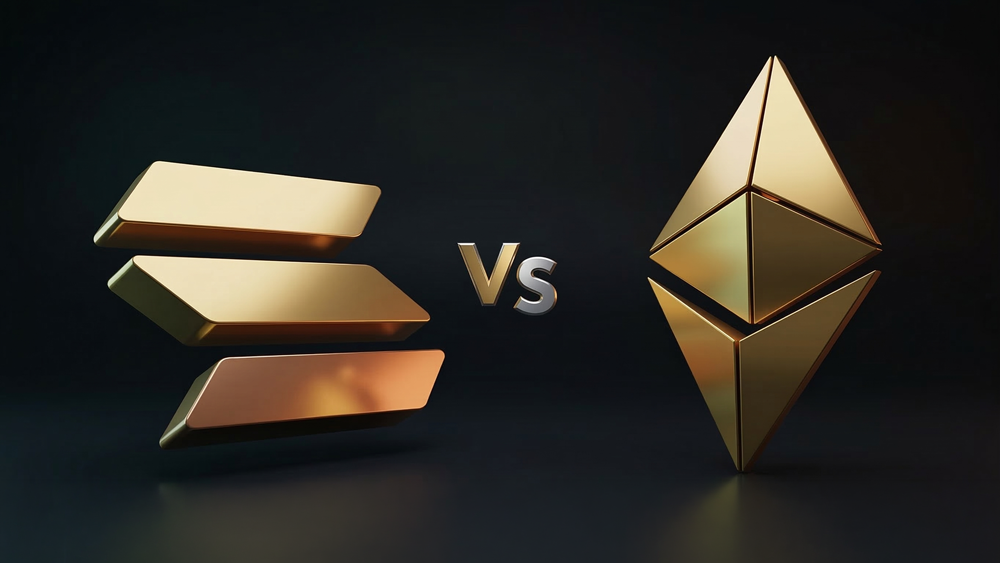
Ethereum (ETH) and Solana (SOL) are increasingly being compared as two competing economic systems—one positioned as a 'network of value' anchored in high-value settlement, the other as a 'transaction factory' optimized for high-volume activity. New fee data suggests that the gap between them is narrowing quickly, raising fresh questions about where on-chain profits are being generated and who ultimately captures them.
According to figures cited as of Saturday, March 22 (UTC), Ethereum recorded $7.30 million in daily fees, down 28.71% from the prior day. Solana, by contrast, generated $5.88 million, up 11.52% over the same period. While day-to-day swings are common in crypto markets, analysts watching network fundamentals say the latest move points to a deeper restructuring of revenue pathways rather than simple volatility.
The central driver on Ethereum’s side is what observers describe as 'mainnet revenue dilution' caused by Layer-2 (L2) scaling. Activity has increasingly shifted to networks such as Base and Arbitrum, where users still transact in the Ethereum ecosystem but pay a meaningful portion of fees outside Ethereum’s main chain. That migration has helped Ethereum scale and reduced user costs, but it also means the most visible measure of economic throughput—mainnet fee revenue—no longer captures the full extent of ecosystem activity.
Ethereum’s fee mechanics further complicate the earnings picture for validators. Under EIP-1559, a significant share of transaction costs is burned via the base fee mechanism, reducing the portion that becomes 'revenue' for block proposers and stakers. The result is a dynamic some market participants characterize as “growth without retained earnings”: usage can remain healthy or even expand, yet the incremental economic benefit to mainnet security providers may not rise proportionally.
Solana’s model, in many ways, runs in the opposite direction. The network has been buoyed by bursts of memecoin speculation, decentralized exchange (DEX) activity, and NFT trading, where per-transaction fees are low but aggregate volume is high. In that environment, revenue scales with throughput. Because a large portion of fees flows back to stakers, the linkage between 'cash-flow capture' and network security can appear more direct—an angle that has become increasingly relevant as investors look for sustainable on-chain business models rather than mere top-line activity metrics.
Recent cumulative numbers highlight both Ethereum’s larger base and Solana’s momentum. Over the past 24 hours, Ethereum posted $7,296,975 in fees, compared with Solana’s $5,879,214. Over seven days, Ethereum recorded $63,294,790 versus Solana’s $46,745,683. Over 30 days, Ethereum reported $323,646,897 against Solana’s $235,235,450. Ethereum still leads on the monthly view, but the weekly spread has tightened notably—an early signal, some analysts argue, of 'capital rotation' as traders and liquidity providers follow the clearest revenue capture.
The tightening comes after a notable February period in which Solana reportedly surpassed Ethereum in monthly revenue—an outcome that, while potentially cyclical, has encouraged the view that Solana’s high-frequency economy can outrun Ethereum’s diluted mainnet monetization under certain market regimes.
Another factor shaping the debate is the ongoing expansion of Circle’s infrastructure and its USDC stablecoin ecosystem. Market watchers expect stablecoin-led flows—ranging from payments and FX-style transfers to tokenized real-world assets (RWA)—to become a more durable source of on-chain fees than purely speculative trading. In that sense, the "quality" of fee generation matters: recurring payment traffic and institutional settlement are typically viewed as stickier than meme-driven surges.
Ethereum maintains structural advantages in this arena. Much of the core RWA infrastructure—such as USDC liquidity depth, tokenized Treasury products, and DeFi collateral frameworks—remains concentrated in Ethereum’s orbit. However, the same L2 migration that improves scalability can weaken the direct translation of that activity into mainnet fee revenue. Put differently, Ethereum may still be hosting the deepest institutional rails, but increasingly those rails run above the main chain.
Solana, meanwhile, is less identified with RWA today and more with transaction-heavy consumer activity. Yet if stablecoin payment traffic expands meaningfully on Solana, the network’s throughput-oriented design could convert those flows into revenue more quickly—potentially increasing what some analysts describe as Solana’s 'revenue leverage' in a stablecoin-driven market cycle.
Ultimately, the shrinking fee gap is being interpreted as a clash between two economic architectures. Ethereum continues to position itself as a high-value settlement layer that can absorb institutional capital and RWA growth, even as revenue capture becomes more distributed across L2s. Solana is increasingly framed as a high-speed execution engine where activity more directly becomes network income and reinforces the connection between token economics and cash flow.
That divergence is also feeding into valuation debates. Some market participants argue that Ethereum could face pressure if investors focus more heavily on where revenue accrues rather than where activity occurs, while Solana’s higher apparent capture rate per unit of activity may strengthen narratives of relative undervaluation. In the near term, observers expect Solana’s close pursuit to continue. Over the longer horizon, the decisive question may be which ecosystem becomes the primary settlement hub for stablecoin payments and tokenized assets—an inflection point that recent data suggests is moving from theory to early reality.


















Comment 0