

 News
News  Coin Information
  About us
  Customer Service


 Add as a preferred source on Google
BitMine Immersion Technologies ($BMNR) is drawing fresh attention from crypto and equity investors as it pivots from a traditional mining business toward an Ethereum (ETH)-heavy treasury and large-scale 'staking' strategy—an approach that could reshape how public companies seek crypto-linked yield.
Shares of BitMine closed at $15.79 on Friday ET, down 4.82% from the prior session’s $16.59. The stock traded between an intraday high of $16.60 and a low of $15.515, with volume reaching roughly 26.97 million shares. Market data cited by local reports showed trading activity broadly clustering in the $15–$16 range, with prints spanning approximately $14.89 to $16.80 during the session.
The company’s evolving identity is increasingly tied to the scale of its ETH holdings. According to treasury tracking data cited from The Block, BitMine held about 5,704,040 ETH as of July 2026, valued at roughly $9.96 billion, with a reported total crypto portfolio near $9.98 billion. BitMine’s own public-facing tracker lists an even higher figure—around 5,742,237 ETH—suggesting it is among the largest concentrated holders in the market.
More notably, BitMine appears to be putting a majority of that ETH to work. Its tracker indicates approximately 4,879,157 ETH is currently staked, underscoring a strategy centered on generating protocol-level rewards rather than simply holding assets on the balance sheet. In Ethereum, 'staking' refers to locking ETH to support network validation in exchange for rewards, but it also introduces operational complexity and risks, including validator performance, custody, and liquidity constraints.
To industrialize that effort, BitMine plans to build an Ethereum staking infrastructure under the banner MAVAN, short for 'Made-in-America Validator Network.' The company has framed MAVAN as an attempt to scale domestic validator operations, with a stated ambition to control as much as 5% of the Ethereum network—an eye-catching target given Ethereum’s size and the decentralization sensitivities around concentrated staking power.
BitMine has reportedly been running staking tests through three pilot partners and aims to expand MAVAN by the first quarter of 2026. The fact that more than 4.8 million ETH is already staked suggests the roadmap is not merely aspirational, even as the company has yet to provide detailed public disclosures on validator geography, counterparties, or how staking is structured across custodians and infrastructures.
Alongside the crypto strategy, BitMine is also broadening its capital markets toolkit. The company has pursued preferred equity issuance in addition to common stock, and received NYSE approval for its 9.50% Series A perpetual preferred shares ($BMNP), which include cash dividend distributions. BitMine also declared its first annual dividend on the common stock at $0.01 per share, signaling an intent to position the equity story around both crypto-linked asset exposure and shareholder returns.
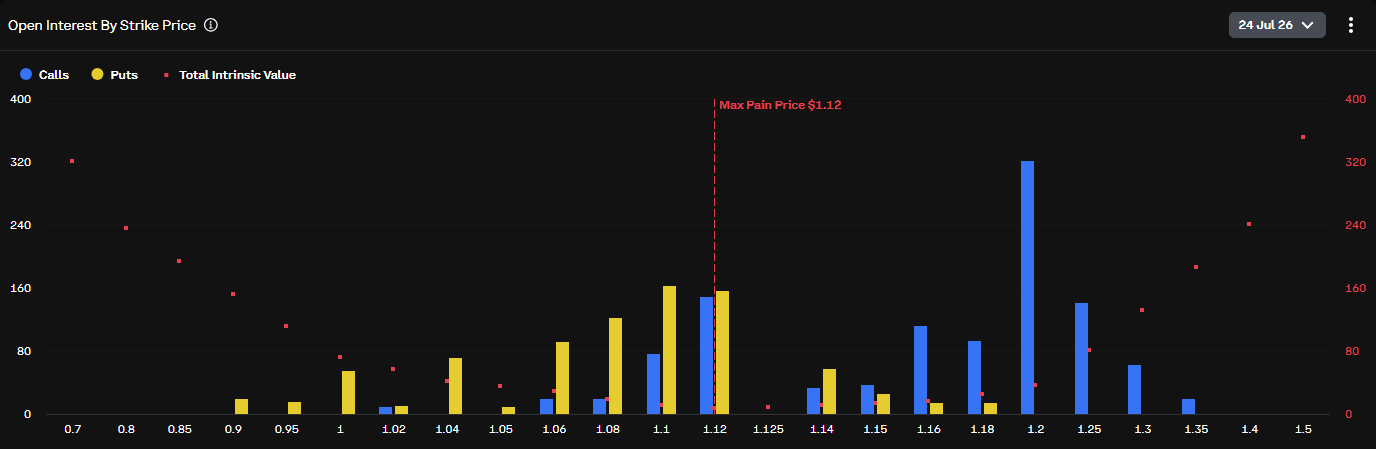
Derivatives activity suggests traders are leaning bullish despite the day’s pullback in the underlying shares. Options flow was described as heavily skewed toward calls—about 83.94%—a sign of prevailing 'risk-on' positioning in the near term, even as spot price action remained volatile.
On the sell-side, analysts tracking the name have assigned a consensus equivalent to a “moderate buy,” with an average price target around $30.15. That implies more than 100% upside from the $15.79 level, though such targets are sensitive to ETH pricing, staking yields, funding costs, and dilution from additional capital raises. Commentators also noted that BitMine is trading at a discount to the reported value of its crypto holdings, cash, and investments—raising the possibility that the gap could narrow if broader index inclusion or improved disclosure attracts incremental institutional interest.
For now, BitMine’s stated playbook centers on continued ETH accumulation, scaling MAVAN, and pairing those efforts with dividends and index positioning. If execution matches the ambition, the company could become a bellwether for a new class of public firms seeking 'yield-bearing' crypto treasuries—an experiment the market is watching closely as staking becomes more institutionalized.
🔎 Market Interpretation
- Pivot narrative: BitMine Immersion Technologies ($BMNR) is shifting from a conventional crypto mining identity toward an ETH-dominant treasury plus staking-driven yield, positioning itself closer to a “yield-bearing crypto treasury” public equity.
- Stock vs. underlying crypto value: Shares closed at $15.79 (-4.82%) with heavy volume (~26.97M), while commentary suggests the equity trades at a discount to reported crypto holdings—a key valuation tension that can widen/narrow with disclosure quality, index inclusion, and ETH price moves.
- Scale and concentration signal: Reported holdings of roughly 5.7M ETH (valued near $10B) and ~4.88M ETH staked indicate the strategy is already operational at significant size, elevating both upside to staking economics and scrutiny around concentration risk.
- Options positioning: Options flow skewed heavily to calls (~83.94%), suggesting traders are leaning risk-on despite near-term equity volatility.
- Street expectations: Analysts show a “moderate buy” consensus with an average target near $30.15 (implying >100% upside), but outcomes remain highly sensitive to ETH price, staking yield, funding costs, and dilution.
💡 Strategic Points
- ETH treasury as core asset: The company’s market story increasingly depends on ETH holdings scale and how transparently it reports custody, valuation, and risk management.
- Staking as operating business line: Staking most of its ETH aims to convert a passive treasury into an income-generating engine. Key drivers: validator uptime/performance, slashing avoidance, fee structure with partners, and net yield after costs.
- MAVAN buildout (infrastructure moat attempt): “Made-in-America Validator Network” seeks to industrialize validator operations and targets up to 5% of Ethereum—a scale that could improve economics and control, but may raise decentralization/compliance optics concerns.
- Execution and disclosure watchlist: Investors may look for specifics on validator geography, counterparties, custody model, staking architecture (self-run vs delegated vs third-party), and liquidity management for staked ETH.
- Capital structure diversification: NYSE approval of 9.50% Series A perpetual preferred ($BMNP) adds a yield-oriented instrument and potential funding avenue; however, preferred dividends can increase fixed obligations and may compete with treasury compounding.
- Shareholder-return overlay: A $0.01 common dividend signals intent to broaden appeal beyond pure crypto beta, but its signaling value may exceed its cash impact at this stage.
- Potential catalysts: (1) clearer staking disclosures, (2) MAVAN rollout milestones by Q1 2026, (3) improved reporting that helps close NAV discount, (4) index inclusion/greater institutional access, (5) sustained ETH strength and stable staking yields.
- Key risks highlighted by the strategy: ETH drawdowns, staking slashing/penalties, operational or custody incidents, liquidity constraints from locked/staked positions, regulatory shifts affecting staking, and equity dilution from additional raises.
📘 Glossary
- ETH (Ethereum): The native asset of the Ethereum blockchain, used for transaction fees and staking.
- Crypto treasury strategy: A corporate approach where a company holds significant crypto assets on its balance sheet, often to gain price exposure and/or generate returns.
- Staking: Locking ETH to help secure and validate the network (Proof-of-Stake) in exchange for rewards; involves performance and penalty (slashing) risk.
- Validator: A node/operator that proposes and attests to blocks on Ethereum. Validators must maintain uptime and follow protocol rules to earn rewards.
- Slashing: A protocol penalty that can reduce staked funds if a validator behaves improperly or violates consensus rules.
- Liquidity constraints: Limits on quickly accessing assets due to lockups, unstaking delays, or operational/custody processes.
- Protocol-level rewards: Yield generated directly from the blockchain’s consensus rules (e.g., staking rewards), distinct from trading or lending returns.
- Perpetual preferred shares: Preferred stock with no maturity date that typically pays a fixed dividend; ranks above common stock in dividends/liquidation.
- Dilution: Reduction in existing shareholders’ ownership percentage due to issuance of additional shares or share-linked securities.
- NAV discount (implied): When a company’s market value trades below the estimated net value of its assets (e.g., crypto holdings minus liabilities).
- Options flow / call skew: A measure of options activity; more calls than puts often indicates bullish positioning or upside speculation.




















Comment 0