

 News
News  Coin Information
  About us
  Customer Service


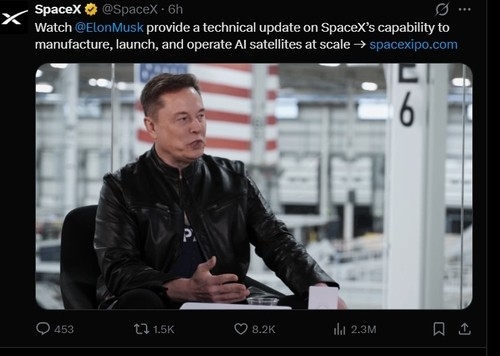
Elon Musk has signaled that SpaceX is looking well beyond rockets and satellites, publicly underscoring the strategic importance of semiconductor manufacturing as investor scrutiny intensifies around the company’s long-anticipated IPO plans. The remarks are fueling speculation that SpaceX could evolve into a broader advanced-manufacturing group with deeper control over critical chip supply chains.
On Wednesday ET, CNBC reported that Musk appeared via video at Dutch chip equipment maker ASML’s annual technology conference, speaking with CEO Christophe Fouquet. During the conversation, Musk outlined how central chip production capabilities are to his businesses—comments that echoed his recent post on X praising ASML as a company that should be ‘valued and supported’.
Market attention is now converging on an ambitious semiconductor facility concept in Texas often referred to as the ‘Terafab’ project. According to CNBC, ASML is being discussed as a leading candidate to supply key tooling. ASML is widely seen as indispensable to cutting-edge semiconductor production due to its dominance in advanced lithography systems—the high-precision equipment used to imprint circuit patterns onto wafers—making it a gatekeeper for everything from iPhone-class processors to AI accelerators.
The Terafab narrative is not simply about capital spending; it points to a broader push by Musk to expand SpaceX into a next-generation manufacturing platform. In April, Musk said Tesla ($TSLA) would invest $3 billion to build a research-focused fab at its Gigafactory Texas site capable of producing thousands of wafers per month. He described Tesla as operating the research fab, while SpaceX would handle the early-stage buildout for the Terafab—an approach that suggests a pilot-line model intended to validate technical feasibility and economics before scaling to full industrial volumes.
The timing reflects intensifying demand for high-performance chips across AI, autonomous driving, and aerospace—sectors where compute density, power efficiency, and resilient supply chains are increasingly decisive competitive factors. Both Tesla and SpaceX rely on sophisticated compute stacks, and both have strong incentives to reduce dependency on external suppliers amid tight capacity cycles and geopolitically sensitive hardware bottlenecks.
If the semiconductor plans become more concrete as SpaceX moves closer to a public listing, they could reshape how investors value the company. Rather than viewing SpaceX strictly as a launch and satellite operator, markets may begin to price in optionality tied to vertically integrated manufacturing and broader participation in the advanced hardware ecosystem. At minimum, Musk’s latest comments reinforce expectations that his companies will pursue greater ‘semiconductor internalization’ and tighter ‘supply-chain control’ as the compute arms race accelerates.













Comment 0