

 News
News  Coin Information
  About us
  Customer Service


 Add as a preferred source on Google
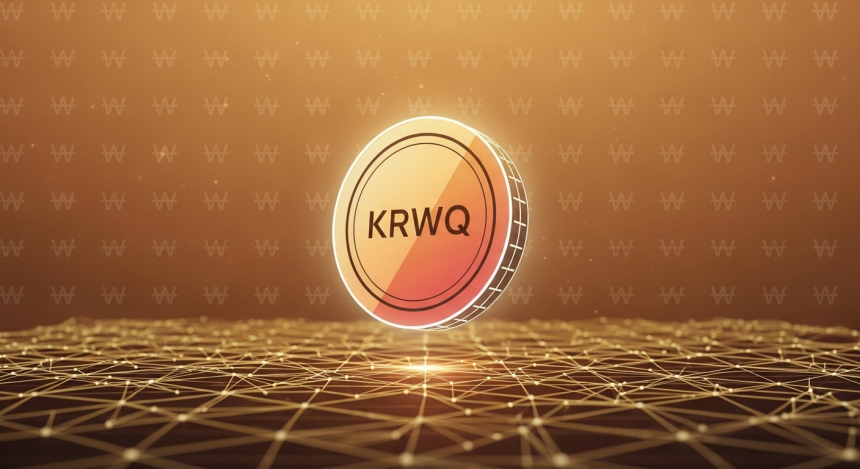
KRWQ and EDX have issued a formal clarification disputing claims that the Korean won-pegged stablecoin is seeing negligible activity on EDX, saying the volume figures cited by Korea’s central bank reflect decentralized finance (DeFi) trading—not institutional flow on the exchange. The response matters because it reshapes the market’s read on whether a won stablecoin is gaining traction in regulated venues or remains confined to small on-chain pools.
The clarification follows a May 7 report that cited data the Bank of Korea submitted to the National Assembly, indicating KRWQ’s daily trading volume was roughly $210,000—just 0.0003% of the average daily volume in Korea’s won non-deliverable forward (NDF) market. KRWQ and EDX dispute the implication that the figure represented EDX activity, arguing it is instead consistent with DeFi exchange volume on public blockchains.
EDX CEO J.D. “Kai” Kono said EDX is a whitelist-based, institution-only venue and does not publicly disclose its trading volumes. “We have never published volume, and it’s unclear where that number came from—but it does not appear to be EDX volume,” Kono said, adding that KRWQ may already be trading via DeFi protocols and that the reported number likely captures that activity.
Public market data appears to support that explanation. CoinGecko lists KRWQ’s 24-hour volume at around $214,000—very close to the figure contained in the Bank of Korea submission—suggesting the activity is coming from on-chain liquidity pools. The trading is believed to be concentrated on DeFi venues such as Aerodrome on Base, an Ethereum layer-2 network.
KRWQ Chief Operating Officer Dave Shin separately confirmed that KRWQ trading on EDX has not yet started, either in spot or derivatives markets. While a market maker has reportedly been designated, Shin said the rollout remains dependent on operational procedures at EDX that have not been completed.
That timeline matters because Kono has previously discussed an ambitious goal: reaching $500 million in average daily volume. In the clarification, he said the target was framed as a one-year milestone after the market goes live. “The market isn’t live yet,” Kono said, declining to provide a specific launch date.
According to Kono, FX platform Spark Systems is currently testing integration with EDX. He described the process of connecting a ‘crypto-native product’ to a traditional finance platform as taking longer than expected—an illustration of the frictions that often emerge when digital-asset infrastructure meets institutional workflows, including compliance checks, custody arrangements, and venue-specific onboarding requirements.
The debate also reopened questions about the size of the won NDF market—an important benchmark because KRWQ is frequently discussed as a bridge between crypto settlement rails and existing offshore won trading. The Bank of Korea submission cited $68.1 billion in average daily NDF volume, while Bloomberg has estimated roughly $27 billion. Shin previously suggested a range of $15 billion to $20 billion in remarks at an industry event.
Shin said the discrepancy likely stems from differences in methodology, arguing that the central bank figure may include broader global NDF activity, while his own estimate was a more conservative attempt to isolate won-specific flow. Because NDF trading is predominantly over-the-counter, the market lacks the transparency of exchange-based products, and estimates can vary materially depending on data sources and definitions.
KRWQ’s price stability was also challenged by the Bank of Korea materials, which reportedly showed KRWQ/USDC trading at roughly 1,465–1,536 won—deviating from the prevailing FX range of about 1,455–1,500 won over the same period. Shin pushed back, noting that even major stablecoins such as USD Coin (USDC) and Tether (USDT) can temporarily deviate from their peg during periods of liquidity stress, fragmented markets, or shallow pool depth, and typically revert over longer time horizons. He did not specify whether the referenced pricing came from a DeFi pool or another venue.
Separately, KRWQ’s reserve transparency tooling appears to have advanced. After earlier communications suggested Chainlink’s Proof of Reserve (PoR) would be integrated “soon,” the service is now confirmed to be live. PoR is designed to provide on-chain verification signals related to asset backing, a feature that has become increasingly central to stablecoin credibility following high-profile failures across the sector.
The episode underscores the broader challenge facing won-linked stablecoins: building meaningful ‘liquidity inflow’ beyond small DeFi pools while also meeting institutional requirements around compliance, connectivity, and market structure. For now, KRWQ and EDX maintain that EDX trading has not begun and that the widely circulated $210,000 figure should not be interpreted as institutional volume on the exchange—leaving the project’s real test tied to when, and how, EDX markets ultimately go live.














Comment 0