

 News
News  Coin Information
  About us
  Customer Service



U.S. crypto markets saw a mix of ‘institutional demand’, regulatory escalation, and law-enforcement pressure Thursday, as Bitcoin (BTC) spot ETFs extended their inflow streak while federal agencies reported major seizures tied to Southeast Asian fraud networks and states intensified scrutiny of prediction markets.
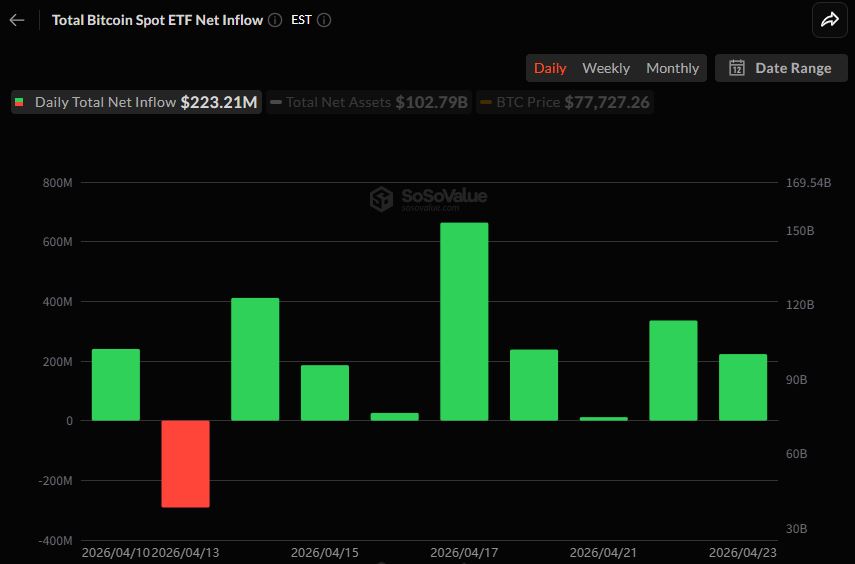
Bitcoin spot ETFs listed in the U.S. recorded a net inflow of $223 million on April 23 U.S. Eastern Time (ET), marking seven consecutive trading sessions of net subscriptions, according to data cited by Odaily. BlackRock’s iShares Bitcoin Trust (IBIT) led the day with $167 million in inflows, while ARK Invest and 21Shares’ ARK 21Shares Bitcoin ETF (ARKB) added $71.22 million. Fidelity’s Wise Origin Bitcoin Fund (FBTC) was the notable outlier, posting $16.92 million in net outflows.
Total net assets across U.S. Bitcoin spot ETFs were reported at $102.79 billion, representing about 6.59% of Bitcoin’s total market capitalization. Cumulative net inflows since launch reached $58.21 billion. Market participants increasingly view the persistence of large-allocator buying—particularly from major asset managers—as a key variable for near-term BTC supply dynamics and broader risk appetite.
In stablecoins, Tether reportedly minted 3 billion USDT over the past week, a pace that traders often interpret as a potential precursor to higher ‘liquidity inflow’—though issuance alone does not guarantee immediate deployment into crypto markets. Blockchain analytics cited by Lookonchain indicated that Abraxas Capital received roughly 2.89 billion USDT from Tether Treasury over the same period, underscoring the scale at which large entities can reposition capital in a short window.
Traditional finance also pushed further into stablecoin infrastructure. Morgan Stanley is launching a “stablecoin reserve portfolio” designed to help stablecoin issuers manage reserves in a more regulated format, according to reporting carried by PANews citing Cointelegraph. The product is structured to align with the proposed U.S. GENIUS Act framework, using a government money market fund-like design to allow reserve assets to be held in more mainstream instruments. The move adds to signs that large financial institutions are preparing for a more formalized stablecoin regime as policy discussions accelerate in Washington.
At the enforcement end of the spectrum, the U.S. Department of Justice said it seized more than $700 million in cryptocurrency during a crackdown on fraud operations based in Southeast Asia, PANews reported Thursday. U.S. authorities said an FBI fraud unit charged two Chinese nationals—identified as Huang Xingshan and Zhang Wenjie—accusing them of managing a scam compound in Myanmar where trafficked workers were allegedly forced to run fake investment platforms targeting U.S. victims. Officials said after the Myanmar military shut the compound, the defendants moved operations to Cambodia before being arrested in Thailand.
Authorities also shut down 503 Telegram channels and scam websites tied to the network, including a recruitment channel with more than 6,000 followers that allegedly lured people to Cambodia with promises of high-paying jobs. Investigators said recruits were then used to impersonate figures such as JPMorgan Chase customer service employees and New York police officers, a tactic meant to bolster credibility in scam scripts.
Separately, the U.S. Treasury Department’s Office of Foreign Assets Control (OFAC) announced sanctions against Cambodian senator Kok An and 28 associated individuals and entities over alleged links to crypto investment fraud operations. OFAC said the network controlled a nationwide set of so-called scam compounds, using relationship-based manipulation and fake crypto investment platforms to persuade victims to send funds. The action followed a reported Cambodian police raid in the border city of Poipet, where Kok An has previously faced allegations of involvement in scam hubs. U.S. authorities also seized more than 500 domains connected to scam operations, highlighting the expanding role of infrastructure takedowns alongside asset freezes.
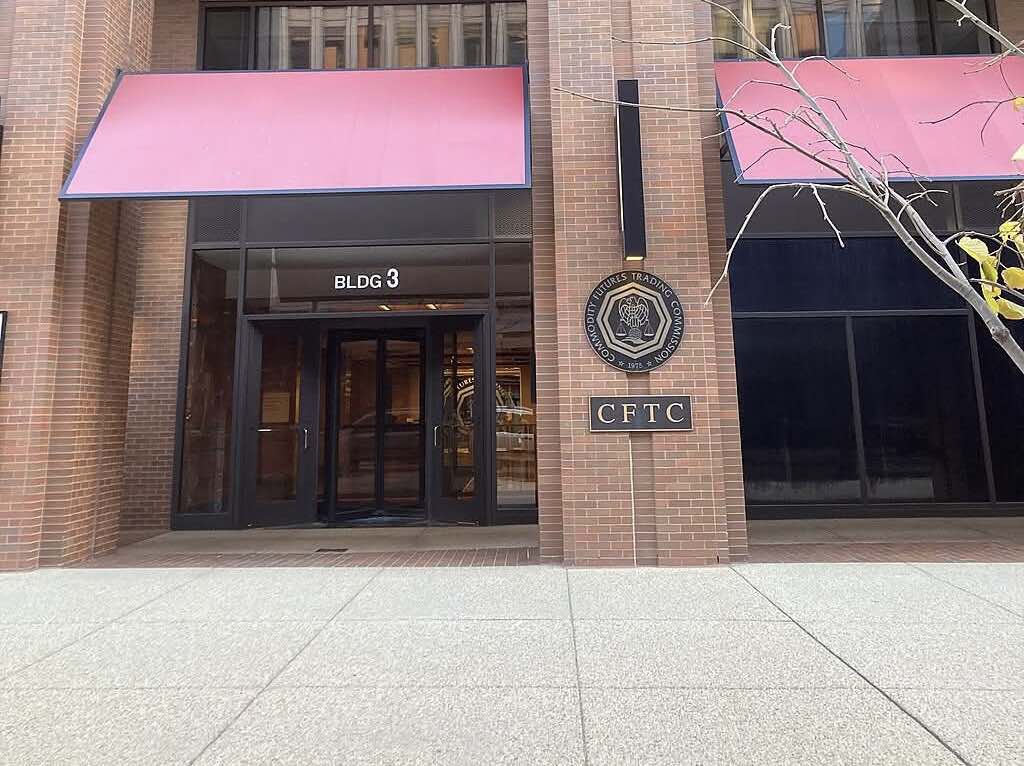
The enforcement push comes as U.S. regulators and states continue to debate where crypto-adjacent products sit on the line between financial instruments and gambling. Wisconsin filed lawsuits against Kalshi, Coinbase ($COIN), Polymarket, Robinhood ($HOOD), and Crypto.com, arguing that event-based contracts offered through prediction-market style services constitute unlicensed gambling under state law, according to PANews citing CoinDesk. The platforms generally position their products as regulated contracts or market-based forecasting tools, but Wisconsin’s complaint contends that the underlying activity matches the state’s legal definition of betting. Industry watchers say the dispute ultimately hinges on whether such contracts fall under Commodity Futures Trading Commission (CFTC) oversight or state gambling statutes—an issue that could escalate into a broader federal court battle.
Meanwhile, tokenization continued to draw attention as DeFiLlama data showed the market capitalization of active real-world assets (RWA) rising from $4.1 billion to $25.2 billion in a little over a year. Growth has been driven primarily by tokenized funds, commodities, and the expansion of private credit products, reflecting deeper institutional experimentation with on-chain representations of traditional financial assets.
Policy optics also remained in focus after the White House said President Trump is scheduled to speak Saturday at a cryptocurrency conference in Florida. With the U.S. president set to address a crypto-focused audience, markets are watching for any signals on regulatory posture, enforcement priorities, and industry development—areas that can quickly reshape sentiment even absent immediate legislative changes.
Outside the U.S., Japan-based Bitcoin treasury company Metaplanet said it will issue ¥8 billion (about $52 million) in zero-coupon ordinary bonds to fund additional BTC purchases, continuing a growing corporate playbook of using debt instruments to expand crypto reserves. In Washington, Senator Cynthia Lummis said bipartisan support is forming in Congress to advance a digital asset market structure bill, a category of legislation that typically seeks to clarify oversight authority, trading rules, and registration frameworks. If momentum holds, the prospect of clearer rules could become a meaningful macro input for crypto markets that have long priced in U.S. regulatory uncertainty.

















Comment 0