

 News
News  Coin Information
  About us
  Customer Service


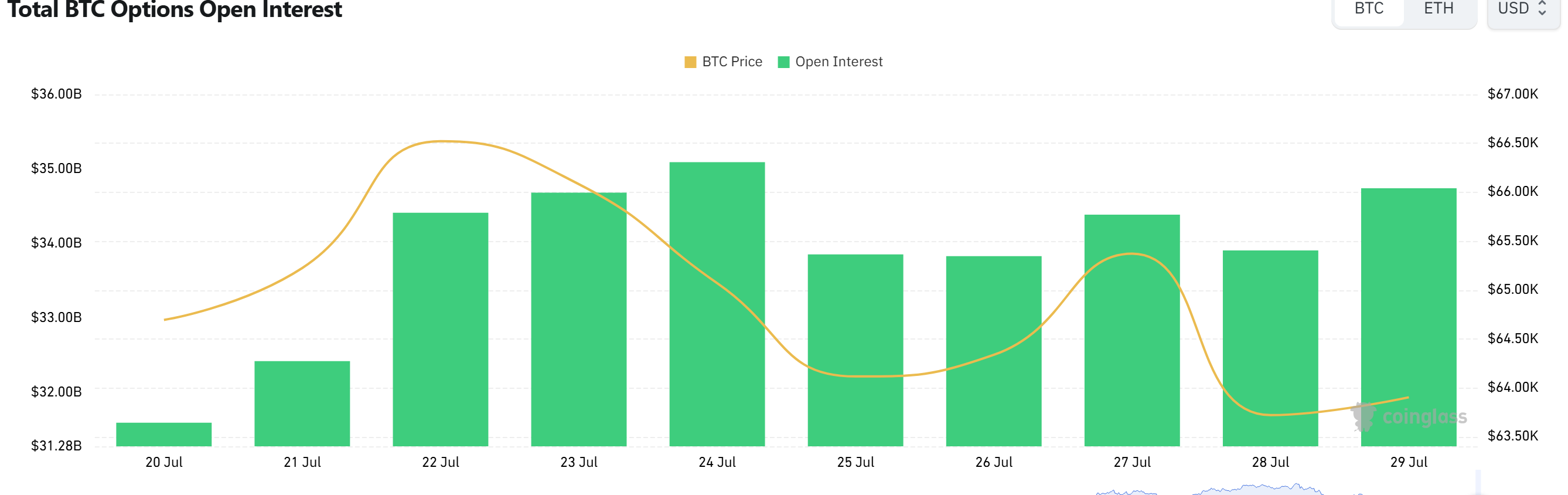
Bitcoin (BTC) options positioning leaned bullish in both the medium and near term on Tuesday, with total open interest rising and call contracts maintaining a clear lead. Still, put activity remained robust, underscoring a market that is pricing upside potential while continuing to hedge against sharp swings.
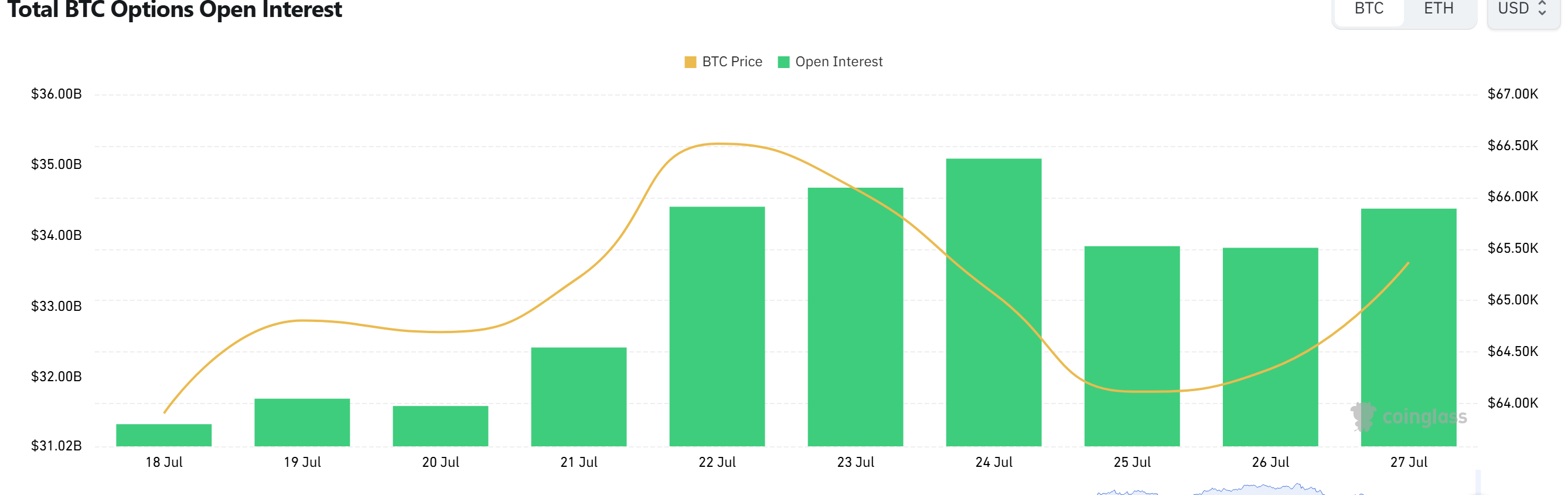
According to CoinGlass data timestamped at 12:40 a.m. ET on July 29, total Bitcoin options open interest (OI) stood at $34.13 billion, up 2.62% from $33.26 billion a day earlier. Notional options trading volume over the same window was about $3.16 billion, pointing to active short-dated positioning ahead of key expiries.
The composition of outstanding positions remained tilted toward calls. Calls accounted for 66.03% of total OI, compared with 33.97% for puts—often interpreted as a sign that traders are allocating more capital to 'upside exposure' over a multi-week to multi-month horizon. However, the picture looked more balanced in the flow data: in the past 24 hours, calls made up 51.34% of volume while puts represented 48.66%.
That near-even split in recent volume suggests two forces operating simultaneously. On one hand, buyers and sellers continue to express optimism through call structures. On the other, the sustained demand for puts indicates ongoing interest in 'downside protection' and volatility trades, particularly as price action approaches widely watched strikes.
On Deribit, the largest concentrations of open interest were clustered at upper strike levels for the July 31 expiry. The most crowded contracts by OI were the $72,000 call (July 31), the $70,000 call (July 31), and the $80,000 call for the Dec. 25 expiry—levels that traders often treat as psychological milestones as well as potential 'gamma' zones that can influence spot price dynamics into expiration.
By 24-hour trading volume, the most active contract was the $66,000 call expiring July 31 on Deribit, followed by the $61,000 put (July 31) and the $58,000 put expiring Aug. 7. The mix of a heavily traded near-term call alongside substantial put volumes at lower strikes reflects a market simultaneously probing for a rebound while preparing for pullbacks.
Options are derivatives that give traders the right—but not the obligation—to buy (via a call) or sell (via a put) an underlying asset at a predetermined price by a certain date. Open interest tracks the total number of outstanding contracts and is widely used as a proxy for the market’s accumulated positioning. Rising OI often signals fresh capital entering options markets, while the balance between calls and puts can help distinguish 'directional conviction' from hedging demand.
With call-heavy open interest but relatively elevated put turnover, the latest data points to constructive positioning without a complacent stance on risk. For the broader crypto market, the immediate focus remains on how positioning around the late-July expiry unwinds—an event that can amplify short-term volatility even when the underlying trend appears supportive.
🔎 Market Interpretation
- Options sentiment skews bullish, but not one-sided: Bitcoin options open interest (OI) rose to $34.13B (+2.62% day-over-day), with calls holding 66.03% of total OI vs puts at 33.97%, signaling greater medium/near-term upside positioning.
- Flow data shows active hedging: Despite call-dominant OI, the last 24 hours’ volume was nearly split (calls 51.34%, puts 48.66%), implying traders are pairing bullish views with meaningful downside protection.
- Expiry dynamics in focus: Concentrated positioning around the July 31 expiry suggests the market is sensitive to strike-related effects (e.g., dealer hedging), which can influence spot price moves and volatility into expiration.
- Psychological and potential “gamma” levels highlighted: Heaviest OI clusters at $70K and $72K calls (Jul 31), plus a larger-dated concentration at the $80K call (Dec 25), framing key upside reference points for traders.
💡 Strategic Points
- Constructive bias with risk awareness: Call-heavy OI suggests traders are positioned for upside or continuation, but near-equal put volume indicates they still expect (or fear) sharp swings—consistent with a “risk-managed bullish” posture.
- Watch key strikes into Jul 31: High OI at $70K–$72K may act as a magnet or volatility zone as hedging flows adjust; price action near these levels can become more reactive.
- Near-term tug-of-war evident in most traded contracts: The top-volume contract being a $66K call (Jul 31) alongside heavy trading in $61K (Jul 31) and $58K puts (Aug 7) signals traders are probing for a rebound while explicitly preparing for pullbacks.
- Volatility risk around expiry unwind: Elevated short-dated activity (notional volume about $3.16B) implies positioning is active and potentially crowded; unwinds can amplify intraday volatility even if the broader trend remains supportive.
- How to read the call/put split correctly: A high call share in OI can reflect bullish bets or structured trades (spreads, overwriting). The near-50/50 volume mix strengthens the view that hedging demand remains significant, reducing complacency signals.
📘 Glossary
- Call option: A contract giving the right (not obligation) to buy the asset at a preset price (strike) before/at expiry; often used to express upside views.
- Put option: A contract giving the right (not obligation) to sell the asset at the strike; often used for downside bets or portfolio protection.
- Open Interest (OI): Total number of outstanding option contracts; rising OI typically indicates new positioning/capital entering the market.
- Notional volume: Dollar-value measure of trading activity over a period; higher values indicate more active repositioning.
- Strike price: The predefined price at which the option can be exercised; heavily traded strikes can become key market reference levels.
- Expiry (expiration): The date when an option contract ends; positioning changes can intensify price moves as traders roll, close, or hedge.
- Gamma zone: A price area where option dealer hedging sensitivity can be high, potentially affecting spot movement and volatility near expiry.
- Downside protection (hedging): Using puts or structures to limit losses during sharp declines or volatility spikes.












Comment 0