

 News
News  Coin Information
  About us
  Customer Service



XRP (XRP) was trading near the $1.10 level on Friday, holding a narrow range even as Ripple’s product and partnership announcements continued to stack up. The disconnect—steady ecosystem expansion alongside muted price action—has become a defining feature of the token’s current setup, with traders and institutions watching for a regulatory or market-structure catalyst that could break the stalemate.
As of July 25, 2026 UTC, XRP changed hands at about $1.0997, according to CoinMarketCap data cited in the source report. The token’s 24-hour trading volume stood near $648 million, with a market capitalization around $68.7 billion. XRP was up roughly 1% on the day and about 1.1% over the week, but the larger trend remained soft: it was down about 18% over 60 days and nearly 23% over 90 days. Circulating supply was estimated at roughly 62.5 billion XRP, about 62.5% of the 100 billion maximum supply.
Technicals hinge on $1.08–$1.09 support
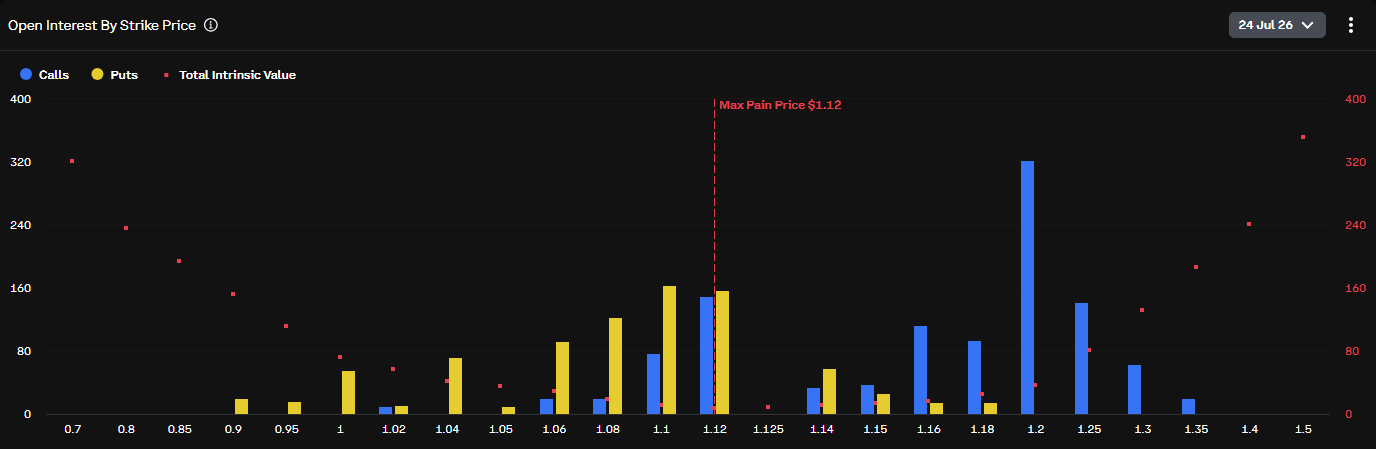
Market technicians are increasingly focused on the $1.08–$1.09 zone as a near-term inflection point. Analysts highlighted in the report pointed to the 200-day moving average clustering around $1.09, framing it as a key line of defense. A decisive break below that band could open the door to a deeper drawdown—some traders have warned that a strong bearish candle could trigger a sharper slide, potentially into the low-$0.90s depending on liquidity conditions.
On the upside, $1.13 is widely cited as the first meaningful resistance. A clean breakout above that level would likely shift momentum back toward the mid-$1.10s, with higher targets around $1.17 and $1.21 discussed by some market watchers. Still, volatility remains compressed. Commentary referenced in the report noted a ‘Bollinger Band squeeze’ on higher timeframes—often interpreted as a coiling phase ahead of a directionally strong move—while cautioning that without a clear catalyst, range-bound trading could persist for an extended period.
RLUSD emerges as an ‘institutional’ payments rail
While XRP’s price has struggled to regain sustained momentum, Ripple’s push to deepen stablecoin and payments infrastructure has accelerated. The company recently introduced ‘Mint,’ a platform designed to let institutional users issue, redeem, and manage RLUSD—Ripple’s U.S. dollar-pegged stablecoin—through both a web console and APIs. The goal is to reduce operational friction for enterprise customers that need programmable settlement and compliance tooling.
Ripple also announced a strategic partnership with compliance payments firm Notabene, including an investment and plans to integrate RLUSD into Notabene’s B2B stablecoin payments product, Notabene Flow. The integration is aimed at banks, payment providers, and fintech firms that want stablecoin settlement while meeting regulatory requirements—an increasingly important constraint as jurisdictions tighten rules around stablecoin issuance, transfer monitoring, and counterparty verification.
Beyond the Notabene deal, Ripple is continuing to build connectivity with traditional finance and crypto-native venues. The report cited collaboration with Mastercard as another step toward bridging legacy rails and digital assets, alongside work with JPMorgan, OKX, and Ondo Finance focused on ‘institutional liquidity’ and DeFi connectivity.
XRPL on-chain growth: tokenized RWAs top $3.5 billion
On-chain metrics tied to the XRP Ledger (XRPL) are also drawing attention. The report said tokenized real-world assets (RWAs) on XRPL have surpassed $3.5 billion, and so-called ‘agentic’ transactions—automated, software-driven activity often associated with AI or rule-based agents—have exceeded 1 million. The emergence of new standards such as XLS-66 is being framed as a foundational layer for more automated payments and on-chain workflows, including permissioned decentralized exchange activity that can incorporate RLUSD and euro-denominated stablecoins.
Ripple’s broader positioning with regulators and institutions remains a key part of the narrative. The company was again recognized on CNBC and Statista’s “World’s Top Fintech Companies 2026” list, marking its fourth consecutive appearance, according to the report. In Europe, Ripple is also emphasizing MiCA-aligned expansion as the EU’s unified crypto framework pushes market participants toward more standardized compliance.
XRP spot ETFs show ‘steady’ cumulative inflows amid quieter daily activity
Interest in spot XRP exchange-traded funds has not disappeared, but flows appear to have normalized. The report pegged cumulative net inflows at roughly $1.49 billion, with total net assets around $997 million. Daily trading volume was about $8.8 million, pointing to a calmer tape compared with earlier launch-period activity.
Some analysts interpreted the slowdown in daily inflows as a sign that retail participation has faded while institutional allocations have moved into a more stable, longer-duration phase. Even so, cumulative inflow and assets-under-management figures remaining above key thresholds were cited as evidence that longer-horizon demand has not broken down.
Separately, the report highlighted that Binance’s XRP holdings were estimated around 2.6 billion XRP—lower than levels seen for much of 2025. Some market observers view shrinking exchange balances as a potential ‘supply’ signal, consistent with coins migrating into longer-term custody, ETF structures, or off-exchange storage, though causality can be difficult to confirm without additional transparency.
Regulation back in focus: the ‘CLARITY’ bill as a potential catalyst
Regulatory clarity in the U.S. is once again being treated as a key variable for XRP. The report pointed to the proposed ‘CLARITY’ bill—legislation designed to define a clearer regulatory framework for digital assets, including how they may be categorized—as a possible market-moving event. Media reports suggesting the White House may be evaluating passage before August have fueled speculation that the bill could function as a ‘second ETF moment’ for parts of the market by reducing uncertainty around legal status and expanding the addressable pool of compliant products.
Institutional players such as Grayscale have been cited as viewing the bill as a potential unlock for additional ETF offerings and broader participation, though the measure has not yet become law and the timeline remains uncertain.
For now, XRP’s near-term outlook appears to rest on a convergence of factors: whether $1.08–$1.09 support holds, whether the market can decisively clear $1.13 resistance, and whether tangible adoption of RLUSD in regulated payment flows picks up. Until one of those threads tightens into a clearer narrative, XRP may continue to reflect the market’s current ‘paradox’: expanding infrastructure and partnerships paired with stubbornly range-bound price action.
🔎 Market Interpretation
- Price-action stalemate: XRP hovered around $1.10 despite ongoing Ripple product launches and partnerships, highlighting a market waiting for a clear regulatory/structure catalyst.
- Trend vs. snapshot: While up ~1% daily and ~1.1% weekly, XRP remains down ~18% (60D) and ~23% (90D), suggesting macro/positioning pressure outweighs near-term news.
- Compression signals “stored volatility”: A higher-timeframe Bollinger Band squeeze implies a coiled market, but direction likely depends on either a support break, resistance breakout, or policy catalyst.
- ETF flows stabilize: Spot XRP ETFs show ~$1.49B cumulative net inflows with quieter daily activity (~$8.8M volume), consistent with a shift from launch-phase speculation to slower institutional accumulation.
- Supply narrative developing: Lower reported Binance XRP holdings (~2.6B) are interpreted by some as exchange-balance drawdown (potentially bullish), though attribution (ETFs, custody migration, off-exchange storage) remains uncertain.
💡 Strategic Points
- Key technical pivot: The $1.08–$1.09 band is critical, with the 200-day moving average clustered near $1.09. A decisive break could accelerate selling toward the low-$0.90s if liquidity thins.
- Upside triggers and levels: The first major resistance is $1.13. A clean breakout may re-open upside targets near $1.17 and $1.21, shifting market structure from range to trend.
- RLUSD infrastructure as adoption lever: Ripple’s Mint platform (web console + APIs) aims to reduce institutional operational friction for issuing/redemption/management of RLUSD, positioning stablecoin rails as a core growth vector even if XRP spot price lags.
- Compliance-first payments distribution: The Notabene partnership (integration into Notabene Flow) targets banks/fintechs needing stablecoin settlement with monitoring and verification—an approach aligned with tightening global compliance expectations.
- Institutional connectivity theme: Collaboration references (e.g., Mastercard, JPMorgan, OKX, Ondo Finance) reinforce Ripple’s strategy of bridging legacy rails, liquidity venues, and DeFi connectivity to expand addressable institutional use cases.
- On-chain growth as a fundamental tailwind: Tokenized RWAs on XRPL > $3.5B and >1M “agentic” transactions suggest expanding non-speculative activity; standards like XLS-66 are positioned as enabling automated workflows and permissioned DEX activity (including RLUSD and euro stablecoins).
- Regulatory catalyst watch: The proposed U.S. CLARITY bill is framed as a potential “second ETF moment” by reducing legal uncertainty and broadening compliant product offerings; timing remains uncertain, but it is a key scenario driver.
- Practical risk framing: Near-term strategy for market participants revolves around (1) defense of $1.08–$1.09, (2) reclaiming $1.13, and (3) evidence of RLUSD traction in regulated payment flows.
📘 Glossary
- 200-day moving average (200D MA): A long-term trend indicator; price interaction with the 200D MA often acts as a support/resistance “line in the sand.”
- Support / Resistance: Price zones where buying (support) or selling (resistance) historically intensifies, shaping breakouts or reversals.
- Bollinger Band squeeze: A period of low volatility where bands contract; often precedes a larger directional move, though not predictive of direction by itself.
- Stablecoin: A cryptocurrency designed to maintain a stable value, commonly pegged to fiat (e.g., USD). RLUSD is Ripple’s USD-pegged stablecoin.
- Mint (Ripple Mint): Ripple’s tooling platform for institutions to issue, redeem, and manage RLUSD via console and APIs with operational/compliance features.
- B2B stablecoin payments: Business-to-business settlement using stablecoins to move value with faster finality and programmable workflows.
- XRPL (XRP Ledger): The blockchain network associated with XRP, used for payments and tokenization features.
- RWA (Real-World Asset) tokenization: Representing claims on off-chain assets (e.g., treasuries, funds, commodities) as on-chain tokens.
- Agentic transactions: Automated transactions initiated by software agents (rule-based or AI-enabled), often used for programmable treasury, market-making, or workflow automation.
- XLS-66: A referenced XRPL standard/proposal framed as enabling more advanced automated workflows and certain permissioned DEX/payment behaviors.
- MiCA: The EU’s Markets in Crypto-Assets regulation—an EU-wide compliance framework influencing how crypto assets and stablecoins are issued and serviced.
- Spot ETF inflows/AUM: Net capital entering an exchange-traded fund that holds the underlying asset (spot); AUM is assets under management, reflecting total fund size.
- Exchange balances: Coins held on centralized exchanges; declines are sometimes interpreted as reduced immediate sell supply, but can also reflect transfers to custody/ETFs/other venues.
- CLARITY bill: Proposed U.S. legislation intended to clarify digital-asset classification and oversight, potentially reducing regulatory uncertainty for issuers and investment products.












Comment 0