

 News
News  Coin Information
  About us
  Customer Service


Crypto markets saw a sharp wave of forced deleveraging over the past 24 hours, with roughly $1.351 billion in leveraged positions liquidated as prices for major assets weakened in tandem. The wipeout was heavily skewed toward bullish bets—around $1.073 billion in 'long' liquidations versus about $278.7 million in 'short' liquidations—suggesting a broad unwind of upside positioning as momentum turned lower.
The liquidation burst highlights how quickly leverage can amplify moves in a market still dominated by perp-driven trading. When spot prices slide, overextended long positions can be closed automatically by exchanges as margin thresholds are breached, accelerating declines and spreading volatility across correlated assets.
On a shorter-timeframe view, the most recent four-hour window recorded $91.22 million in liquidations across major venues, according to CoinGlass data. Binance led with $38.94 million—about 42.7% of the total—where roughly 95.3% of the liquidations were longs. Hyperliquid followed with $23.20 million (25.4%), with liquidations reported as almost entirely long-side. Bybit posted $10.77 million (11.8%), Gate $5.90 million (6.5%), and OKX $5.74 million (6.3%).
One notable outlier was HTX, where liquidations totaled about $1.07 million, but shorts represented approximately 63.7%—a reversal from the long-heavy pattern seen elsewhere. Such divergences often reflect exchange-specific positioning, liquidity conditions, or a local squeeze as traders crowd into the same directional bet.
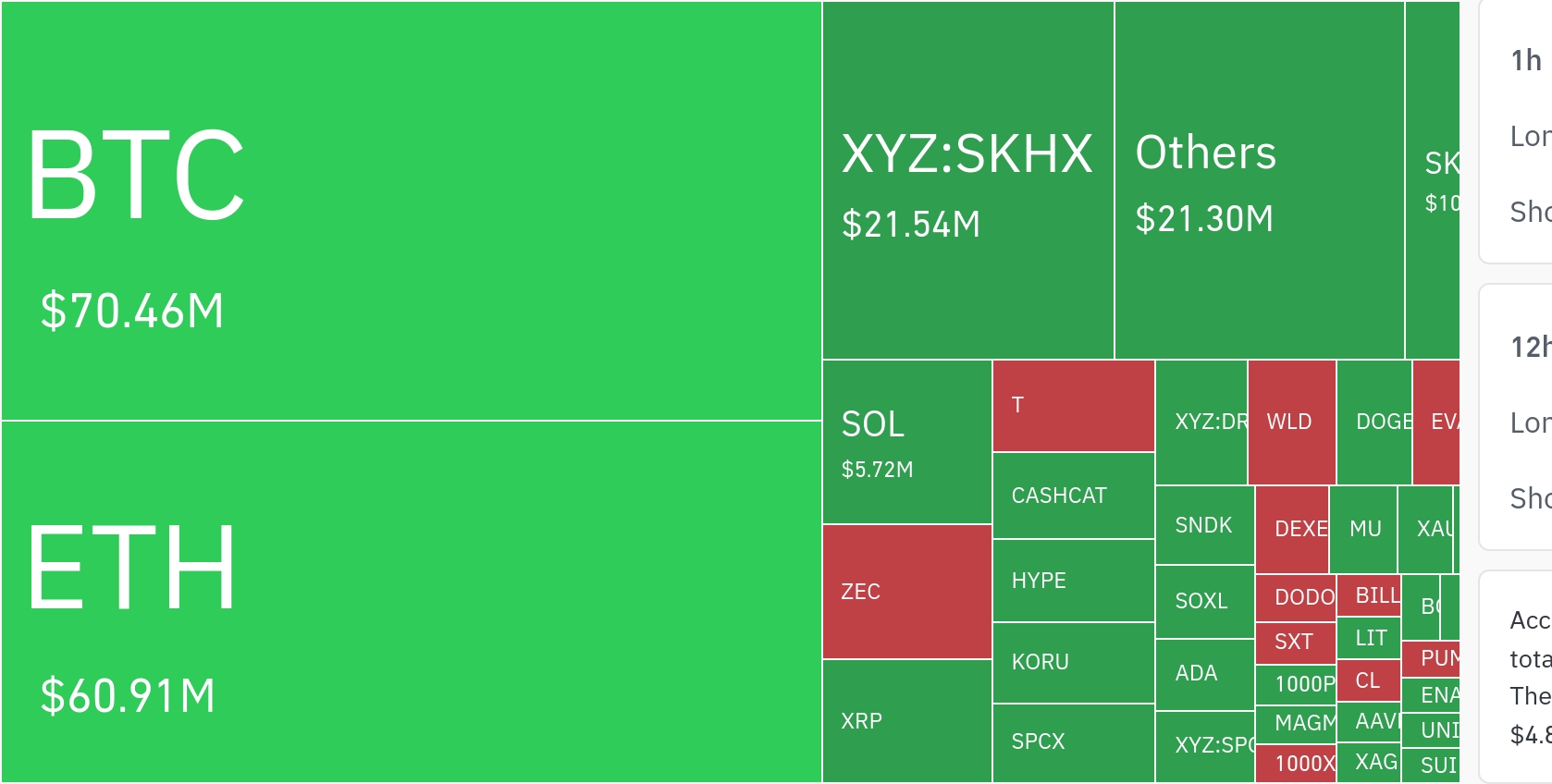
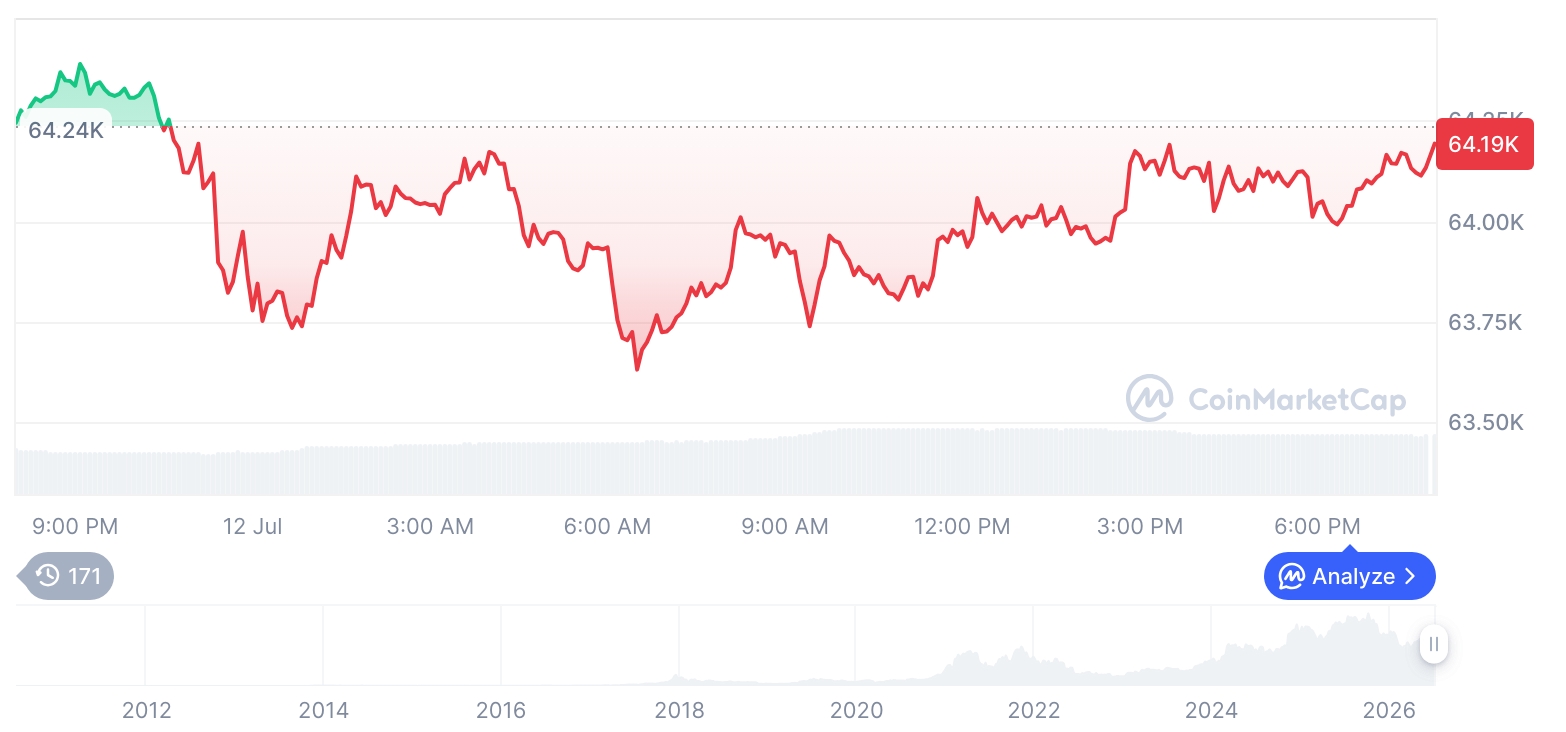
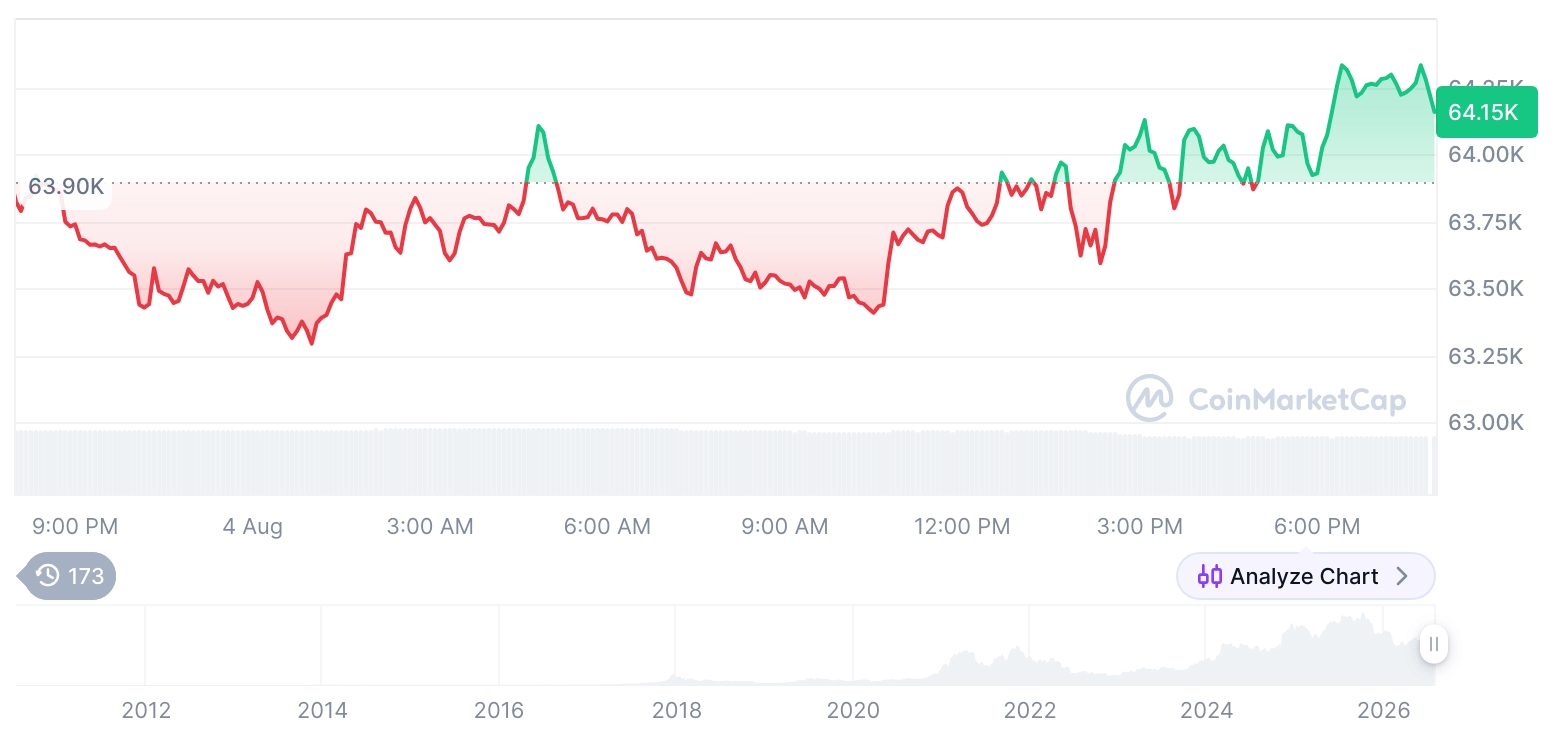
By asset, Bitcoin (BTC) accounted for the largest liquidation total. BTC traded around $104,716, down roughly 1.1% over 24 hours, while liquidations reached about $664.6 million. The imbalance was striking: approximately $662.4 million in longs were liquidated versus about $2.16 million in shorts, underscoring how aggressively bullish leverage had accumulated ahead of the move lower.
Ethereum (ETH) told a different story. ETH fell about 4.1% to roughly $3,671, with around $90.48 million liquidated over 24 hours. Unlike most major assets in this episode, ETH saw larger short liquidations (about $58.69 million) than long liquidations (about $31.79 million), pointing to choppy, two-way price action—an initial drop that was punctuated by sharp rebounds capable of squeezing bearish positions.
Among larger altcoins, XRP (XRP) traded near $2.33, down about 2.8%, while posting about $105.9 million in 24-hour liquidations—one of the highest totals after BTC and ETH. CoinGlass data also showed an especially intense four-hour stretch for XRP, with long liquidations alone reaching about $63.49 million, signaling elevated short-term volatility and concentrated leverage.
Solana (SOL) recorded one of the steepest percentage declines among top tokens, slipping about 4.9% to roughly $199.97, alongside about $64.3 million in liquidations. Cardano (ADA) fell about 2.3% to around $0.82, yet saw about $80.03 million liquidated—an outsized cleanup relative to the price move, consistent with heavy leverage in derivatives. Dogecoin (DOGE) dropped about 4.0% to roughly $0.214, with about $57.38 million in liquidations.
Other tokens also saw sizable forced closures, including BNB (BNB) at about $91.48 million in 24-hour liquidations, Shiba Inu (SHIB) at about $61.08 million, Tron (TRX) at about $45.93 million, Uniswap (UNI) at about $28.01 million, Avalanche (AVAX) at about $27.28 million, and Chainlink (LINK) at about $24.86 million. Hyperliquid’s token HYPE also posted roughly $14.70 million in liquidations. CoinGlass figures for Sui (SUI) appeared abnormal in the dataset—showing repeated $50 entries—suggesting a potential data anomaly that may not reflect actual market activity.
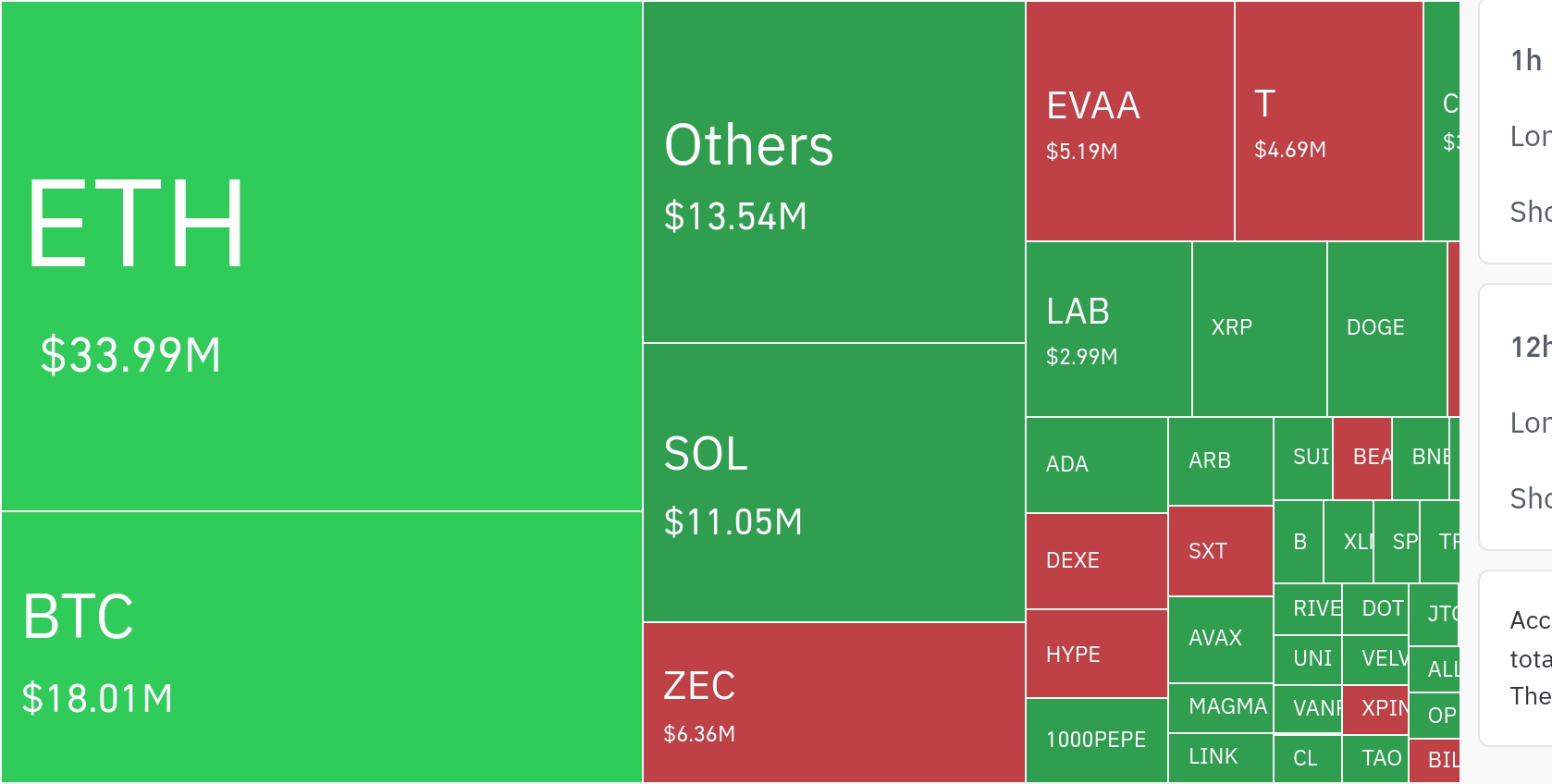
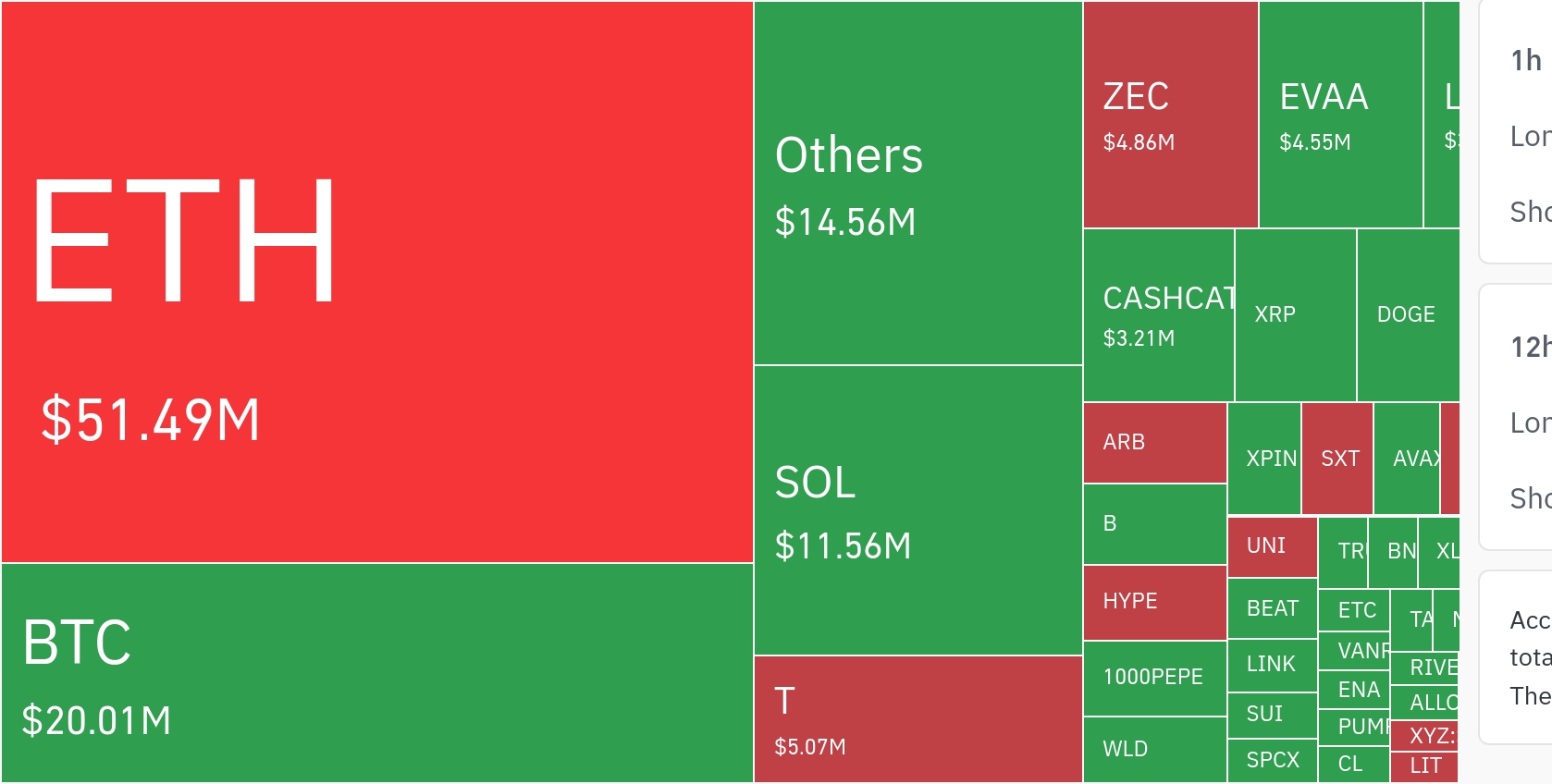
CoinGlass heatmap data also indicated that liquidation pressure remained concentrated in the largest, most liquid markets, with BTC and ETH dominating the board. That concentration is often a sign that 'directional risk' is propagating from large-cap benchmarks into the broader complex, while dispersion across exchanges and the presence of short-heavy liquidation pockets—such as on HTX—suggest a regime of rapid swings rather than a smooth, one-way trend.
Liquidations occur when traders fail to meet margin requirements and exchanges forcibly close positions to prevent further losses. This latest deleveraging wave underscores how quickly volatility can return when leverage builds up, particularly in altcoins where thinner liquidity can magnify both selloffs and short squeezes. For the broader market, the episode serves as a reminder that large liquidation clusters—especially in BTC and ETH—often coincide with heightened intraday instability and shifting risk appetite across crypto.
🔎 Market Interpretation
- Forced deleveraging dominated the tape: About $1.351B in liquidations over 24 hours signals a leverage-driven flush rather than a purely spot-led selloff.
- Longs were the primary casualty: Roughly $1.073B longs vs $278.7M shorts implies bullish positioning was crowded and unwound quickly as prices softened.
- Perp/derivatives mechanics amplified downside: As prices dipped, margin breaches triggered automatic closures, which likely accelerated declines and spread volatility across correlated majors and alts.
- Exchange distribution shows where leverage was concentrated: In the latest 4 hours, Binance led liquidations ($38.94M, ~42.7%) with ~95.3% longs; Hyperliquid followed ($23.20M, ~25.4%) with liquidations almost entirely on the long side.
- HTX divergence hints at localized positioning: HTX showed a short-heavy liquidation mix (~63.7% shorts), suggesting exchange-specific crowding or a micro squeeze.
- BTC was the epicenter: BTC near $104,716 (-1.1%) yet $664.6M liquidated—almost entirely longs—indicates heavy bullish leverage built up ahead of the downtick.
- ETH was choppier and two-sided: ETH near $3,671 (-4.1%) with short liquidations exceeding longs suggests rebounds strong enough to squeeze bears amid volatility.
- Altcoins showed leverage sensitivity: Notable liquidation totals in XRP, ADA, SOL, DOGE, and others point to thinner liquidity + higher leverage translating into outsized forced closures.
- Data quality note: Reported SUI liquidation prints looked abnormal (repeated $50 entries), implying a possible dataset anomaly rather than true activity.
💡 Strategic Points
- Watch liquidation imbalances for positioning clues: Extreme long-skew (e.g., BTC longs overwhelmingly liquidated) can mark a leverage reset and potential shift from crowded bullishness to more neutral risk-taking.
- Use majors as risk barometers: With liquidation pressure concentrated in BTC/ETH, spikes there often precede volatility spillovers into altcoins and can guide exposure sizing across the book.
- Expect whipsaws when liquidations are mixed: ETH’s net short squeeze behavior suggests a regime of sharp rebounds; strategies relying on smooth trends may underperform versus mean-reversion/vol-aware approaches.
- Exchange-specific flows matter: Divergences like HTX’s short-heavy liquidations can signal localized squeezes; monitoring multi-venue data can help avoid false consensus from a single exchange.
- Manage leverage proactively: In perp-dominated conditions, modest spot moves can cascade into large derivative liquidations—tighten risk limits, consider wider liquidation buffers, and avoid crowded directional trades during leverage build-ups.
- Identify altcoin fragility: Large liquidation totals relative to price change (e.g., ADA) can indicate hidden leverage; treat such markets as higher tail-risk during broader deleveraging waves.
- Validate anomalous prints before acting: Treat suspicious data (e.g., SUI) as non-actionable until confirmed by multiple sources to avoid signal pollution.
📘 Glossary
- Liquidation: Forced position closure by an exchange when margin requirements are no longer met, designed to prevent further losses.
- Leverage: Borrowed exposure that magnifies gains and losses; higher leverage increases liquidation risk.
- Long / Short: Long bets on price rising; short bets on price falling.
- Perpetual futures (perps): Derivative contracts without expiry, widely used in crypto to trade with leverage.
- Margin: Collateral posted to support a leveraged position; if it falls below thresholds, liquidation can occur.
- Deleveraging: Market-wide reduction of leveraged positions, often via liquidations during fast moves.
- Short squeeze: A rapid price jump that forces short sellers to buy back, triggering more upward pressure.
- Directional risk: Concentrated exposure to one market direction (up or down) that can propagate across correlated assets.
- Heatmap (liquidations): Visualization of where and how much forced closure activity is occurring across assets/exchanges.


















Comment 0