

 News
News  Coin Information
  About us
  Customer Service



XRP (XRP) is struggling to regain upside momentum, repeatedly failing to break above the key $1.10 level even as Ripple strengthens its foothold in regulated payments infrastructure across Europe. The divergence underscores a familiar dynamic in crypto markets: near-term price action is being driven more by macro risk sentiment than by project-specific fundamentals.
According to CoinMarketCap data as of July 31, XRP was trading at $1.0601, down 2.63% over the past 24 hours and 2.57% over the past week. Its market capitalization stood at roughly $66.29 billion, representing about 3.07% of the total crypto market, while 24-hour trading volume was approximately $1.16 billion.
From a technical perspective, XRP remains pinned below the Bollinger Band midline around $1.10 and under major exponential moving averages (EMAs), a setup that typically signals capped short-term rebounds and reinforces $1.10 as a decisive 'resistance' zone. Market participants note that XRP’s price has been moving largely in tandem with broader risk assets—Bitcoin (BTC), Ethereum (ETH), and major U.S. equity indices—suggesting macro correlation is outweighing XRP-specific catalysts for now.
Performance data further reflects the tension between stabilizing short-term conditions and persistent medium-term pressure. XRP’s 30-day return is roughly flat at +0.13%, but it remains down 17.64% over 60 days and 23.84% over 90 days, indicating that the broader downtrend has not yet fully reset.
Attention is also turning to Ripple’s scheduled escrow release. On Aug. 1 UTC, the company is set to unlock 1 billion XRP from escrow—worth about $1.06 billion at current prices—continuing a monthly practice implemented in 2017. Because the release occurs on a predictable cadence, traders generally classify it as a 'known supply event' rather than an unexpected shock.
Ripple still holds roughly 32.44 billion XRP in escrow, valued at around $34.4 billion, while circulating supply is approximately 62.53 billion XRP. If the full 1 billion were to enter circulation, it would mechanically lift circulating supply by about 1.6%. However, Ripple’s historical pattern has been to re-lock 60% to 80% of released tokens back into escrow. Based on recent pacing, analysts estimate that only around 300 million XRP per month effectively transitions toward circulation, implying it could take roughly nine more years for escrow reserves to be fully drawn down if current practices persist.
Even as price action softens, Ripple’s regulatory momentum in Europe is strengthening. The company has secured full authorization as a crypto-asset service provider (CASP) under the European Union’s Markets in Crypto-Assets regulation (MiCA). Following an earlier preliminary license in Luxembourg, the approval broadens Ripple’s ability to roll out 'Ripple Payments' across the European Economic Area (EEA), a step that could materially expand the company’s addressable market for regulated cross-border settlement services.
Market observers view the MiCA authorization as particularly significant for institutional adoption, since it offers a clearer compliance framework for banks, payment firms, and institutional investors seeking to engage with XRP-based payment rails. Ripple has framed the approval as a milestone that bolsters XRP’s standing as a payment asset in a regulated environment.
In the U.S., regulatory clarity remains less settled. Policymakers continue to debate proposals such as the 'Clarity Act,' but the timing of Senate action and the legislative calendar leave uncertainty around when—or whether—near-term clarity will translate into direct tailwinds for XRP.
On-chain indicators for the XRP Ledger (XRPL) also point to steady ecosystem expansion. The network’s wallet count has reached an all-time high, while activity linked to AI agents has climbed to roughly 1 million transactions, highlighting growing experimentation with automation and AI-driven on-chain workflows.
Tokenization progress is also drawing attention. AVA Investors has launched a tokenized share class of a U.S. dollar liquidity fund on XRPL after receiving approval from the Central Bank of Ireland. The development is being interpreted as a meaningful proof point that regulated institutional assets are beginning to operate on XRPL infrastructure, aligning with Ripple’s longer-term roadmap to support institutional-grade asset tokenization.
Meanwhile, exchange flows and fund data offer mixed but noteworthy signals. Data indicates that Binance has recorded a record number of XRP withdrawal transactions by count, even if the total withdrawn amount has not surged proportionally. Analysts say that pattern may reflect retail users shifting toward self-custody in smaller batches or distributing withdrawals as a risk-management practice.
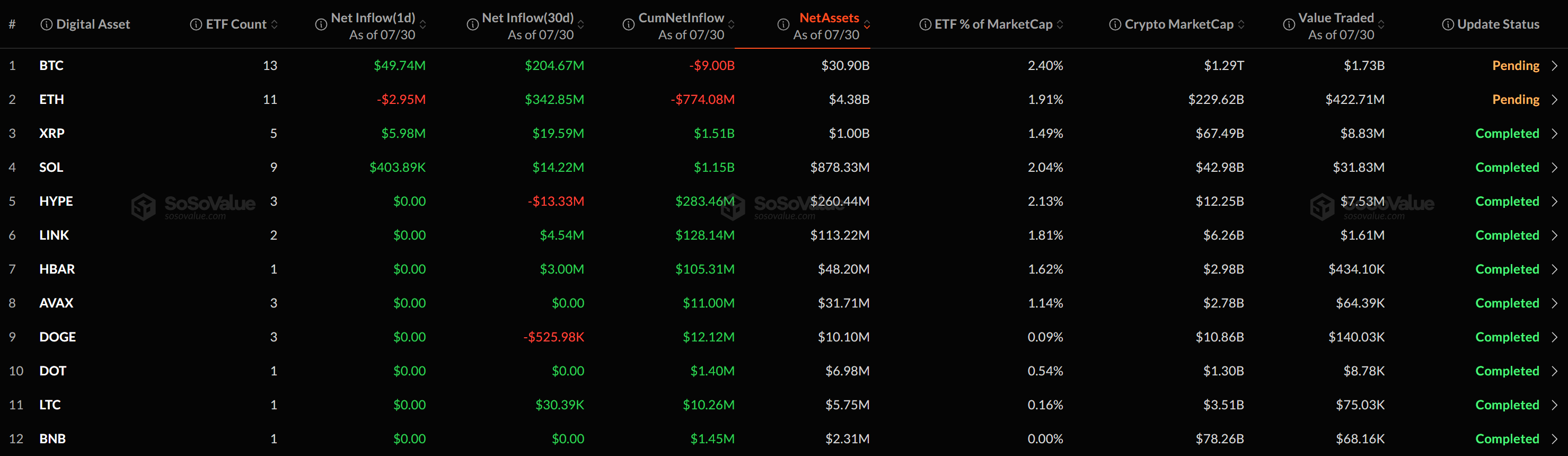
In addition, spot XRP ETF products registered continued net inflows. On July 30 UTC, XRP spot ETFs saw approximately $6 million in net inflows, alongside inflows into Bitcoin and Solana (SOL) ETFs—an indication that 'institutional demand' for selected crypto exposures remains active despite choppy price performance.
Ultimately, macro conditions continue to loom large. The Federal Reserve’s restrictive policy stance and persistent global growth uncertainty are widely viewed as limiting upside across crypto markets, including XRP. Analysts argue that while XRP’s fundamentals appear to be improving through regulatory progress, ecosystem growth, and institutional channels, the near-term catalyst for a sustained rally is likely to be a broader shift in global liquidity conditions—potentially providing the momentum needed to challenge the $1.10 'resistance' level again.
🔎 Market Interpretation
- Price vs. fundamentals divergence: XRP remains capped below $1.10 despite improving Ripple fundamentals in Europe; near-term moves are being driven more by macro risk sentiment than project catalysts.
- Current pricing snapshot (Jul 31): XRP at $1.0601 (24h: -2.63%, 7d: -2.57%), market cap ~$66.29B, 24h volume ~$1.16B.
- Technical posture remains defensive: Trading below EMA clusters and under the Bollinger midline near $1.10 suggests rallies are being sold and reinforces $1.10 as a key resistance zone.
- Macro correlation dominates: XRP is moving in tandem with BTC/ETH and major U.S. equity indices, indicating that broad “risk-on/risk-off” conditions are currently the primary driver.
- Trend context: Returns show stabilization short-term (+0.13% over 30d) but lingering weakness medium-term (-17.64% over 60d, -23.84% over 90d), implying the broader downtrend has not fully reset.
- Known supply event ahead: Ripple’s Aug. 1 escrow unlock of 1B XRP (~$1.06B) is largely anticipated; the market typically treats this as scheduled supply rather than a surprise shock.
- Supply overhang is moderated by re-locks: While 1B XRP equals ~1.6% of circulating supply if fully added, Ripple historically re-locks 60%–80%, implying ~300M XRP/month net drift toward circulation and a multi-year drawdown timeline.
- Regulatory/news tailwinds not yet priced in: Ripple’s MiCA CASP authorization and XRPL institutional/tokenization milestones appear constructive but insufficient to overpower restrictive global liquidity conditions.
💡 Strategic Points
- Key level to watch: $1.10 is the tactical “line in the sand.” A sustained reclaim above it would improve short-term structure; repeated rejection keeps the bias range-bound to bearish.
- Escrow release playbook: Treat Aug. 1 as a liquidity/supply monitoring event rather than an automatic dump—focus on how much is re-locked and whether exchange inflows rise materially.
- Macro-first framework: With XRP highly correlated to broader risk assets, near-term direction likely depends on Fed policy expectations and global liquidity—project-specific wins may mainly affect relative performance once macro turns supportive.
- Europe as a structural catalyst: MiCA CASP approval expands Ripple Payments rollout across the EEA, strengthening the long-run institutional narrative even if price response is delayed.
- Institutional “signals” to track:
- Spot ETF flows: Continued net inflows (e.g., ~$6M on Jul 30 UTC) can support demand at the margin, especially during broader market stabilization.
- Tokenization adoption: The AVA Investors tokenized fund share class on XRPL (approved by the Central Bank of Ireland) is a tangible step toward regulated on-chain assets.
- On-chain growth as a durability metric: Rising wallet counts and ~1M AI-agent-related transactions suggest ecosystem experimentation continues, potentially improving baseline network usage over time.
- Exchange flow nuance: Record Binance withdrawal transaction count without a comparable surge in withdrawn amount may indicate smaller retail moves toward self-custody or staggered risk management—not necessarily whale accumulation.
- Primary bullish unlock: A sustained rally likely requires easier liquidity conditions (or a clear risk-on pivot), allowing fundamentals like regulatory clarity and institutional rails to translate into price momentum.
📘 Glossary
- Resistance: A price area where selling pressure historically prevents further upside (here, ~$1.10).
- Bollinger Band midline: Typically a moving average used as a trend/mean reference; trading below it often signals weaker momentum.
- EMA (Exponential Moving Average): A moving average that weights recent prices more heavily; price below major EMAs can indicate bearish/weak trend conditions.
- Macro risk sentiment: Broad investor appetite for risk influenced by rates, growth expectations, and liquidity—often driving correlated moves across crypto and equities.
- Escrow unlock: Scheduled release of previously locked tokens; can affect perceived supply depending on how much enters circulation.
- Circulating supply: Tokens available to the market (tradable), excluding locked/escrowed holdings.
- MiCA: The EU’s Markets in Crypto-Assets regulation, providing a regulatory framework for crypto assets and service providers.
- CASP: Crypto-Asset Service Provider; an authorization/registration category under MiCA allowing regulated crypto services in the EU/EEA.
- EEA: European Economic Area; EU countries plus certain aligned states, enabling broader passported service reach.
- XRPL (XRP Ledger): The blockchain network associated with XRP, used for payments and increasingly for tokenization experiments.
- Tokenization: Representing real-world or traditional financial assets (e.g., fund shares) as on-chain tokens for settlement and transfer.
- Spot ETF inflows: Net new capital entering exchange-traded products holding the underlying asset directly, often viewed as an institutional demand proxy.
- Self-custody: Holding crypto in a personal wallet rather than on an exchange, reducing exchange counterparty exposure.













Comment 0