

 News
News  Coin Information
  About us
  Customer Service


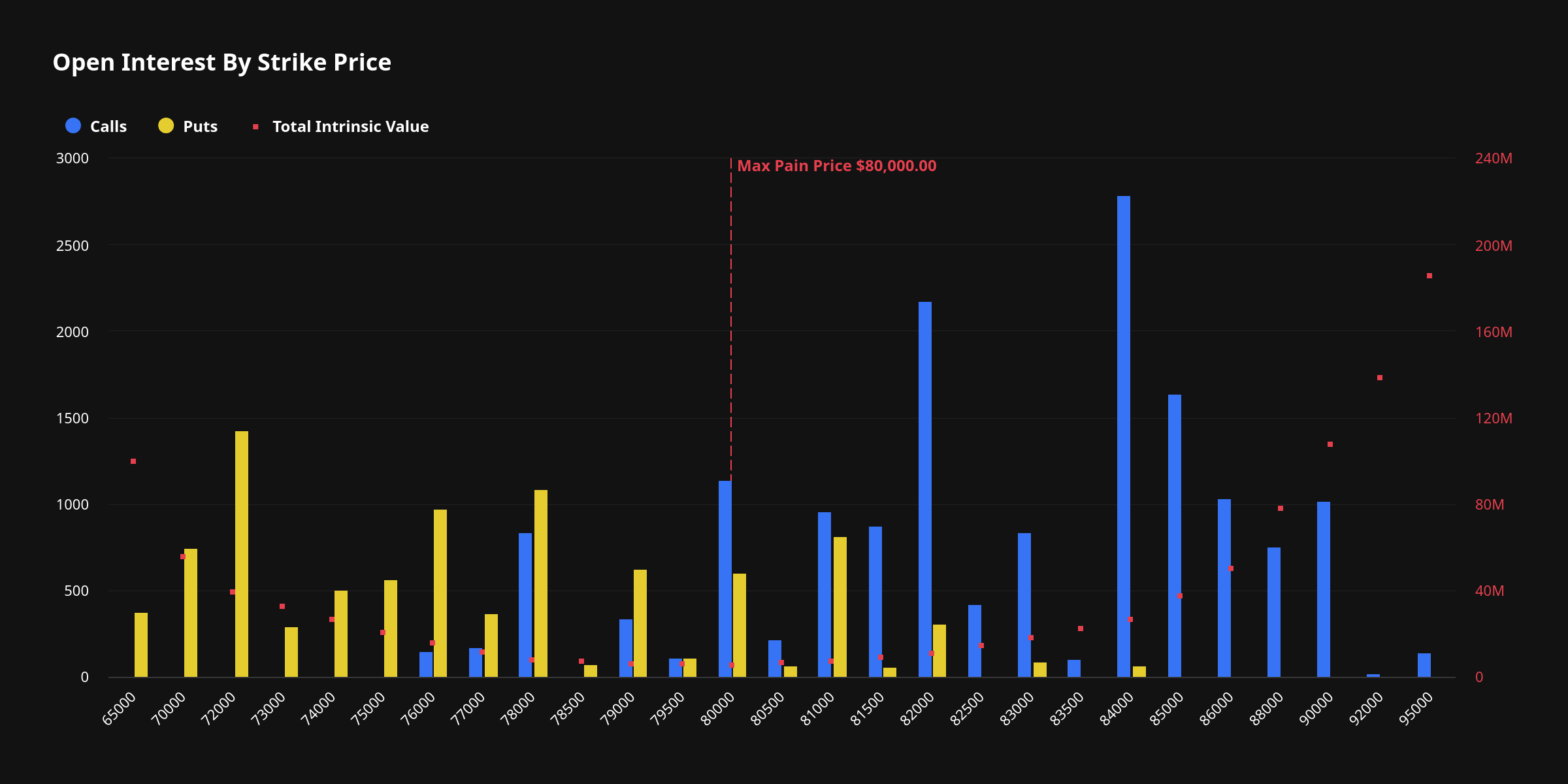
Bitcoin (BTC) options traders are clustering bullish bets around the $82,000–$85,000 range, signaling that ‘upside expectations’ remain intact even as spot prices soften. Positioning data from Deribit, the largest crypto options venue, suggests the market is still leaning toward calls over puts—an important barometer of sentiment as traders navigate near-term resistance levels.
As of Wednesday UTC (May 14), Deribit showed total Bitcoin options open interest at 25,012 contracts, representing roughly $2.04 billion in notional value. Call open interest stood at 15,808 contracts versus 9,204.4 contracts in puts, putting the put/call ratio at 0.58. In options market convention, a put/call ratio below roughly 0.7–0.8 is typically read as ‘bullish,’ while readings above 1 are often associated with a more defensive or bearish stance. The current level points to relatively strong call-side dominance, implying traders are more focused on upside participation than downside protection.
Deribit’s ‘max pain’—the strike price where option buyers collectively experience the largest losses at expiry—was pegged at $80,000. Max pain levels can become a psychological reference point, particularly into large expiries, as dealers and hedgers adjust exposures around heavily positioned strikes.
For options expiring the same day, open interest was most concentrated in $84,000 calls, followed closely by $82,000 calls and $85,000 calls. The clustering suggests the market is simultaneously expressing optimism about a push higher while acknowledging a likely battle zone near the upper band, where call-heavy strikes can coincide with technical resistance and intensified hedging activity.
Across all expiries, the largest open interest was in the $80,000 call, with notable positioning also in the $90,000 call and the $60,000 put. That structure reflects a market still willing to pay for ‘tail upside’ into higher strikes, while maintaining an anchor of longer-dated downside protection around $60,000—often interpreted as a key ‘defense line’ if risk sentiment deteriorates.
Flow over the past 24 hours reinforced the call-leaning tone. Deribit recorded put volume of 14,175.90 contracts versus call volume of 19,727.90 contracts, placing the 24-hour put/call ratio at 0.72. While less extreme than the open-interest ratio, the reading still indicates that call trading activity is outpacing puts, pointing to continued near-term appetite for upside exposure.
The most actively traded contracts were the $82,000 call (May 15, 2026 expiry) and the $84,000 call (May 15, 2026 expiry), alongside notable put activity in the $71,000 and $78,000 strikes (May 29, 2026 expiry) and a longer-dated $60,000 put (Dec. 25, 2026 expiry). The combination highlights a market expressing ‘breakout hopes’ in the front end while keeping hedges in place—an increasingly common posture in crypto options during periods of elevated volatility and headline risk.
Open interest was most concentrated in the June 26 expiry (59% calls), May 29 (53% calls), and Dec. 25 (65% calls). By volume, the May 15 expiry skewed heavily to calls (80%), while May 29 and June 26 showed put-led volume splits (55% and 53%, respectively), suggesting that traders are selectively adding protection around specific dates even as the broader positioning remains constructive.
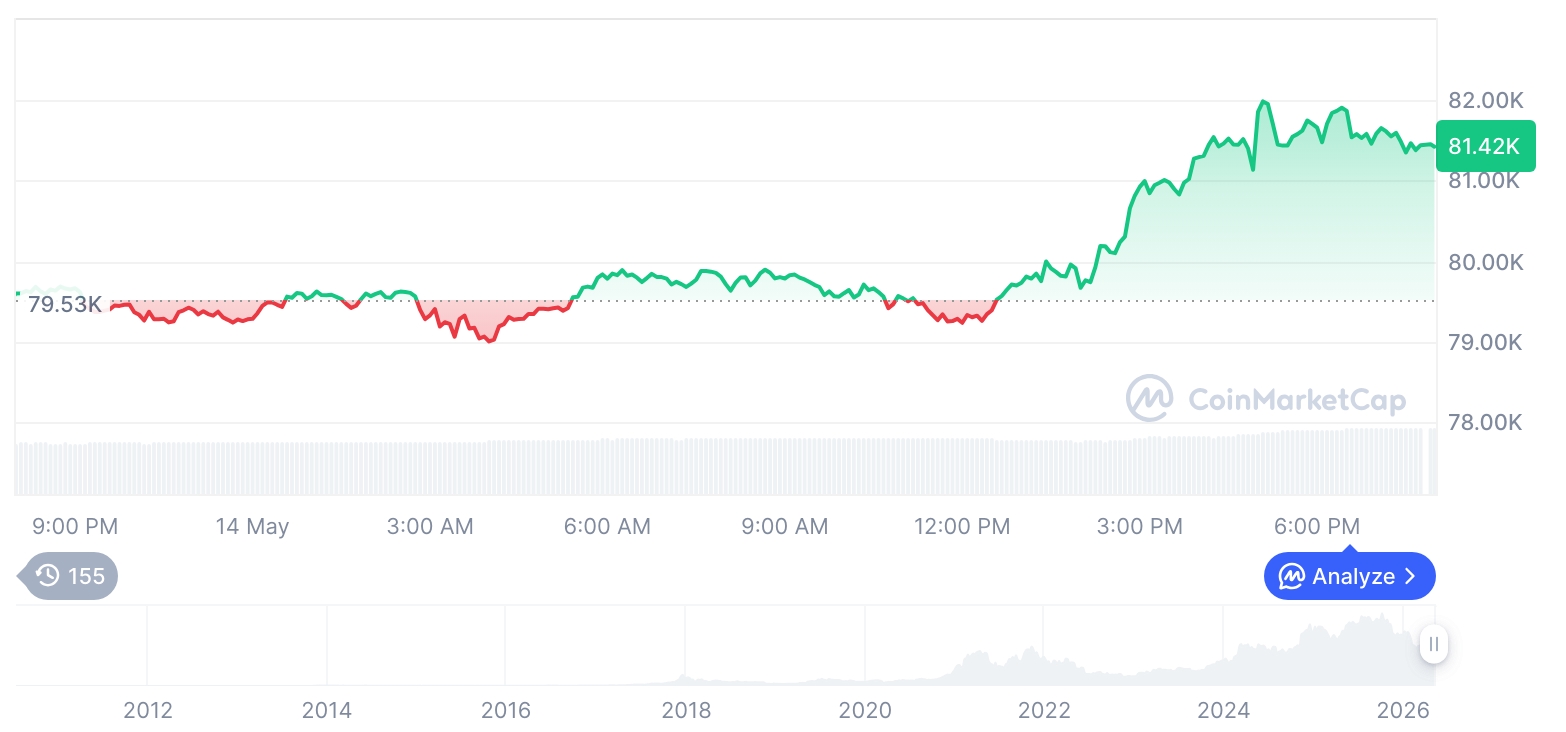
In spot markets, Bitcoin traded at $81,587 as of Thursday 1:18 a.m. ET (May 15), down 2.53% over the prior day, according to TokenPost Market data. The divergence—call-heavy options positioning alongside a pullback in spot—may reflect traders using dips to maintain upside exposure rather than capitulating, though the dense $82,000–$85,000 call area also underscores a critical zone for price discovery in the sessions ahead.
Options are leveraged derivatives that allow traders to speculate on price moves or hedge existing holdings. A ‘call option’ provides the right to buy the underlying asset at a predetermined price, while a ‘put option’ provides the right to sell. ‘Open interest’ measures the number of outstanding contracts that remain active in the market.
🔎 Market Interpretation
- Options sentiment remains net-bullish despite spot weakness: Deribit BTC options show call open interest (15,808) materially above put open interest (9,204.4), with an overall put/call ratio of 0.58—typically interpreted as bullish positioning even as BTC spot slipped to $81,587 (-2.53%).
- Key near-term “battle zone” is $82K–$85K: Same-day expiry open interest is clustered in $84K calls, then $82K and $85K calls, suggesting traders are targeting upside continuation while acknowledging that heavy call strikes can coincide with resistance and hedging-driven volatility.
- “Max pain” anchored at $80K: Deribit max pain is $80,000, a level that can act as a psychological magnet into expiry as dealers rebalance hedges around concentrated strikes.
- Skew shows optimism plus downside insurance: Across expiries, the largest open interest sits at the $80K call with notable interest at the $90K call (tail upside) and a meaningful $60K put (longer-dated protection), implying investors want upside participation while keeping a “risk-off” backstop.
- Recent flow supports the constructive bias, but hedging is date-specific: In the last 24 hours, call volume (19,727.90) exceeded put volume (14,175.90), for a 24h put/call ratio of 0.72. However, some expiries (e.g., May 29 and June 26) saw put-led volume, indicating protection being added around particular calendar risk windows.
💡 Strategic Points
- Watch $82K–$85K for “pin vs breakout” dynamics: Dense call OI can create a zone where price oscillates as hedgers adjust delta exposure; a clean move through this band may force additional hedging flows that amplify momentum, while failure can lead to quick mean reversion.
- $80K is a key reference level into near expiries: With max pain at $80K and large call OI at $80K, price reactions around this level may be sharper into expiration as positioning-related flows intensify.
- Tail positioning hints at a two-track market view: Interest in $90K calls suggests some traders are paying for a high-upside scenario (breakout continuation), while $60K puts imply institutions/large traders still respect a deep drawdown risk and prefer to keep disaster hedges.
- Interpret volume-vs-OI divergences: Call-heavy open interest reflects accumulated bullish exposure, while pockets of put-heavy volume by certain maturities suggest incremental hedging rather than a wholesale shift bearish—useful for assessing whether “dip buying” remains intact.
- Most-active strikes spotlight trader focus: Heavy trading in long-dated $82K and $84K calls (May 15, 2026) indicates conviction in maintaining upside optionality beyond short-term noise, alongside active puts at $71K/$78K (May 29, 2026) and $60K (Dec 25, 2026) to manage downside scenarios.
📘 Glossary
- Call option: A contract giving the buyer the right (not obligation) to buy BTC at a specified strike price by (or on) an expiry date; typically benefits from price increases.
- Put option: A contract giving the buyer the right (not obligation) to sell BTC at a specified strike price by (or on) expiry; typically benefits from price declines and is often used as protection.
- Open Interest (OI): The number of outstanding option contracts that remain open (not closed or exercised). Higher OI at a strike often signals stronger market focus and potential hedging activity.
- Put/Call ratio: Puts divided by calls (by OI or volume). Lower values (commonly below ~0.7–0.8) are often read as more bullish; values above 1 can imply more defensive positioning.
- Max pain: The strike level at which option buyers would collectively lose the most at expiry; sometimes used as a reference point for where price may gravitate near expiration due to hedging and positioning effects.
- Notional value: The dollar value represented by derivative contracts (here, BTC options), used to gauge market size/exposure rather than direct cash invested.
- Strike price: The preset price at which the option can be exercised (buy for calls, sell for puts).
- Expiry (maturity): The date when the option contract ends and can no longer be exercised.
- Hedging / dealer hedging: Risk-management activity (often by market makers) to offset option exposure, which can add buying/selling pressure around heavily positioned strikes.
- Tail upside / tail risk: Low-probability but high-impact outcomes. Tail upside refers to large rally scenarios (e.g., $90K calls); tail risk hedges often refer to protection against large drawdowns (e.g., $60K puts).



















Comment 0