

 News
News  Coin Information
  About us
  Customer Service


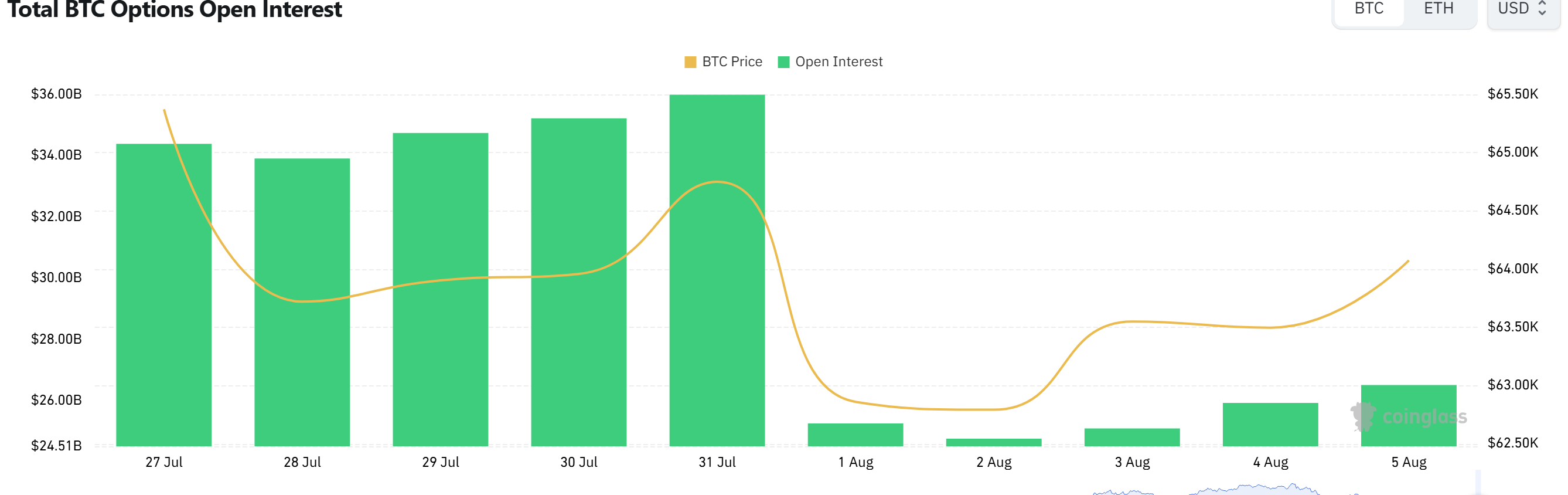
Bitcoin (BTC) options positioning continued to signal a market leaning bullish over the medium term, even as short-dated flows reflected persistent demand for downside protection—an indication that traders are not fully dismissing near-term volatility.
As of Tuesday 01:40 UTC (based on CoinGlass data), total open interest (OI) in Bitcoin options stood at $26.09 billion, up 2.42% from $25.48 billion a day earlier. Total options volume over the same period was about $2.88 billion, underscoring active participation as traders recalibrated exposure across major venues including Deribit, Binance, and Bybit.
The composition of open interest remained decisively tilted toward calls, with call options accounting for 62.20% versus 37.80% for puts. That skew is typically interpreted as a sign of stronger 'upside positioning' in accumulated bets, since OI reflects outstanding, unclosed contracts rather than only fresh trades.
However, the 24-hour volume split was far more balanced: calls represented 51.41% while puts made up 48.59%. The narrow gap suggests that while many traders continue to hold bullish positions, a substantial cohort is actively buying puts—often used for hedging spot or perpetual-futures exposure—reinforcing the idea that the market is still pricing in the possibility of pullbacks.
The largest concentrations of open interest were clustered around several key strikes on Deribit, led by the $80,000 call expiring Dec. 25, followed by the $70,000 call expiring Aug. 7, and the $60,000 put expiring Dec. 25. These strike levels can act as focal points for positioning and potential 'gamma' effects near expiration, particularly if spot prices drift toward heavily trafficked zones.
By 24-hour traded volume, the most active contract was a $57,000 put expiring Aug. 28 on Binance. It was followed by a $54,000 put with the same Aug. 28 expiry on Deribit, and a $65,000 call expiring Aug. 5 on Bybit. The prominence of sub-spot put strikes in the top volume rankings points to heightened interest in near-term insurance, even as longer-dated OI remains call-heavy.
Options are widely used in crypto markets for leveraged directional bets and risk management. Calls confer the right to buy an asset at a predetermined price, while puts give the right to sell—often serving as a hedge against declines. Traders typically read rising open interest as evidence of new position building, whereas volume reflects immediate activity and shifts in sentiment. In this snapshot, the rise in total OI alongside a call-dominant outstanding book suggests growing 'medium-term bullish conviction', but the near-even flow of put buying indicates that defensive positioning is still materially present.
🔎 Market Interpretation
- Medium-term bias remains bullish: Bitcoin options open interest (OI) rose to $26.09B (+2.42% YoY), with outstanding positioning skewed to calls (62.20%) versus puts (37.80%), signaling accumulated upside exposure.
- Near-term caution is still being priced: Despite call-heavy OI, the last 24-hour trading flow was nearly split—calls 51.41% vs puts 48.59%—implying active demand for downside hedges and unresolved near-term volatility risk.
- Hedging alongside conviction: The combination of rising OI (position building) and balanced volume (active put buying) suggests traders may be maintaining bullish core exposure while purchasing protection against drawdowns.
- Strike “magnets” and potential volatility zones: Large OI clusters at specific strikes can influence price behavior into expiration via dealer hedging dynamics (gamma), especially if spot approaches heavily concentrated levels.
- Venue-spanning participation: Activity is distributed across major derivatives venues (Deribit, Binance, Bybit), reinforcing that the observed positioning is market-wide rather than isolated.
💡 Strategic Points
- Track OI vs. volume divergence: Call-dominant OI with near-even put/call volume often indicates structural bullish positioning paired with tactical hedging. If put volume begins to exceed call volume persistently, it may foreshadow a shift toward risk-off sentiment.
- Key OI strikes to watch (Deribit):
- $80,000 call (Dec. 25) — reflects longer-dated upside targets; may act as a sentiment barometer for year-end expectations.
- $70,000 call (Aug. 7) — nearer-term upside waypoint; could become a gamma-sensitive zone into early August.
- $60,000 put (Dec. 25) — notable long-dated downside hedge level; suggests investors are still paying attention to tail-risk protection.
- Most active 24h contracts imply near-term insurance demand:
- $57,000 put (Aug. 28, Binance) — top traded; indicates meaningful interest in protection below prevailing spot levels.
- $54,000 put (Aug. 28, Deribit) — reinforces the concentration of short-dated downside hedges.
- $65,000 call (Aug. 5, Bybit) — shows traders still keep upside exposure in the front end, but alongside heavy put demand.
- Expiration-driven risk management: Into early August and late August expiries, price moves toward high-OI strikes can amplify short-term volatility. Traders often reduce leverage, roll hedges, or stagger strike coverage to avoid being forced to adjust during fast markets.
- Interpretation framework for readers:
- Rising OI = more outstanding risk in the system (position buildup).
- Balanced volume = two-way trading; hedging demand can coexist with bullish positioning.
- Put-heavy activity at sub-spot strikes = demand for “insurance,” not necessarily outright bearish conviction.
📘 Glossary
- Open Interest (OI): The total number (or notional value) of outstanding, unclosed option contracts. Often used to gauge how much positioning is in place.
- Options Volume: The amount of options traded over a period (e.g., 24 hours). Reflects immediate activity and sentiment shifts.
- Call Option: Contract granting the right (not obligation) to buy BTC at a set strike price before/at expiration; typically used for upside exposure.
- Put Option: Contract granting the right (not obligation) to sell BTC at a set strike price; commonly used for downside hedging or bearish bets.
- Strike Price: The predetermined price at which the option can be exercised (buy/sell the underlying).
- Expiration: The date the option contract ends. Price sensitivity and dealer hedging effects often intensify as expiration nears.
- Hedging: Using derivatives (often puts) to reduce risk from spot or futures exposure, limiting losses during drawdowns.
- Gamma Effect (Gamma Exposure): A dynamic where option market makers adjust hedges as price changes; large strike concentrations near spot can amplify moves or “pin” price near certain levels close to expiry.
- Sub-spot Strike: A strike below the current BTC price; put demand here typically reflects demand for near-term downside protection.














Comment 0