

 News
News  Coin Information
  About us
  Customer Service


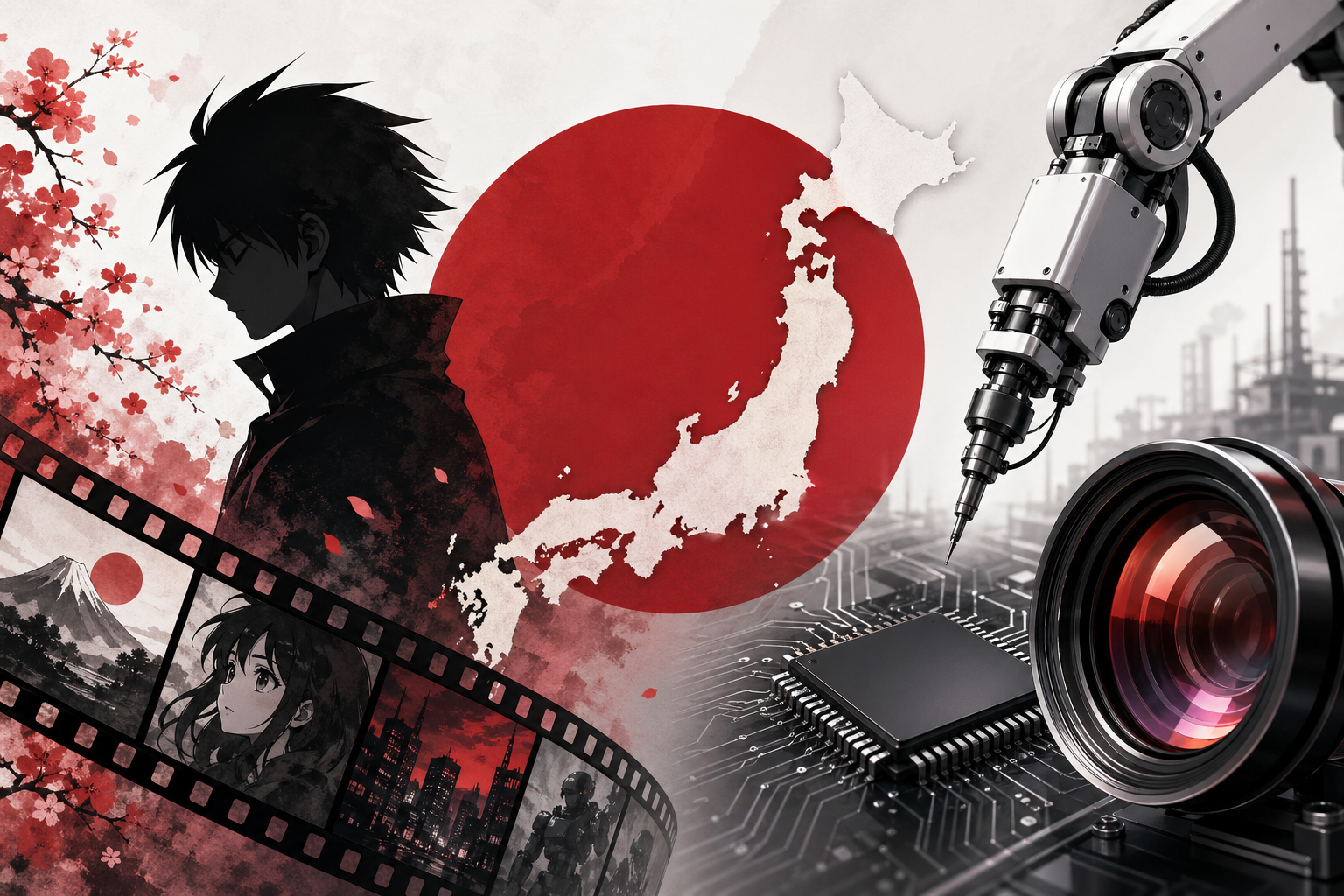
Japan’s global influence is being reappraised through two seemingly unrelated forces: a surging international appetite for Japanese animation and a rapid expansion in defense spending that leans heavily on the country’s long-cultivated ‘precision manufacturing’ base. Together, they are pushing investors and policymakers to look again at Japan’s distinctive blend of cultural depth and industrial capability.
What is striking, analysts note, is that many of the country’s most enduring assets were not engineered by bureaucracy but emerged from individuals—creators, engineers, and craftsmen—who pursued an obsessive level of quality in narrow domains. Iconic franchises and brands—from landmark manga and character IP to globally recognized electronics and gaming names—are often the product of singular focus rather than centralized design. That pattern, observers argue, helps explain why Japan can simultaneously export mass-appeal stories and produce components that only a handful of countries can reliably manufacture at scale.
The numbers behind the ‘anime boom’ underscore how far the medium has moved beyond niche status. The global animation market, once estimated around $1 billion roughly three decades ago, is projected to reach $88.5 billion by 2033, implying annual growth above 9%.
Japan’s animation industry is increasingly driven by overseas audiences. In 2024, overseas revenue for Japanese animation rose 26% year over year to $14.3 billion, accounting for 56% of total sales—an inflection point that signals global demand now outweighs domestic consumption.
Streaming platforms have accelerated the shift. Netflix has said that more than half of its roughly 300 million members watch animation, with anime viewership on the platform tripling over the past five years. In 2024 alone, cumulative anime views exceeded 1 billion. Long-running franchises remain powerful global engines of engagement: the series Naruto, which began serialization in 1999, logged 330 million hours viewed on Netflix in the second half of 2024. Half of the world’s top 10 franchises, the report adds, trace their origins to Japan—evidence that Japanese IP has become a form of cross-generational ‘social infrastructure’ shaping taste and memory worldwide.
At the same time, Japan is moving quickly to bolster defense capabilities. Its defense budget has nearly doubled over the past three years and has surpassed 2% of GDP for the first time. Tokyo has committed ¥43 trillion over five years through 2027 under its defense buildup plan—a scale that reframes how markets think about Japan’s industrial priorities and supply chains.
The timing aligns with a broader global investment cycle. Crunchbase data cited in the report shows venture capital investment in defense-related startups reached a record $7.7 billion in 2025, reflecting heightened geopolitical uncertainty and greater willingness to fund dual-use technologies.
On the surface, blockbuster anime and rearmament may look like separate narratives. But the report argues they share a common root: Japan’s culture of relentless refinement. The same national ecosystem that produced frame-by-frame perfectionism in animation studios also built world-leading competence in high-tolerance manufacturing—silicon wafers, photoresists, specialty ceramics, industrial robotics, high-end optics, and sensor technologies. Those capabilities, developed for consumer electronics and industrial automation, now underpin next-generation domains such as autonomous systems and high-precision guidance, where micron-level reliability can be decisive.
This is why some analysts see Japan’s competitive edge as more than the sum of factories and patents. Manufacturing leadership can be copied over time as production methods diffuse and competitors invest. Cultural depth—especially global familiarity with characters, stories, and aesthetics formed in childhood—is far harder to replicate or transplant through policy and capital alone. IP libraries with decades of emotional resonance, the report suggests, function as durable economic infrastructure alongside Japan’s hardware strengths.
The challenge is not whether Japan has valuable assets, but whether it can connect them to global capital, legal frameworks, distribution, and localization fast enough in the AI era. As automation lowers barriers to content creation and accelerates commercialization cycles, having great technology or storytelling is no longer sufficient; winning also requires ‘cross-border execution’—speedy licensing, scalable partnerships, and translation of products and narratives into global standards.
For markets, the question is increasingly straightforward: the world appears ready to pay for what Japan’s long-underestimated individual creators and engineers quietly built over decades. Whether Japan can recognize that value internally and mobilize it with enough speed may determine how much of the upside it captures in the next cycle of cultural and industrial competition.
🔎 Market Interpretation
- Japan’s influence is being repriced on two fronts: global demand for anime/IP and a defense-spending surge that activates Japan’s precision manufacturing supply chain.
- Anime has shifted from domestic to global-driven: 2024 overseas revenue for Japanese animation rose 26% to $14.3B, making up 56% of total sales—signaling international consumers now dominate industry growth.
- Streaming is the distribution catalyst: Netflix reports over half of ~300M members watch animation; anime viewership tripled in five years, topping 1B cumulative views in 2024—supporting recurring monetization via licensing and long-tail catalog consumption.
- Defense policy is reorienting industrial priorities: Japan’s defense budget has nearly doubled in three years and surpassed 2% of GDP; the planned ¥43T (through 2027) implies multi-year demand visibility for high-spec components and integrators.
- Global capital is rotating toward defense/dual-use: cited data shows VC in defense startups hit $7.7B (2025), improving the funding environment for autonomy, sensing, robotics, and guidance—areas aligned with Japan’s manufacturing strengths.
- Shared underlying moat: both cultural exports (anime perfectionism) and industrial exports (micron-level manufacturing) stem from a national ecosystem of “relentless refinement,” creating defensible advantages that are difficult to replicate quickly.
- Key market risk shifts from capability to execution: in the AI era, value capture depends on speed in global licensing, localization, legal structuring, and partnerships—not just on having great IP or hardware.
💡 Strategic Points
- Look for convergences, not silos: investors may benefit from viewing anime/IP monetization and defense industrial ramp as connected plays on Japan’s quality-focused ecosystem.
- IP as “economic infrastructure”: decades-old franchises with multi-generational emotional attachment can support durable revenues (streaming, merchandise, licensing) and are harder to duplicate than manufacturing know-how.
- Precision manufacturing as strategic leverage: strengths in silicon wafers, photoresists, specialty ceramics, industrial robotics, high-end optics, and sensors position Japan to supply critical inputs for autonomy and precision-guidance systems.
- Execution checklist for IP upside: accelerate cross-border licensing, standardize rights management, expand localization/translation pipelines, and build scalable global distribution partnerships.
- Execution checklist for defense upside: expand capacity for high-tolerance components, qualify suppliers for security requirements, and prioritize dual-use R&D pathways that convert industrial automation expertise into defense-grade systems.
- What to monitor next: (1) overseas anime revenue mix and licensing yields, (2) Netflix/streaming demand signals and franchise hours viewed, (3) defense procurement timetables and supplier wins, (4) regulatory/legal reforms enabling faster international IP and defense-tech scaling.
📘 Glossary
- IP (Intellectual Property): legally protected creations (characters, stories, franchises) monetized via licensing, streaming, merchandise, and adaptations.
- Localization: adapting content/products for foreign markets (translation, cultural edits, compliance, packaging, marketing).
- Precision manufacturing: production requiring extremely tight tolerances and high reliability (often at micron/sub-micron levels).
- Photoresist: light-sensitive material used in semiconductor lithography; critical for advanced chip fabrication.
- Silicon wafers: base substrate for semiconductors; quality affects yield and performance.
- Specialty ceramics: advanced ceramic materials used in electronics and high-stress/heat applications.
- High-end optics: precision lenses/optical systems used in imaging, sensing, and guidance.
- Sensors: components that detect physical inputs (light, motion, position) essential for robotics and autonomous systems.
- Dual-use technology: technology applicable to both civilian and military purposes (e.g., robotics, autonomy, advanced sensing).
- Cross-border execution: operational ability to commercialize globally—licensing speed, legal frameworks, distribution, partnerships, and standardized processes.






















Comment 0