

 News
News  Coin Information
  About us
  Customer Service


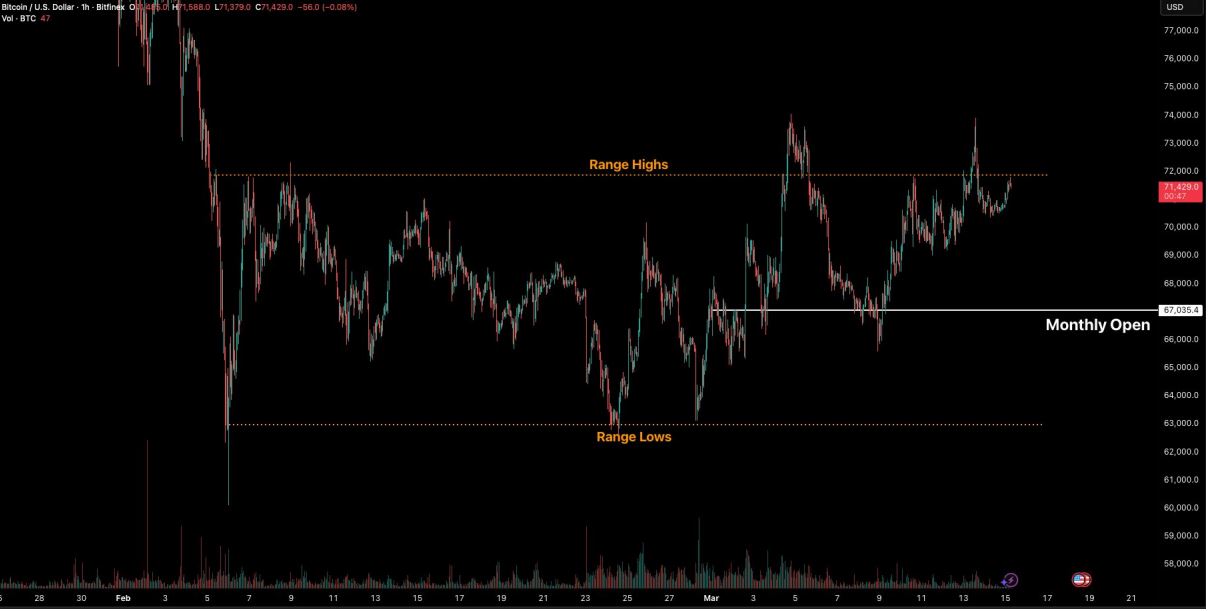
Bitcoin (BTC) is showing signs of a developing 'supply vacuum' as institutional buying accelerates faster than new coins are being mined—an imbalance that could make the current range-bound market vulnerable to a breakout.
In its latest Bitfinex Alpha report published Sunday UTC, the exchange’s research team argued that crypto markets are increasingly forming their own supply-and-demand dynamics despite persistent macro uncertainty. The focus now shifts to this week’s U.S. Federal Reserve meeting, where traders are pricing an overwhelming likelihood of no change to interest rates, while expectations for an April cut have sharply faded amid renewed geopolitical and energy-driven inflation risks.
According to the report, the probability of the Federal Open Market Committee holding rates on March 18 remains near certainty, while bets on an April reduction have dropped markedly from levels seen a month earlier. The reset reflects a market digesting escalating Iran-related tensions, rising oil prices, and concerns that supply-side shocks could slow global growth—leaving the Fed chair’s guidance as the key catalyst for broader risk sentiment.
Yet Bitfinex said Bitcoin has recently exhibited signs of 'decoupling' from macro headwinds, supported by a sharp rebound in the Absorption-to-Emission Ratio (AER), a metric comparing demand absorption to fresh issuance from mining. The AER was cited at 6.2x, with a seven-day average of 4.8x, turning higher after spending an extended period in negative territory—an indication that demand is overwhelming new supply.
The rebound suggests institutional investors view sub-$70,000 levels as a 'value-based buying' zone rather than simply a trading range, the report said. Bitfinex summarized the current setup in three themes: AER tends to recover quickly even after short-term pullbacks; demand is absorbing available supply at roughly five times the pace of mining issuance; and while price has moved sideways, AER continues to trend upward, widening the gap between price action and underlying demand.
That divergence was described as a 'coiling' phase—an environment where buying pressure builds without immediate price follow-through, often preceding a directional move. Bitfinex added that historically, when AER remains above 3x for more than 14 consecutive days, the odds of a spot-led advance increase, implying the current absorption profile could be laying groundwork for an upside resolution.
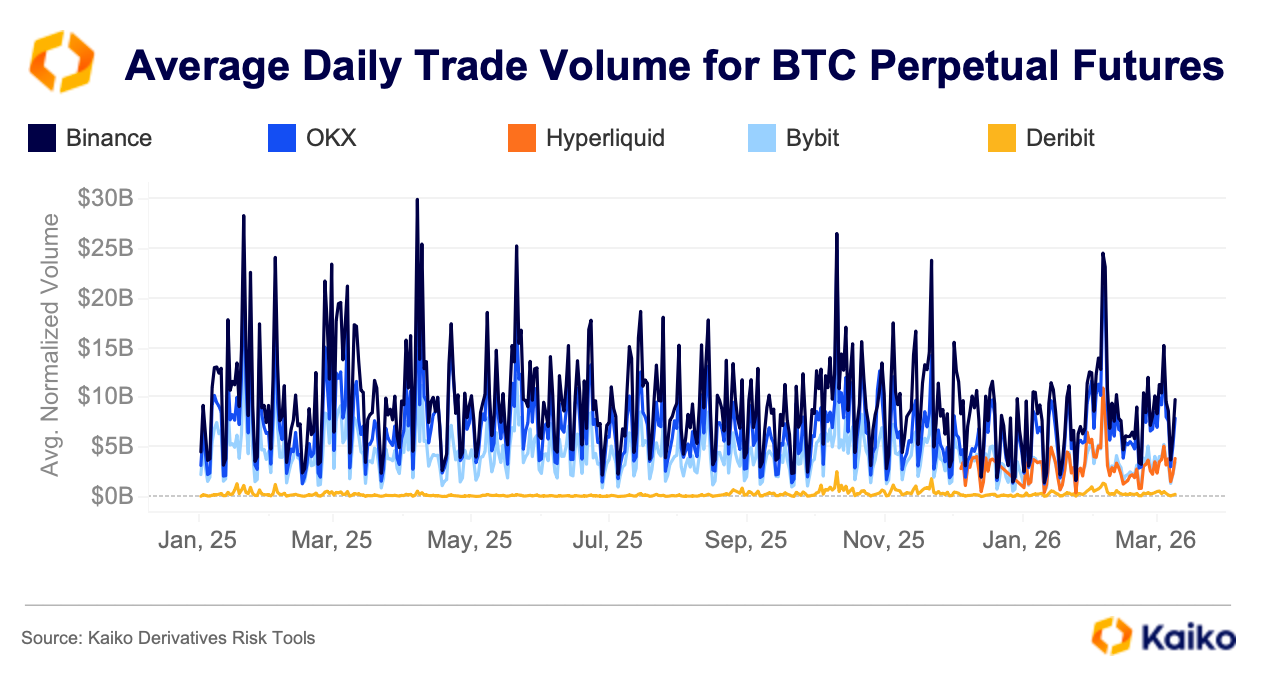
Derivatives positioning, meanwhile, appears less fragile than in prior rally attempts. The report said global leverage has been reset to its most conservative levels in roughly two years, while open interest has been rising gradually alongside price rather than surging abruptly. Funding rates have also remained near neutral, signaling limited evidence of speculative overheating.
Liquidation data points to asymmetric pressure points around the range. Bitfinex estimated roughly $2.4 billion in potential short liquidations clustered near $72,500, a level that could fuel a 'short squeeze' if breached. Below $70,000, however, there is also a notable pocket where long liquidations may be triggered, leaving room for a brief downside sweep before any sustained move higher.
Overall, Bitfinex’s base case is that if elevated AER readings persist and ETF- and institution-driven flows remain steady, Bitcoin’s chances of breaking above the top of its current consolidation band improve—even as macro headlines and central-bank messaging continue to dictate near-term volatility across global markets.
🔎 Market Interpretation
- Supply vacuum forming: Institutional/ETF-style demand is absorbing BTC faster than miners can emit new supply, creating an imbalance that can destabilize a sideways market into a breakout.
- Macro still the volatility trigger: Markets expect the Fed to hold rates at the upcoming meeting; April-cut expectations have faded due to geopolitical risk (Iran-related tensions), higher oil prices, and renewed inflation concerns.
- BTC “decoupling” narrative: Despite macro headwinds, Bitcoin shows self-contained supply/demand dynamics, with demand metrics strengthening even as price remains range-bound.
- Breakout setup vs. sweep risk: A bullish resolution is favored if demand stays elevated, but liquidation clusters suggest both an upside squeeze and a potential brief downside flush are plausible.
💡 Strategic Points
- Watch the Absorption-to-Emission Ratio (AER): Bitfinex cites AER at 6.2x (7D avg 4.8x), implying demand is overwhelming issuance. Historically, AER > 3x for 14+ days has correlated with higher odds of spot-led upside continuation.
- Interpret the “coiling” phase: Price consolidation alongside rising AER signals building buy pressure without immediate price response—often a precursor to a directional move.
- Key upside trigger level: Around $72,500, Bitfinex estimates ~$2.4B in potential short liquidations; a clean break above this zone can accelerate price via a short squeeze.
- Key downside risk pocket: Below $70,000 sits an area where long liquidations may cascade, allowing a temporary downside sweep before any sustained advance.
- Derivatives risk appears healthier: Leverage is described as near the most conservative in ~2 years; open interest is rising gradually (not explosively), and funding is near neutral—suggesting less overheating than prior rallies.
- Event-driven caution: Fed guidance (tone, inflation outlook, rate-path signaling) remains the near-term catalyst for cross-asset risk sentiment, even if BTC’s internal demand is improving.
📘 Glossary
- Supply vacuum: A market condition where available supply is scarce relative to demand, increasing the chance of sharp price moves when buyers compete for limited coins.
- Absorption-to-Emission Ratio (AER): A metric comparing how much BTC demand absorbs versus how much new BTC miners emit; higher values imply demand outpacing new supply.
- Decoupling: When an asset’s price behavior becomes less correlated with broader macro forces (rates, inflation, risk-off moves) and more driven by its own flows and fundamentals.
- Coiling: A consolidation phase where pressure builds (often seen in positioning/flow metrics) without immediate price breakout, potentially preceding a strong directional move.
- Open interest: The total value/number of outstanding derivatives contracts; rapid spikes can signal crowded positioning and liquidation risk.
- Funding rate: Periodic payments between long/short positions in perpetual futures; neutral funding suggests balanced sentiment and less speculative froth.
- Short squeeze: A rapid price rise triggered when short sellers are forced to buy back to cover positions, often amplified by liquidation cascades.
- Liquidation cluster: A price zone where many leveraged positions are likely to be forcibly closed, increasing the probability of accelerated moves when that level is reached.

















Comment 0