

 News
News  Coin Information
  About us
  Customer Service


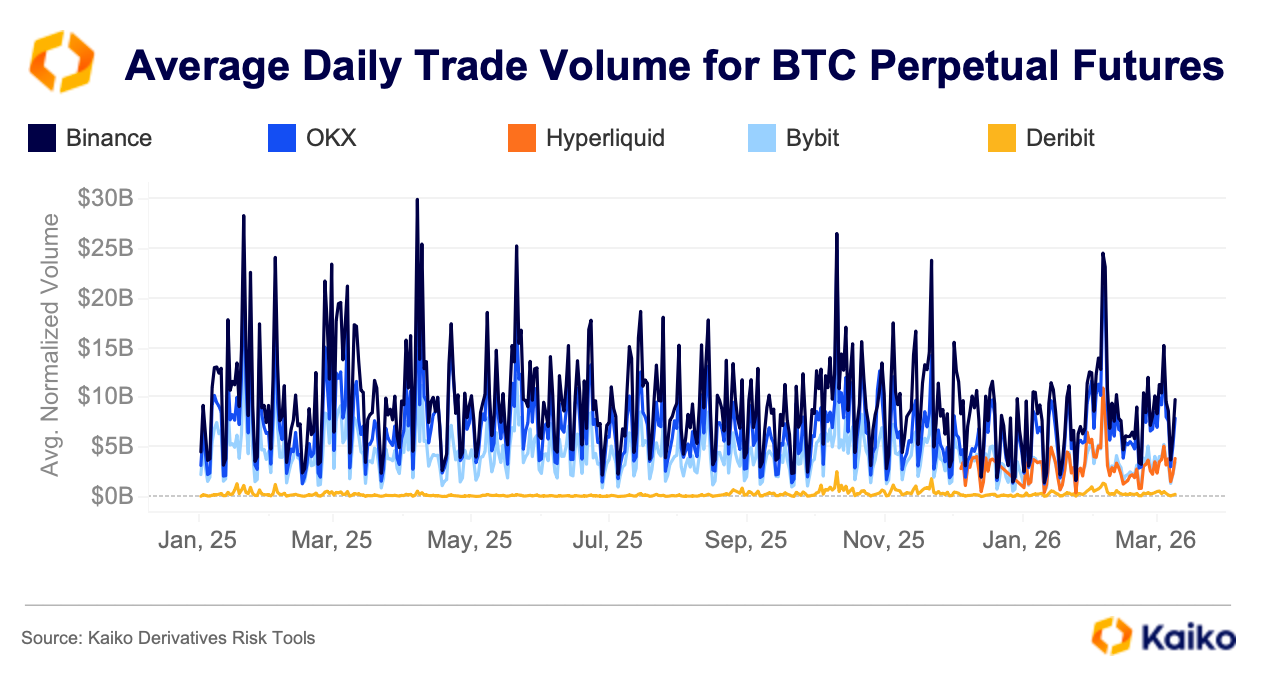
Crypto derivatives are still dominated by offshore giants, but new challengers are beginning to carve out meaningful space—an early sign that the market’s long-standing structure may be entering a transition phase.
In a report published Monday UTC, Kaiko Research said the derivatives market—central to crypto 'price discovery' and risk management—remains heavily concentrated on a handful of global exchanges, even as U.S. venues and decentralized platforms accelerate their efforts to compete.
Kaiko’s data show that as of 2025, more than 60% of total Bitcoin (BTC) trading activity was tied to 'perpetual futures', the high-liquidity contracts that have become the industry’s preferred leverage instrument because they trade without expiry and are easier to roll than dated futures.
That concentration has historical roots. In the U.S., perpetual futures were not allowed through the end of 2025, pushing much of the product’s growth to non-U.S. platforms over the past cycle and leaving Binance, OKX, and Bybit as the primary venues setting global derivatives liquidity.
Among them, Binance continues to define the market’s center of gravity. Kaiko estimates Binance’s average daily Bitcoin perpetual futures volume sits above $9 billion, with recurring spikes exceeding $25 billion—levels that give it outsized influence over liquidations, funding rates, and broader sentiment during volatility.
Still, Kaiko flagged emerging cracks in that dominance. Following approval from the U.S. Commodity Futures Trading Commission (CFTC) in 2025, Coinbase ($COIN) has seen rapid growth in perpetual futures volume, suggesting the U.S. derivatives ecosystem could expand along a path similar to the spot market—gradual at first, then increasingly competitive as liquidity and institutional participation arrive.
At the same time, decentralized exchanges are pushing deeper into perpetuals. While DEXs still represent a smaller share of total derivatives volume than centralized exchanges, activity has expanded sharply over the past two years, underscoring a broader shift toward onchain execution and self-custody for sophisticated traders.
Kaiko pointed to Hyperliquid as the standout in that trend, estimating it has reached roughly 10% to 15% market share in perpetual futures—enough to put it in the same conversation as the largest centralized venues in certain segments, even if Binance, OKX, and Bybit still account for most aggregate flow.
Part of Hyperliquid’s momentum stems from product expansion. Since January 2026, it has broadened support beyond crypto into additional asset classes including equities and commodities, while offering a 24/7 trading framework—features designed to capture cross-asset speculative demand that traditional venues may not provide in the same format.
Kaiko added that in a year marked by elevated volatility, these derivatives offerings can create new types of trading opportunities, helping explain why some flow is beginning to migrate from centralized rails to decentralized infrastructure.
The upshot, according to the report, is that crypto derivatives remain overwhelmingly shaped by global exchanges, but faster growth from U.S.-regulated platforms and leading DEXs is increasing the likelihood of a more contested market structure—one that could gradually diversify liquidity sources and reshape how leverage is accessed across the industry.
Article Summary by TokenPost.ai
🔎 Market Interpretation
- Offshore venues still anchor crypto derivatives liquidity: Bitcoin derivatives activity remains highly concentrated, with Binance, OKX, and Bybit continuing to set key market conditions (liquidity depth, funding, liquidation dynamics).
- Perpetual futures dominate BTC trading: As of 2025, over 60% of total BTC trading activity is tied to perpetual futures, reflecting trader preference for high-liquidity, non-expiring leverage instruments.
- Regulation shaped today’s market structure: U.S. restrictions on perpetual futures through the end of 2025 helped push perpetuals growth offshore, reinforcing the dominance of non-U.S. exchanges during the last cycle.
- Early signs of fragmentation are emerging: Growth from U.S.-regulated platforms (notably Coinbase after CFTC approval in 2025) and DEX perpetuals suggests the market may be entering a transition toward more diversified liquidity hubs.
- DEXs are becoming structurally relevant: Although still smaller than CEXs in aggregate, onchain derivatives growth over the last two years indicates increasing acceptance of onchain execution and self-custody among sophisticated traders.
💡 Strategic Points
- Binance remains the primary volatility amplifier: With estimated average daily BTC perpetual volume above $9B and spikes beyond $25B, Binance is positioned to disproportionately influence liquidations, funding rates, and short-term sentiment during market stress.
- Watch U.S. perpetuals for a “spot-like” adoption curve: Kaiko suggests Coinbase’s post-approval growth could mirror U.S. spot evolution—slow initial liquidity formation followed by acceleration as institutions participate and spreads tighten.
- Hyperliquid is the standout DEX challenger: Estimated at 10–15% perpetual futures share, Hyperliquid is large enough to matter in certain segments and may pressure incumbents on fees, execution, and product design.
- Cross-asset perpetuals are a differentiator: Hyperliquid’s expansion since Jan 2026 into equities and commodities with 24/7 trading targets demand that traditional venues may not fully match—potentially pulling incremental speculative flow onchain.
- Liquidity diversification changes risk transmission: If volume spreads across more venues (U.S. regulated + DEXs), market shocks may transmit differently—reducing single-venue dominance but increasing the importance of cross-venue arbitrage and monitoring funding/price dislocations.
- Volatility creates migration incentives: Elevated volatility tends to increase derivatives usage; combined with improving DEX UX/liquidity, it can accelerate shifts from centralized rails toward decentralized infrastructure.
📘 Glossary
- Derivatives: Financial contracts whose value is derived from an underlying asset (e.g., BTC), commonly used for hedging or leveraged trading.
- Price discovery: The process by which markets determine the prevailing price through trading activity and order flow.
- Perpetual futures (perps): Futures contracts with no expiry that typically use a funding rate mechanism to keep prices aligned with spot markets.
- Dated futures: Futures contracts with a defined expiration date that require rolling to maintain exposure.
- Funding rate: Periodic payments between long and short positions in perpetuals; positive funding generally means longs pay shorts, negative means shorts pay longs.
- Liquidation: Forced closure of leveraged positions when margin falls below required thresholds, often contributing to cascade effects during sharp moves.
- CEX (Centralized Exchange): A custodial exchange run by a company that matches trades offchain (e.g., Binance, OKX, Bybit, Coinbase).
- DEX (Decentralized Exchange): A non-custodial trading venue using smart contracts and onchain settlement, enabling users to trade while retaining control of assets.
- CFTC: U.S. Commodity Futures Trading Commission, the regulator overseeing U.S. derivatives markets.
- Onchain execution: Trade placement, matching, and/or settlement recorded on a blockchain rather than exclusively on centralized infrastructure.



















Comment 0