

 News
News  Coin Information
  About us
  Customer Service



XRP is drawing renewed attention after a short-term rebound in key technical indicators coincided with Ripple’s rollout of a new corporate treasury product that brings digital assets directly into enterprise finance workflows.
As of Tuesday ET, XRP was trading around $1.3364, up roughly 0.95% on the day. Several widely watched signals—including the MACD, Connors RSI (CRSI), and the Alligator indicator—shifted back into bullish territory for the first time in about two weeks, suggesting momentum may be stabilizing after a prior slide. CRSI, which had been in the ‘oversold’ zone, climbed to 59.98, a move traders often interpret as rising buying pressure.
Technicians are also watching nearby resistance levels. The 20-day exponential moving average sits near $1.3808, while the Supertrend indicator around $1.5054 is being treated as a higher short-term hurdle. Some market participants argue that a decisive break in Bitcoin (BTC) above $74,000 could provide the broader risk-on impulse needed for XRP to challenge the $1.50–$1.62 range, though that scenario remains highly dependent on the direction of the wider crypto market.
On the fundamentals side, Ripple unveiled a product it says integrates ‘digital asset accounts’ with an enterprise-grade treasury system, allowing companies to manage fiat and crypto liquidity within a single framework. Ripple executives positioned the release as an answer to corporate treasury teams seeking a more seamless way to operationalize digital assets—particularly for payments and liquidity management—without treating crypto as a separate, siloed process.
The company said the new system builds on its 2025 acquisition of GTreasury and leverages Ripple’s payments infrastructure, which it claims processed $13 trillion in payments last year. With the treasury integration, companies can deploy and manage digital assets, including XRP, in real time—an approach that could appeal to firms exploring token-based settlement, cross-border treasury operations, or near-instant liquidity movement across entities.
Policy developments in Washington are also feeding into market narratives. The Office of the Comptroller of the Currency (OCC) has implemented a final rule related to national trust bank activities, a shift that could broaden the ability of crypto-focused firms to pursue certain ‘non-custodial’ activities. Traders and analysts have framed the change as incrementally improving the odds that large crypto-native companies such as Ripple could move closer to a national banking-style posture, though the scope and practical impact will depend on how individual business models align with supervisory expectations.
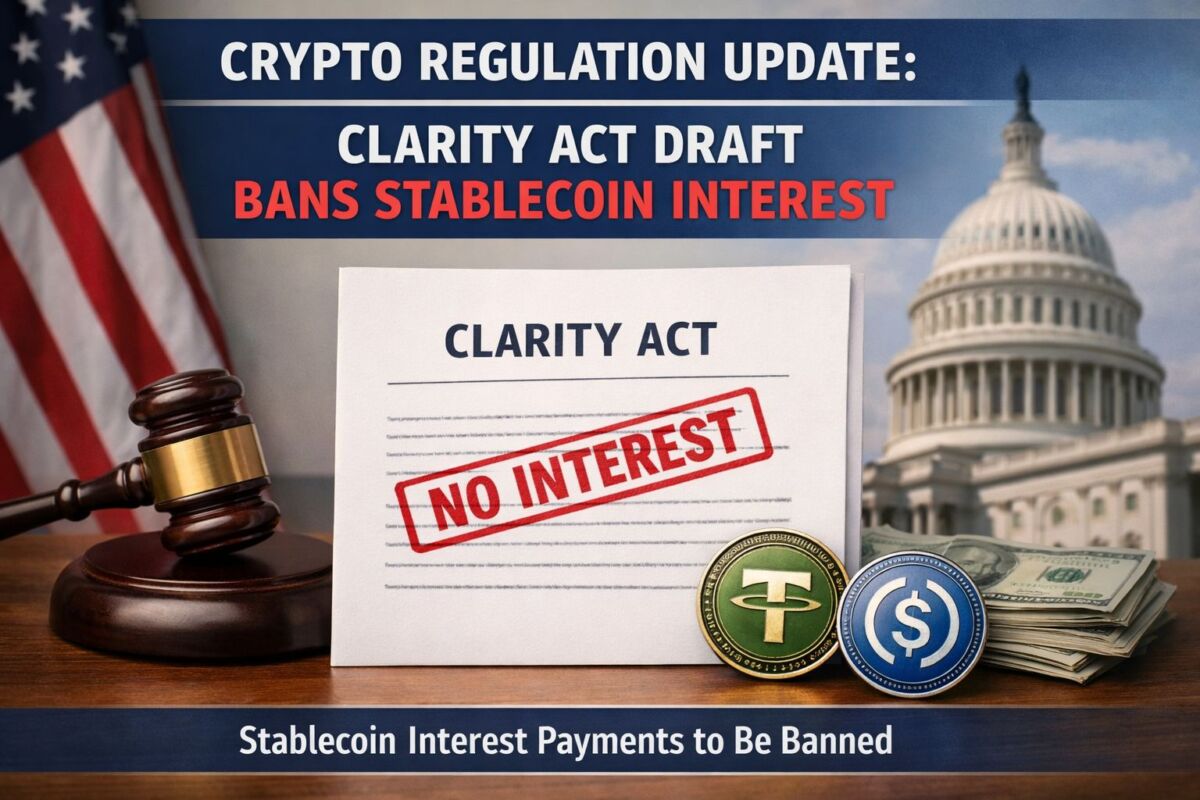
Separately, attention remains on the CLARITY Act, which is heading toward a Senate markup. Some market estimates put the bill’s passage odds at around 68%. If enacted, it could influence how certain tokens are categorized, with supporters arguing it may increase the likelihood that XRP is treated as a ‘digital commodity’ under a clearer regulatory regime.
Ripple’s long-running supply management program is also in view. The company continues to release 1 billion XRP from escrow each month—worth approximately $1.34 billion at current prices—while typically re-locking a large portion back into escrow. Supporters say the process is designed to be ‘supply-neutral’ for the open market and has been a core feature of Ripple’s distribution strategy since 2017.
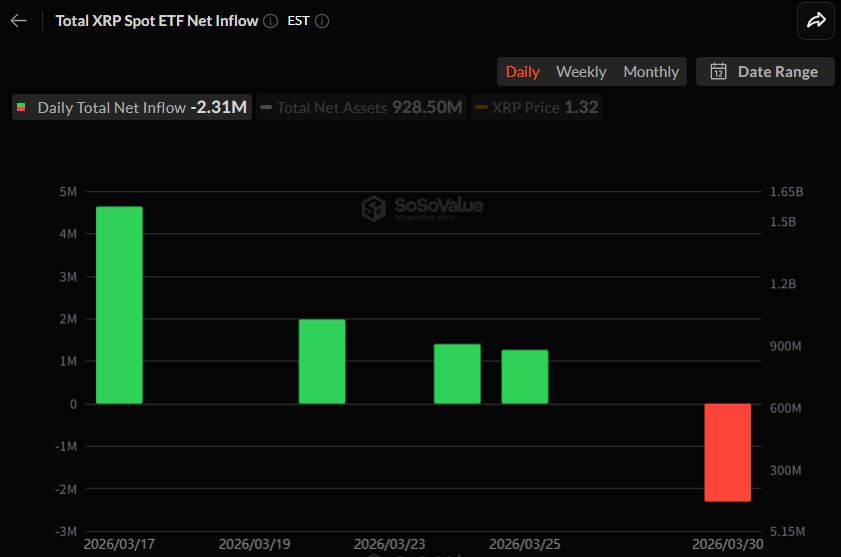
In the ETF market, XRP-linked exchange-traded funds recorded their first monthly net outflow since their late-2025 debut. Data cited in local reporting showed roughly $31 million in net outflows in March, a reversal that may reflect softer risk appetite for XRP exposure. The ProShares Ultra XRP ETF was last referenced around $7.63, while broader flow deceleration has been interpreted as cooling sentiment in the segment.
At the same time, exchange outflows of XRP have been viewed by some as a potential ‘spot scarcity’ signal, as withdrawals can indicate coins moving into longer-term storage rather than being held available for sale. For now, market participants appear focused on two near-term catalysts: whether Bitcoin can reclaim and hold key psychological levels, and how U.S. lawmakers proceed on crypto market structure legislation that could reshape the regulatory outlook for major tokens such as XRP.
🔎 Market Interpretation
- Price/Trend snapshot: XRP traded near $1.3364 (+0.95%), with short-term momentum indicators (MACD, CRSI, Alligator) flipping bullish after ~2 weeks of weakness—suggesting stabilization rather than a confirmed trend reversal.
- Momentum reset: Connors RSI (CRSI) rebounded from oversold to ~59.98, often read as improving buy pressure and reduced downside exhaustion.
- Key resistance band: Traders are watching the 20-day EMA (~$1.3808) as the first near-term ceiling; above that, Supertrend (~$1.5054) becomes the higher hurdle tied to a potential push toward $1.50–$1.62.
- Macro dependency: A decisive BTC break above $74,000 is framed as a potential “risk-on” trigger that could help XRP test higher resistance, but follow-through remains contingent on broader crypto direction.
- Flows vs. supply signals: XRP-linked ETFs saw their first monthly net outflow since late-2025 (about $31M in March), hinting at cooler demand; simultaneously, exchange outflows are interpreted by some as “spot scarcity” (coins moving to storage), creating a mixed sentiment backdrop.
💡 Strategic Points
- Technical roadmap for traders:
- Upside checkpoints: reclaim $1.3808 (20D EMA) → challenge $1.5054 (Supertrend) → potential test zone $1.50–$1.62 if momentum and market beta cooperate.
- Signal confirmation: bullish indicator flips are strongest when paired with breaks above resistance and sustained volume; otherwise they may represent a counter-trend bounce.
- Fundamental catalyst—enterprise treasury integration: Ripple launched a corporate treasury product integrating digital asset accounts into a single system for managing fiat + crypto liquidity. If adopted, this could expand XRP’s relevance in payments, settlement, and real-time liquidity workflows beyond speculative trading.
- GTreasury acquisition leverage: Ripple’s system builds on its 2025 GTreasury acquisition and Ripple’s payments rails (claimed $13T processed last year), positioning the offering as “crypto operationalization” rather than a siloed add-on.
- Regulatory optionality:
- OCC final rule: may broaden pathways for certain non-custodial activities at national trust banks—potentially supportive for crypto-native firms’ long-term positioning, though practical impact depends on supervisory interpretation and business model fit.
- CLARITY Act: moving toward Senate markup; some estimates place passage odds near 68%. If enacted, it could strengthen the case for clearer token classification—supporters argue it may increase the likelihood of XRP being treated as a digital commodity.
- Supply overhang monitoring: Ripple continues its long-running program of releasing 1B XRP/month from escrow (about $1.34B at current prices) while typically re-locking a substantial portion—market impact often hinges on how much ultimately reaches open markets and prevailing demand conditions.
- Near-term catalysts to watch: (1) BTC holding/reclaiming key psychological levels; (2) U.S. market-structure legislation progress and any guidance affecting XRP’s classification; (3) ETF flow direction vs. exchange outflow “scarcity” narratives.
📘 Glossary
- MACD (Moving Average Convergence Divergence): a momentum indicator showing the relationship between two moving averages; bullish signals often occur when the MACD line crosses above its signal line.
- Connors RSI (CRSI): a short-term mean-reversion oscillator combining RSI and price streak metrics; values rising from “oversold” can indicate bounce potential.
- Alligator Indicator: uses multiple smoothed moving averages (“jaw/teeth/lips”) to identify trend emergence and strength; “opening” alignment can suggest trend formation.
- 20-day EMA: an exponential moving average emphasizing recent prices; often used as near-term dynamic support/resistance.
- Supertrend: a volatility-based trend indicator that plots a trailing support/resistance line; price above it is typically treated as bullish.
- Resistance: a price zone where selling pressure historically increases, making upward moves harder to sustain.
- Escrow (XRP): locked XRP released on a schedule; Ripple may re-lock portions to manage circulating supply dynamics.
- Enterprise treasury system: corporate tools/processes for managing cash, liquidity, payments, and risk across entities and accounts.
- Non-custodial activities: services where a firm does not hold customer assets (e.g., certain payments/transaction facilitation models), typically reducing custody-related obligations but still subject to oversight.
- ETF net outflow/inflow: the net capital leaving/entering an ETF over a period; can proxy investor demand for exposure.
- Exchange outflows: net withdrawals from exchanges to private wallets/custody; often interpreted as reduced immediate sell supply (though not always bullish).
- Digital commodity (regulatory): a token classification concept implying commodity-like treatment under clearer market-structure rules, potentially affecting oversight, listings, and compliance.



















Comment 0