

 News
News  Coin Information
  About us
  Customer Service


 Add as a preferred source on Google
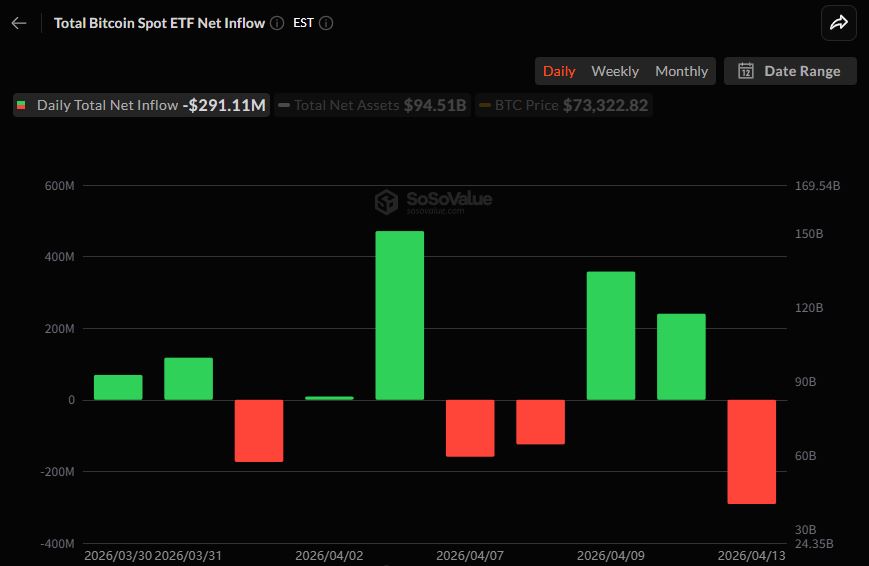
U.S. spot Bitcoin (BTC) ETFs swung back to net outflows on Monday, signaling renewed caution among investors after two sessions of inflows and highlighting persistent churn in some of the largest products—most notably Fidelity’s fund.
According to SoSoValue data for April 13 local time (April 13 ET), the U.S. spot Bitcoin ETF market recorded a daily net outflow of $291.11 million. The reversal comes after net inflows on April 9 ($358.17 million) and April 10 ($240.42 million), trimming cumulative net inflows to about $56.45 billion.
Flows were mixed across the 13 U.S.-listed spot Bitcoin ETFs. BlackRock’s iShares Bitcoin Trust ($IBIT) posted $34.70 million of net inflows, while Bitwise Bitcoin ETF ($BITB) added $11.88 million and Morgan Stanley’s MSBT ETF ($MSBT) gained $6.28 million. Those gains, however, were more than offset by heavy redemptions led by Fidelity Wise Origin Bitcoin Fund ($FBTC), which saw $229.22 million exit in a single day.
Additional net outflows were recorded in ARK 21Shares Bitcoin ETF ($ARKB) at $62.89 million, Grayscale Bitcoin Trust ($GBTC) at $38.25 million, Grayscale Bitcoin Mini Trust ($BTC) at $11.03 million, and VanEck Bitcoin Trust ($HODL) at $2.58 million. The remaining ETFs were effectively flat on the day.
Trading activity remained robust despite the net outflows. Total spot Bitcoin ETF turnover was $2.44 billion, led by $IBIT with $1.76 billion in volume. $FBTC followed with $300.38 million, while $GBTC saw $138.0 million.
Assets across the spot Bitcoin ETF complex stood at roughly $94.51 billion, representing about 6.45% of Bitcoin’s total market capitalization. By net assets, $IBIT remained the clear leader at $57.67 billion, followed by $FBTC at $13.60 billion and $GBTC at $11.24 billion.
Market participants generally view daily ETF flows as a high-frequency gauge of 'institutional demand' and risk positioning, particularly when outflows concentrate in a single large fund. Monday’s skew toward $FBTC redemptions suggests allocation shifts rather than an industry-wide exodus, but the return to net outflows underscores how quickly sentiment can flip as investors respond to macro signals, price volatility, and short-term positioning around Bitcoin’s spot market.
🔎 Market Interpretation
- ETF flow momentum flipped negative: U.S. spot Bitcoin ETFs recorded $291.11M in net outflows (Apr 13 ET), reversing the prior two inflow days ($358.17M and $240.42M).
- Outflows were concentrated—not broad-based: The day’s net redemption was dominated by Fidelity’s FBTC (-$229.22M), implying reallocation/rotation more than a systemic exit from the ETF category.
- Selective risk-on persisted in leaders: IBIT (+$34.70M), BITB (+$11.88M), and MSBT (+$6.28M) still attracted capital, showing investors are differentiating by issuer, liquidity, and positioning.
- High trading volume alongside withdrawals: Turnover remained strong at $2.44B (IBIT $1.76B), suggesting active repositioning and hedging rather than disengagement.
- Category scale remains significant: Total AUM near $94.51B (~6.45% of BTC market cap) indicates ETFs remain a major access channel even as daily sentiment swings.
💡 Strategic Points
- Watch concentration risk in daily flows: When net outflows are driven by one fund (e.g., FBTC), interpret it as portfolio shifts (provider switching, tax/fee optimization, liquidity preference) rather than market-wide “institutional selling.”
- Pair flows with volume for signal quality: Heavy volume plus outflows can indicate rotation/trading activity; low volume plus outflows can indicate risk-off liquidation. Here, strong volume supports a “repositioning” read.
- Track leader behavior as the tone-setter: Continued inflows into IBIT while others bleed can imply a flight to liquidity/brand within the ETF complex.
- Use multi-day smoothing: Single-day flow reversals are common; consider 3–10 day rolling net flows to reduce noise and better map demand trends.
- Monitor macro/volatility catalysts: The article notes sentiment can flip quickly with macro signals and BTC spot volatility—key for timing entries, sizing risk, and setting hedges.
- AUM ranking suggests structural stickiness: With IBIT ~$57.67B, FBTC ~$13.60B, GBTC ~$11.24B, larger funds may retain liquidity advantages even during volatile flow regimes.
📘 Glossary
- Spot Bitcoin ETF: An exchange-traded fund designed to track Bitcoin’s price by holding Bitcoin (or equivalent spot exposure) rather than futures contracts.
- Net inflow / net outflow: The day’s net capital moving into/out of an ETF, typically via creation/redemption activity in ETF shares.
- Redemption: Authorized participants return ETF shares to the issuer and receive underlying assets/cash, reducing shares outstanding—often seen as “outflow.”
- Turnover (trading volume): Total dollar value of ETF shares traded in a session; high turnover can reflect active trading even if net flows are negative.
- AUM (assets under management): Total value of assets held by the ETF(s); used to gauge product scale and liquidity depth.
- Institutional demand (flow proxy): Market shorthand for interpreting ETF creations/redemptions as positioning by larger pools of capital; it’s a signal, not a perfect measure.
- Rotation/Allocation shift: Rebalancing from one ETF/provider to another (or between BTC and other assets) without implying a bearish view on Bitcoin overall.























Comment 0