

 News
News  Coin Information
  About us
  Customer Service


 Add as a preferred source on Google
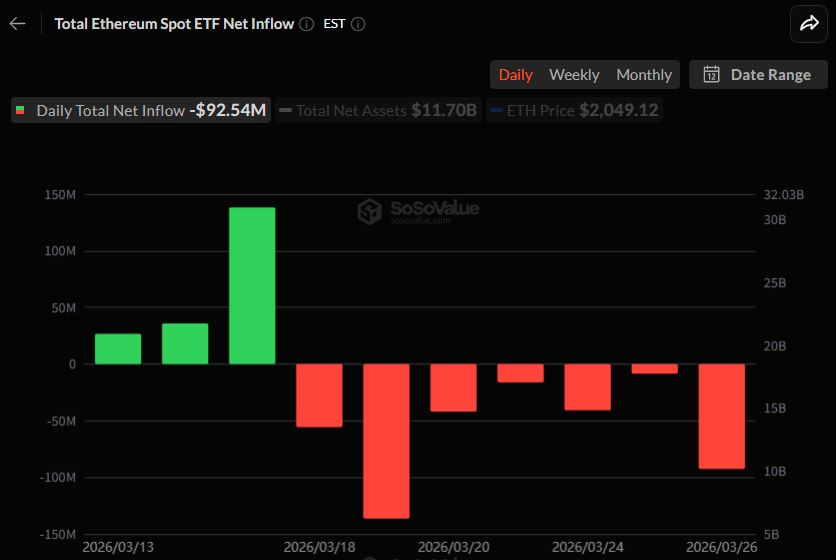
U.S. spot Ethereum (ETH) ETFs extended their streak of outflows to a seventh consecutive trading session on Wednesday ET, underscoring renewed selling pressure in the category even as trading activity remained robust.
According to data compiled by SosoValue, spot Ethereum ETFs posted a combined $92.54 million in net daily outflows on March 26 ET. The latest figure marks a sharp acceleration from the prior session’s $8.51 million in net redemptions, reinforcing the view that near-term allocation appetite has weakened since the outflow trend began on March 18 ET.
Despite the persistent redemptions, cumulative net inflows for the U.S. spot Ethereum ETF market were recorded at $11.57 billion, highlighting that the product set still retains a sizable base of longer-term inflows even as recent flows have turned decisively negative.
Flows were highly concentrated. Among the 10 listed funds, only BlackRock’s ETHB registered net inflows, adding $96.81 million. Outflows were led by BlackRock’s ETHA, which saw -$140.24 million in net redemptions. Other notable withdrawals included Fidelity’s FETH at -$23.95 million, Grayscale’s ETHE at -$13.83 million, Grayscale’s ETH at -$6.21 million, and Bitwise’s ETHW at -$5.12 million. The remaining ETFs were broadly flat on the day.
Trading volumes suggest investors are actively repositioning rather than simply stepping away. Aggregate turnover across spot Ethereum ETFs totaled $878.53 million on March 26 ET. BlackRock’s ETHA led activity with $605.32 million in value traded, followed by Fidelity’s FETH at $100.61 million and Grayscale’s ETH at $80.54 million.
In terms of assets, total net assets across the spot Ethereum ETF complex stood at about $11.7 billion, equivalent to roughly 4.70% of Ethereum’s total market capitalization. By fund size, BlackRock’s ETHA remained the largest vehicle with $6.27 billion in net assets, followed by Grayscale’s ETH at $1.77 billion and Grayscale’s ETHE at $1.74 billion.
The widening outflows following a brief period of smaller redemptions point to a cooling in near-term 'institutional demand' for ETH exposure through ETFs, even as liquidity and turnover remain concentrated in the largest products. Whether the streak extends further is likely to hinge on broader crypto market risk sentiment and Ethereum-specific catalysts that could re-ignite 'allocation flows' in the weeks ahead.
🔎 Market Interpretation
- Outflow streak extends: U.S. spot Ethereum ETFs recorded a 7th straight session of net outflows, with -$92.54M on March 26 ET—an acceleration from -$8.51M the prior day.
- Near-term demand softening: The sharp step-up in redemptions suggests weakening short-horizon appetite for ETH ETF exposure since the outflow trend began on March 18 ET.
- Longer-term picture still positive: Despite the recent drawdown, cumulative net inflows remain high at $11.57B, indicating a substantial installed base of earlier allocations.
- Flows concentrated in flagship products: Only BlackRock’s ETHB saw inflows (+$96.81M), while outflows were dominated by BlackRock’s ETHA (-$140.24M) alongside notable selling in Fidelity and Grayscale products.
- Repositioning, not retreat: Strong turnover ($878.53M) alongside redemptions implies active reallocations (rotations between funds, hedging, or risk reductions) rather than a collapse in trading participation.
- Market footprint remains meaningful: Total spot ETH ETF net assets are about $11.7B, roughly 4.70% of Ethereum’s market cap—large enough for flows to influence marginal price dynamics and sentiment.
💡 Strategic Points
- Watch ETHA as the key flow barometer: ETHA is both the largest fund ($6.27B AUM) and the biggest driver of daily flows and volume; sustained ETHA outflows often signal broader de-risking.
- Client/channel rotation signal: Simultaneous ETHB inflows and ETHA outflows may indicate internal reallocations across BlackRock products, fee/structure preferences, or different distribution channels—worth monitoring over multiple sessions.
- Liquidity remains concentrated: Trading activity is dominated by a few vehicles (ETHA $605.32M traded; FETH $100.61M; Grayscale’s ETH $80.54M), so execution and spreads are likely best in these products during volatile periods.
- Short-term catalysts matter: Continuation or reversal of outflows likely hinges on broader crypto risk sentiment and Ethereum-specific catalysts (network upgrades, L2 activity trends, regulatory headlines, or macro liquidity conditions).
- Interpreting “negative flows” correctly: Heavy volume with net outflows can reflect hedged positioning (e.g., long ETF vs. short futures unwinds), profit-taking after rallies, or duration shortening—not necessarily a bearish long-term thesis shift.
- Track “flat” funds for a tell: Broadly flat flows in the remaining ETFs suggests decision-making is concentrated among large allocators; a widening participation in outflows could indicate contagion in sentiment.
📘 Glossary
- Spot Ethereum ETF: An exchange-traded fund designed to track ETH price using direct ETH holdings rather than derivatives.
- Net inflow/outflow: The day’s creations (new shares issued) minus redemptions (shares removed). Negative values indicate more redemptions than creations.
- Redemptions: The process where authorized participants return ETF shares to the issuer in exchange for underlying assets/cash, shrinking fund assets.
- Cumulative net inflows: Total net creations since launch, aggregating daily net flows over time.
- Turnover / trading volume: Dollar value of ETF shares traded during the day; high turnover signals active trading interest regardless of net flows.
- Net assets (AUM): Total value of assets held by the ETF after accounting for inflows/outflows and market price changes.
- Allocation flows: Capital movements from investors allocating (buying) or de-allocating (selling) exposure via the ETF structure.
- Institutional demand: Buying interest attributed to professional investors (asset managers, funds, corporates) often reflected through ETF creations and sustained inflows.




















Comment 0