

 News
News  Coin Information
  About us
  Customer Service


 Add as a preferred source on Google
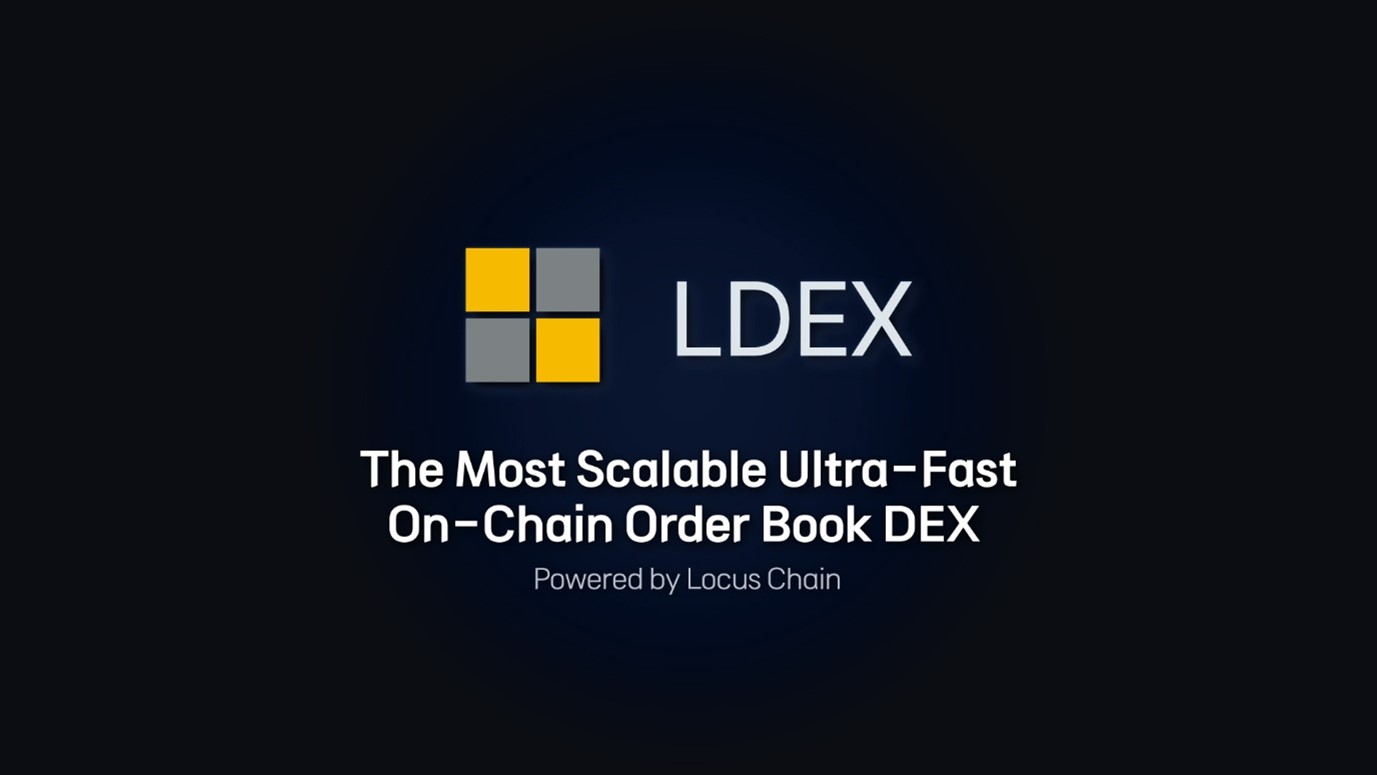
Bloom Technology, the developer behind the high-performance blockchain platform Locus Chain, has released a demo video of ‘LDEX,’ an orderbook-based decentralized exchange (DEX) it says is designed to deliver centralized-exchange speed without sacrificing decentralization. The company is positioning the project as a response to one of DeFi’s longest-running trade-offs: fast execution versus truly distributed infrastructure.
The demonstration, disclosed on Monday ET, was conducted in a test environment and showcased the core workflows required for orderbook trading—order submission and matching, real-time orderbook updates, position management, and transfers of test assets. The video also included cross-network asset movement between the Locus Chain core network and an Ethereum Virtual Machine (EVM) subchain, along with MetaMask wallet connectivity, reflecting a focus on interoperability with Ethereum-centered tooling.
DEX usage has accelerated as crypto traders increasingly seek to avoid depositing assets with centralized venues, where custody and operational risks can concentrate. Unlike most centralized exchanges (CEXs) and traditional brokerage trading systems—where the platform holds client funds and processes trades internally—DEXs typically allow users to trade directly from self-custodied wallets, with outcomes verified on-chain. That model can reduce the structural risk of exchange hacks or misuse of customer assets, while improving transparency of settlement and record keeping.
However, the DEX sector has historically struggled to replicate the ‘orderbook’ model that dominates equities and CEX crypto markets, largely because blockchains have not been able to handle the relentless cycle of creating, cancelling, modifying, and executing orders at very high frequency. As a result, much of DeFi liquidity has gravitated toward automated market makers (AMMs), which are less demanding from a throughput perspective but can introduce different trade-offs, including price impact and liquidity fragmentation.
Recent market history has shown that high-speed on-chain trading is possible. Hyperliquid’s growth—built on fast orderbook execution—has helped set a new bar for DEX usability and volume. Yet industry debate has intensified over whether some performance-first architectures rely too heavily on a small set of components, such as a single matching engine or tightly coordinated operator roles, potentially weakening ‘decentralization’ even as they improve user experience. In that context, next-generation DEX designs are increasingly judged not only on speed, but also on resilience, scalability, and distribution of control.
Bloom Technology says LDEX is intended to meet those requirements by leaning on Locus Chain’s base-layer performance rather than compromising decentralization to achieve low latency. According to the company, Locus Chain combines features such as dynamic sharding, directed acyclic graph (DAG)-based parallel processing, Byzantine fault tolerant (BFT) consensus, and ‘verifiable pruning’—a method aimed at reducing the amount of data verification nodes must store while preserving integrity of transaction validation.
In Bloom Technology’s framing, dynamic sharding is designed to expand capacity as load increases, while DAG parallelism enables high levels of concurrency—an approach the firm says can support tens to hundreds of thousands of transactions per second in demanding environments. It also claims an additional “multi-layer dynamic sharding” system could extend validation and processing capacity further, targeting future large-scale usage scenarios.
The company argues that ‘verifiable pruning’ is central to maintaining decentralization at scale, because it reduces storage requirements and operating costs enough that verification nodes could be run on consumer-grade PCs and even mobile devices. Lower hardware barriers, in theory, broaden participation and reduce dependence on a narrow set of high-resource operators—an issue that has become increasingly important as DEX platforms compete to prove they are not merely fast, but also credibly neutral and robust.
Bloom Technology said internal performance tests showed LDEX reaching up to three times the order-processing and execution speed of existing high-performance DEX systems, while maintaining consistent responsiveness under sharp spikes in activity. The company did not provide third-party benchmarks or detailed methodology in the announcement, but emphasized that the project is being built as infrastructure for sustained high-throughput trading rather than a one-off proof of concept.
Beyond exchange functionality, the firm described LDEX as a validation environment for applying Locus Chain technology to real-time, data-intensive services. Bloom Technology said it plans to broaden the scope toward finance, gaming, real-world assets (RWA), and digital payments—sectors where low-latency settlement and large-scale transaction processing are increasingly viewed as prerequisites for mainstream Web3 adoption.
“LDEX is not just about implementing the functions of a decentralized trading platform—it’s a project to demonstrate how Locus Chain’s blockchain technology can be applied to real-time order processing and a range of industrial services,” a Bloom Technology representative said in a statement. The company added that it aims to combine the convenience of conventional exchanges with the transparency and security of decentralized systems, positioning LDEX as a candidate ‘next-generation’ trading infrastructure for the global Web3 financial ecosystem.





















Comment 0