

 News
News  Coin Information
  About us
  Customer Service



Geopolitical risk in the Middle East and shifting regulatory and on-chain signals in the crypto market collided in a busy Tuesday, as Iran’s Islamic Revolutionary Guard Corps (IRGC) announced an immediate closure of the Strait of Hormuz—an energy chokepoint with global inflation implications—while U.S. lawmakers moved toward a key vote on a sweeping digital asset framework.
According to PANews, citing a report from Jinse, the IRGC Navy said early Tuesday UTC that it is “immediately” blocking the Strait of Hormuz and banning passage for “all vessels.” The IRGC warned that any foreign interference in Hormuz-related matters or attempts to unilaterally set shipping routes would trigger a forceful response from Iran. The statement added that the blockade would remain in place until further notice and until the U.S. halts regional intervention.
The IRGC claimed that in the hours before the announcement, several ships attempted to transit without Iranian authorization. One vessel allegedly disabled its Automatic Identification System (AIS) and stopped only after Iranian warning shots. The IRGC also warned that if the U.S. uses the episode as grounds to attack Iran, it would respond by striking additional U.S. military bases across the Middle East.
The Strait of Hormuz is a critical artery for seaborne shipments of Middle Eastern crude oil and liquefied natural gas. Any sustained disruption tends to ripple quickly into energy prices and risk assets, as markets reprice inflation expectations, growth forecasts, and the likelihood of tighter financial conditions. For crypto, heightened geopolitical stress can produce two-way volatility: short-term de-risking and liquidity tightening on one hand, and selective demand for non-sovereign assets on the other, depending on funding conditions and dollar strength.
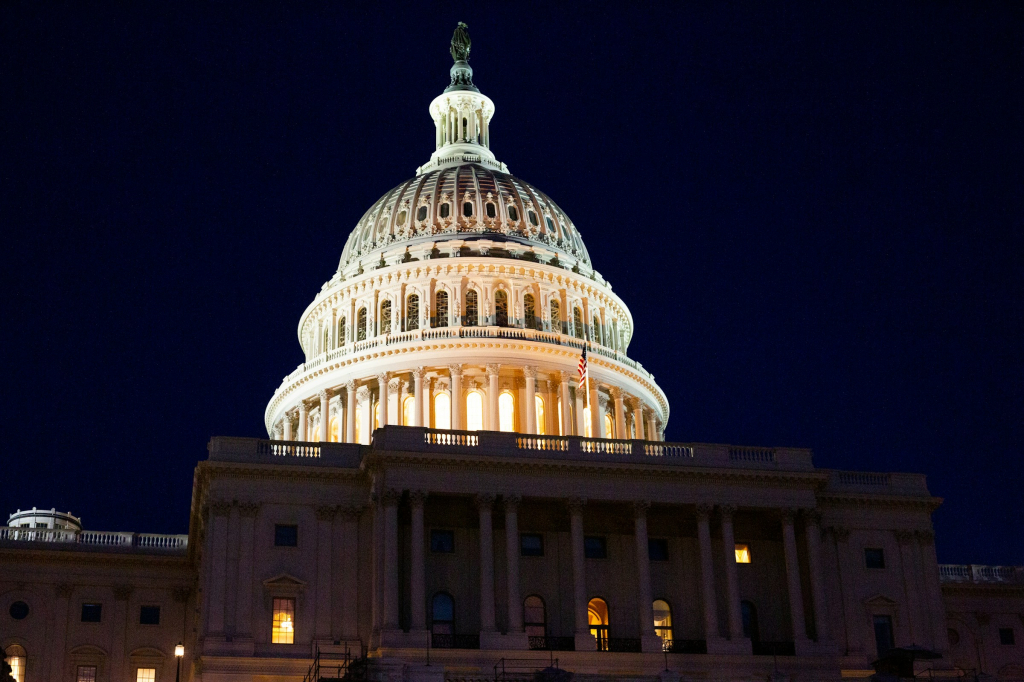
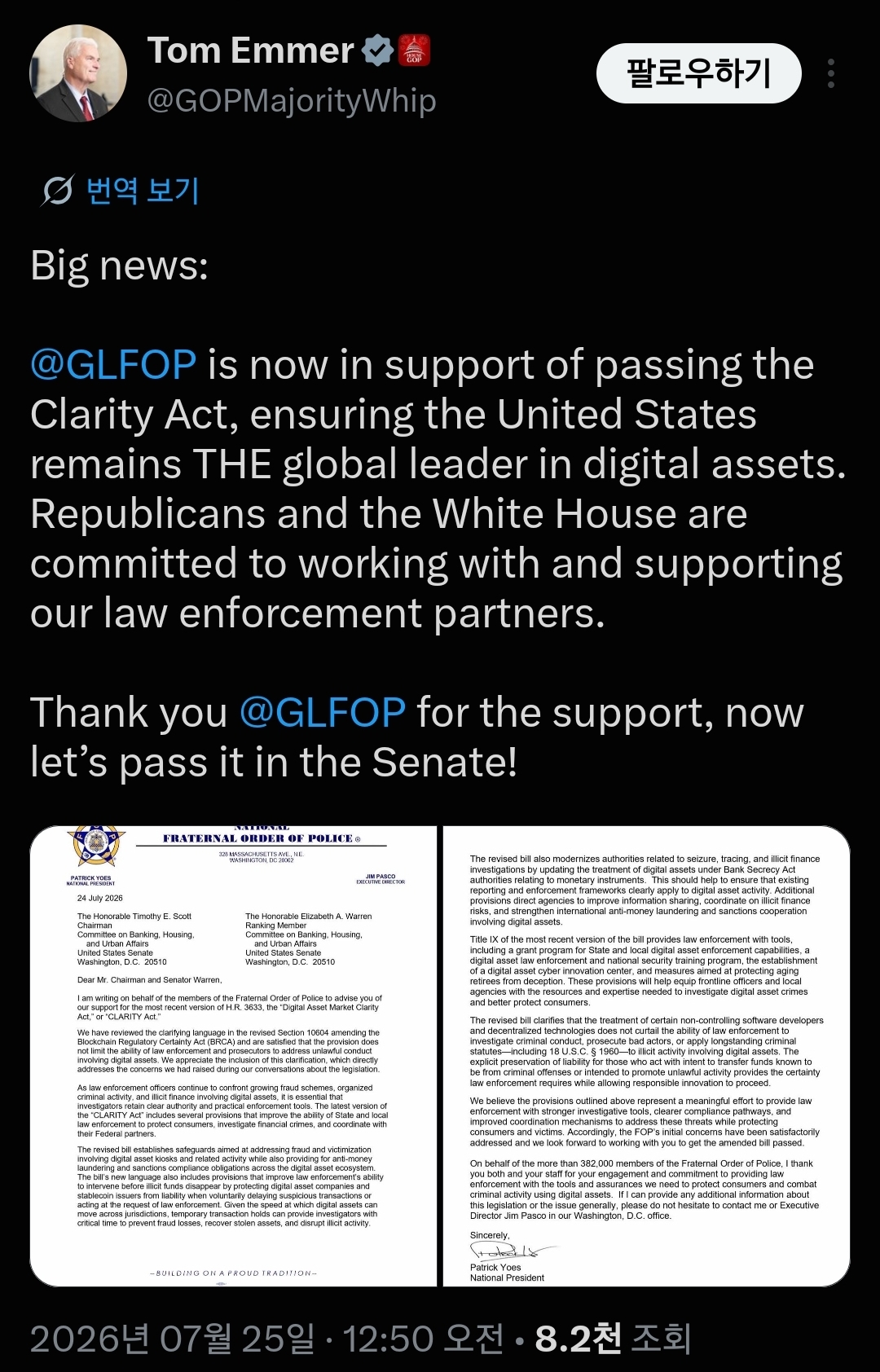
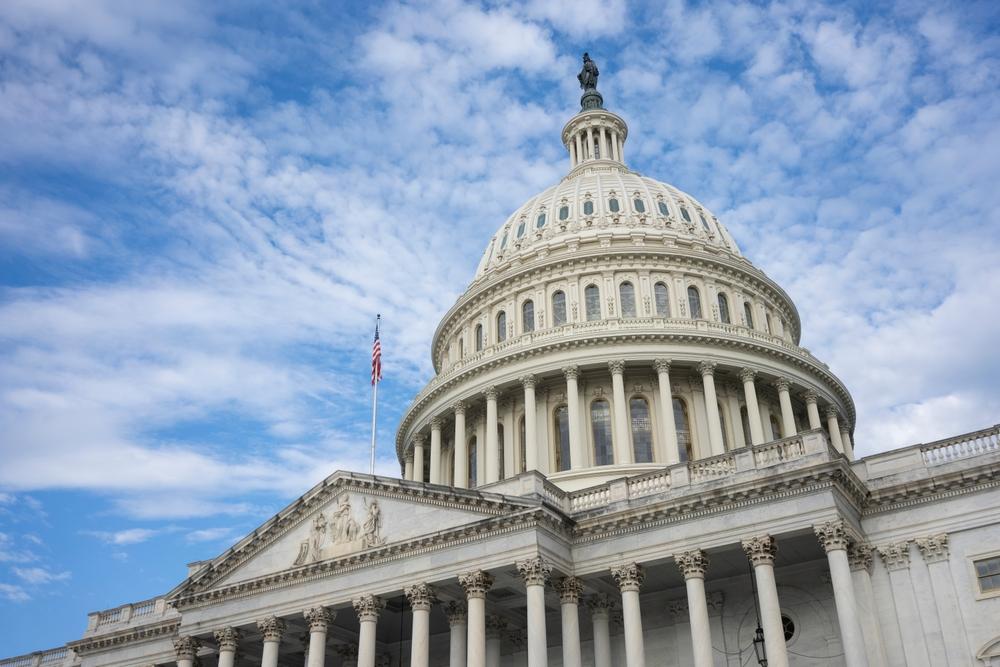
In Washington, U.S. Senate Republican leadership is aiming to bring the ‘CLARITY Act’—a flagship digital asset market structure bill—to the Senate floor on July 20, The Block’s Korean-language partner outlets reported, citing Odaily. The timing matters because if negotiations slip past the August recess, the legislative calendar ahead of the midterm election season could narrow significantly, reducing the odds of major crypto legislation advancing this year.
However, the bill’s pathway remains uncertain. Bipartisan talks are still stuck on key issues including ethics rules for government officials and provisions aimed at curbing illicit finance, according to the report. While Republican leaders are pushing to proceed, passage would still require support from at least seven Democratic senators.
Related sentiment has begun to shift in prediction markets. Kalshi reportedly moved the implied probability of a “Bitcoin and crypto clarity” bill becoming law before the August recess up to 50%. Commentator Pete Rizzo wrote on X that lawmakers want to “finish this” to lock in certainty around consumer protections—suggesting negotiations may be moving into a final stretch even if the hardest compromises remain unresolved.
Beyond the U.S., enforcement and compliance headlines underscored regulators’ continued focus on financial crime. Turkish prosecutors indicted an alleged money-laundering network accused of concealing illicit proceeds through shell companies, bank accounts, exchange offices, POS terminals, and crypto transactions, according to PANews citing Hürriyet Daily News. The indictment reportedly covers 504 suspects and alleges laundering activity amounting to roughly 40 billion Turkish lira (about $850 million). Prosecutors are seeking sentences of up to 34.5 years for the alleged ringleader Türker Ak and up to 31 years for suspected manager Murat Dönmezoğlu, the report said.
Institutional research also continued to frame tokenization as a multi-year structural trend. In a July 9 report, Grayscale said stock tokenization is likely to evolve in three phases and that Ethereum (ETH), Solana (SOL), BNB Chain, Avalanche (AVAX), and Canton Network could be among the biggest beneficiaries of changing ownership infrastructure.
Grayscale noted that more than 70% of today’s tokenized-stock market capitalization uses third-party ‘wrapping’ structures, where traditional shares are placed into an SPV and investors receive tokens representing claims on that vehicle rather than direct equity ownership. These wrapped assets are already being deployed across Ethereum, Solana, and BNB Chain and can be integrated into decentralized finance applications for trading and collateral use.
The second phase in Grayscale’s framework centers on market infrastructure pilots, including initiatives linked to DTCC’s tokenization experiments—where the firm expects Canton Network to be used as the first blockchain in the program. The third phase would involve issuers directly minting securities on-chain. Grayscale pointed to Securitize as an early example, noting the firm tokenized its common stock in conjunction with a New York Stock Exchange listing process. Over the next few years, the report projected that wrapped tokens, DTCC-linked entitlements models, and issuer-led tokenization could coexist rather than quickly replacing one another.
Meanwhile, Singapore authorities highlighted the growing role of exchange partnerships in disrupting scams. PANews cited Bitcoin.com as reporting that Singapore Police Force worked with seven crypto exchanges, including Coinbase, over a six-week operation that identified more than 145 potential victims and prevented losses exceeding $4.2 million. The operation ran from April 16 to May 31, 2026, involving the Anti-Scam Centre and Cybercrime Command, and used Chainalysis and TRM Labs tooling to trace transactions tied to impersonation schemes, investment fraud, job scams, and romance scams. Police said they used the findings to flag users at risk of crypto transfers and, in coordination with exchanges, connect suspicious activity to reachable customers.
Corporate treasury behavior also sent mixed signals. Odaily reported that Bitcoin-holding firm Emperi Digital sold 1,400 Bitcoin (BTC) over the last two months at an average price of $62,200, raising roughly $87.1 million. The company said proceeds were used for AI data center investments and debt repayment— including a 25% stake purchase in an AI data center project and $10 million applied to outstanding liabilities. Emperi Digital’s BTC holdings fell 48% to 1,514 BTC, valued at about $97 million at current prices. The company’s stock Emperi Digital ($EMPD) rose as much as 4.2% early in the session before closing up 1.58%.
On-chain flows, often read as a proxy for investor intent, drew attention as Lookonchain reported that a whale address beginning with 0x2684 withdrew 49,407 ETH and 250 WBTC from Binance starting June 30. The move totals roughly $99.86 million—about $84.3 million in ETH and $15.66 million in WBTC. Large transfers from exchanges to self-custody are frequently interpreted as a potential reduction in near-term sell pressure, though they can also precede OTC activity or collateral repositioning.
Separate exchange flow data suggested stress at one venue and strength at another. Wu Blockchain, citing DeFiLlama, said Gate recorded net outflows of about $207 million over the past seven days following a user theft incident, ranking second among centralized exchanges. Over the same window, Binance reportedly led with net inflows of roughly $308 million. Wu Blockchain added that delisting policies in the European Union have contributed to notable outflows from Binance and Bybit over the past month, reflecting the market impact of compliance-driven product changes.
Finally, Whale Alert flagged a major stablecoin transfer: 190.9 million USDC moved from Aave to an unidentified whale wallet. The beneficiary and purpose were not immediately known, but such large USDC movements often reflect ‘liquidity rotation’—including OTC settlement, exchange funding, or preparations for leveraged positioning—rather than a directional bet by itself.
Taken together, the day’s headlines reinforced a familiar crypto market dynamic: macro shocks can reprice risk quickly, while legislation, enforcement, and infrastructure upgrades shape the medium-term path for adoption and capital formation. Traders are now watching whether Middle East tensions escalate into sustained energy disruption, and whether Washington can convert rising ‘regulatory clarity’ momentum into a bill that can pass both chambers before the clock runs down.














Comment 0