

 News
News  Coin Information
  About us
  Customer Service


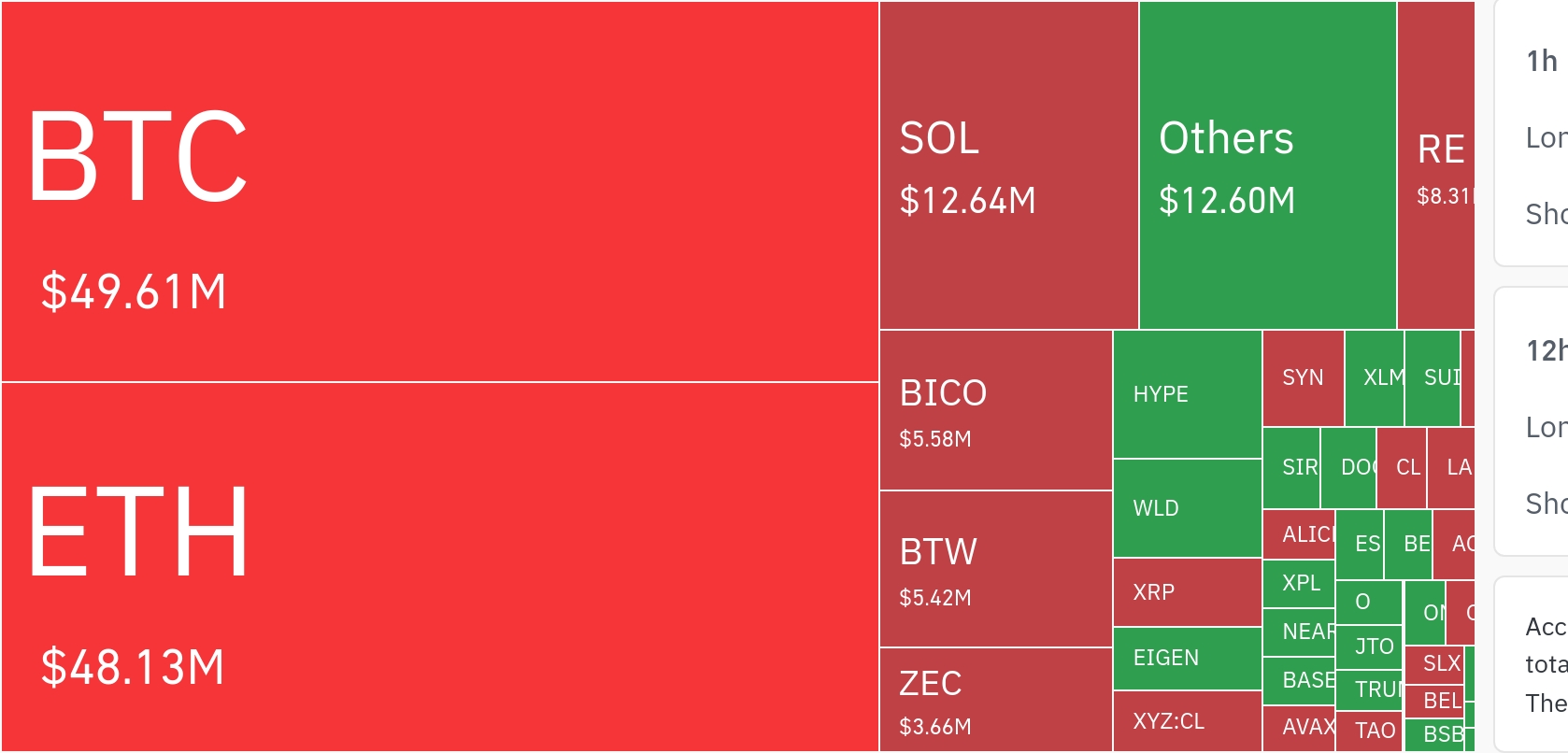
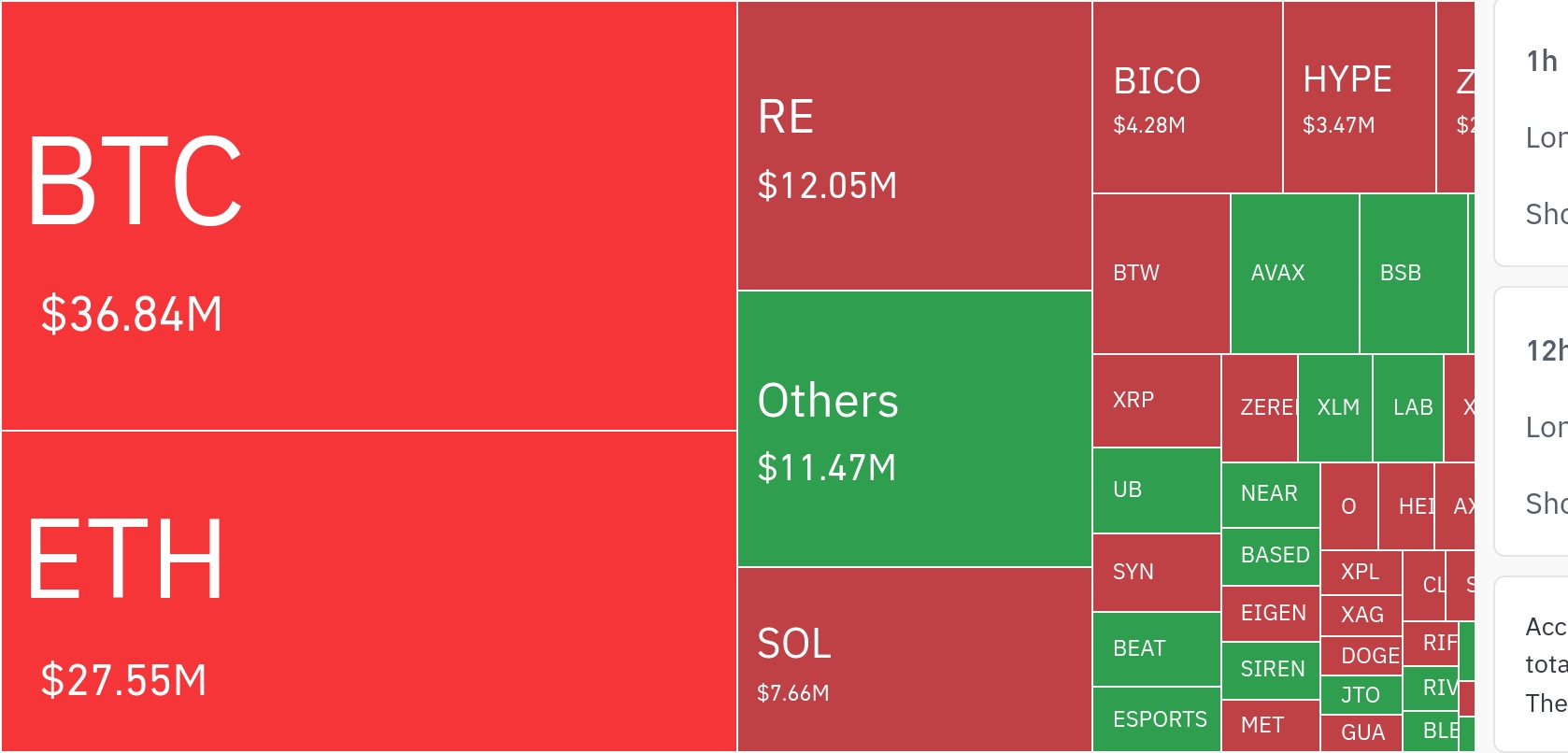
Roughly $128.57 million in leveraged cryptocurrency positions were liquidated over the past 24 hours, underlining a fresh bout of volatility that has punished traders positioned for upside.
Data compiled by CoinGlass shows liquidations were skewed heavily toward bullish bets: long positions accounted for $88.73 million, or 68.9% of total liquidations, while short liquidations came in at $39.96 million, or 31.1%. The imbalance suggests a rapid downside move or sharp intraday whipsaw that caught overcrowded longs off guard, forcing exchanges to close positions as margin requirements were breached.
On a shorter time horizon, CoinGlass’ four-hour exchange breakdown points to liquidation pressure concentrating on major venues. Binance led with $7.46 million in liquidations—49.72% of the total recorded in that window—with longs representing $3.99 million (53.46%). OKX followed with $2.08 million (13.88%), where long liquidations dominated at $1.66 million (79.87%). Bybit recorded approximately $2.02 million (13.5%), notably with shorts making up 54.66% of its liquidations, suggesting exchange-level positioning and order flow differed meaningfully across platforms.
By asset, Bitcoin (BTC) and Ethereum (ETH) drove the bulk of forced unwind activity. BTC-linked positions saw about $49.61 million liquidated over 24 hours, while ETH accounted for roughly $48.13 million—together representing the majority of the day’s total. Solana (SOL) contributed around $12.64 million in liquidations, while Zcash (ZEC) saw $3.66 million.
ZEC drew particular attention because liquidations occurred even as the token rose 5.7%, a pattern often associated with choppy, two-sided markets where rapid spikes and pullbacks can trigger both long and short margin calls. Such behavior is more typical in thinner altcoin order books, where abrupt price swings can cascade through leveraged positioning.
In crypto derivatives markets, a 'liquidation' occurs when an exchange forcibly closes a trader’s leveraged position after collateral falls below required maintenance levels. While liquidations can accelerate price moves in the moment, they also tend to reduce excess leverage, sometimes easing short-term instability once the forced selling or buying wave subsides.
Overall, the long-heavy wipeout suggests that optimism had become concentrated in leverage, and the latest move reset positioning across major venues. With BTC and ETH still commanding the majority of liquidation volumes, broader market direction remains closely tied to how quickly derivatives traders rebuild risk—especially as volatility continues to ripple into higher-beta altcoins.
🔎 Market Interpretation
- $128.57M in liquidations in 24 hours signals a volatility spike that primarily punished traders positioned for upside.
- Longs were disproportionately hit: $88.73M (68.9%) vs. shorts $39.96M (31.1%), consistent with a fast downside move or sharp whipsaw that trapped crowded long positioning.
- Exchange-level flow diverged over the last 4 hours: Binance led liquidations ($7.46M; ~49.72% share) with slightly long-tilted pressure, OKX showed strongly long-dominant liquidations (79.87% longs), while Bybit skewed to short liquidations (54.66%), implying different positioning or client mix across venues.
- BTC and ETH dominated the forced unwinds (BTC ~$49.61M; ETH ~$48.13M), indicating that broader market risk is still concentrated in majors rather than purely altcoin-driven leverage.
- ZEC liquidation despite +5.7% price move suggests a two-sided, choppy market where rapid spikes and pullbacks triggered both sides—often seen in thinner order books with higher slippage and cascade risk.
💡 Strategic Points
- Positioning takeaway: A long-heavy liquidation event often resets bullish leverage and can temporarily reduce one-directional overcrowding—watch whether long open interest rebuilds quickly (risk of repeat flush) or stays muted (stabilization).
- Volatility management: In whipsaw conditions, tighter leverage, wider liquidation buffers, and smaller position sizing can lower the probability of forced closure during intraday spikes.
- Venue selection matters: The differing long/short liquidation mix (e.g., Bybit vs. OKX) implies that liquidity, user positioning, and liquidation engines can create different risk profiles across exchanges.
- Majors as the market “risk barometer”: With BTC/ETH responsible for most liquidations, near-term directional clues likely come from their derivatives metrics (open interest changes, funding trends), with alts reacting as higher-beta followers.
- Altcoin caution: Assets like ZEC and SOL can experience liquidation cascades even without a clean trend; traders should account for thinner liquidity, larger wicks, and faster margin swings.
📘 Glossary
- Liquidation: Forced closure of a leveraged position by an exchange when collateral falls below maintenance margin requirements.
- Long / Short: A long position profits from price increases; a short position profits from price declines.
- Leveraged position: A trade that borrows funds to amplify exposure, increasing both potential gains and losses.
- Maintenance margin: The minimum collateral required to keep a leveraged position open; falling below it triggers liquidation.
- Whipsaw: Rapid back-and-forth price movement that can trigger stop-outs and liquidations on both sides.
- Order book depth: The amount of buy/sell liquidity at various prices; thinner depth can cause larger price jumps and slippage.
- Open interest (OI): The total number/value of outstanding derivative contracts; rising OI can indicate leverage building.
- Funding rate: Periodic payments between longs and shorts in perpetual futures, often used as a crowding/positioning signal.












Comment 0