

 News
News  Coin Information
  About us
  Customer Service


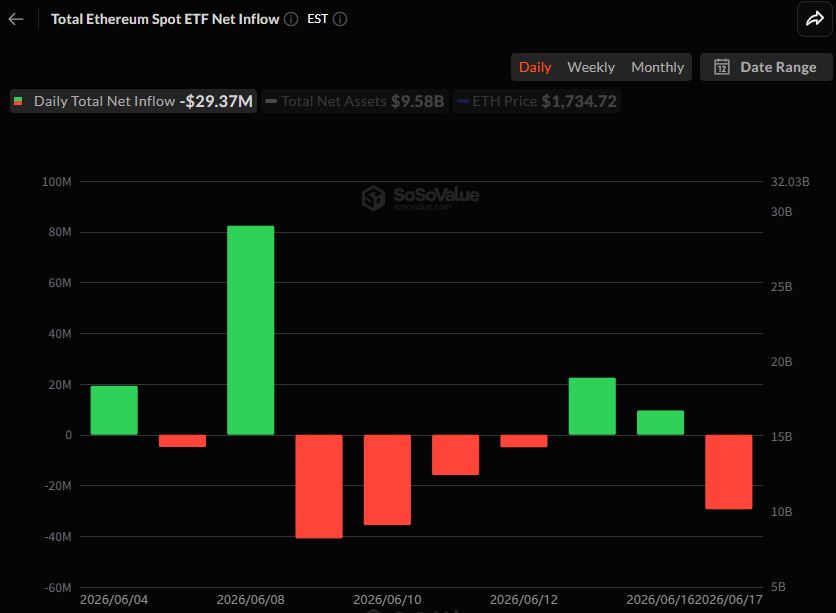
U.S. spot Ethereum (ETH) exchange-traded funds swung back to net outflows on Tuesday, reversing course after two straight sessions of inflows and underscoring how quickly demand can shift in crypto-linked products.
Data compiled by SoSoValue showed spot Ethereum ETFs posted a combined $29.37 million in daily net outflows on June 17 (U.S. Eastern Time). Despite the day’s pullback, cumulative net inflows across the category remained sizable at $11.19 billion.
Outflows were broad-based across most of the 10 listed products. Grayscale Ethereum Trust ($ETH) led the day’s redemptions with -$9.89 million, followed by BlackRock iShares Ethereum Trust ($ETHA) at -$8.97 million and Fidelity Ethereum Fund ($FETH) at -$4.34 million. Additional net outflows were recorded in 21Shares Core Ethereum ETF ($CETH) at -$2.79 million, Grayscale Ethereum Trust ($ETHE) at -$2.24 million, VanEck Ethereum ETF ($ETHV) at -$0.64 million, and Bitwise Ethereum ETF ($ETHW) at -$0.50 million. The remaining funds were flat on the day.
Trading activity remained concentrated in the largest vehicles, with total daily turnover across spot Ethereum ETFs reaching $504.61 million. BlackRock’s $ETHA accounted for the bulk of that volume at $408.57 million, followed by Grayscale’s $ETH at $46.71 million and Fidelity’s $FETH at $33.27 million.
Collectively, the spot Ethereum ETF market held $9.58 billion in net assets, representing roughly 4.54% of Ethereum’s total market capitalization, according to the dataset. By net assets, the largest funds were BlackRock’s $ETHA at $5.0 billion, Grayscale’s $ETH at $1.51 billion, and Grayscale’s $ETHE at $1.35 billion.
The return to net outflows after a brief inflow streak highlights the sector’s sensitivity to near-term positioning and macro-driven risk appetite. For market participants, the day’s figures suggest that while ETF ownership continues to deepen Ethereum’s institutional footprint, demand remains episodic rather than linear—an important signal as investors gauge whether recent participation reflects durable allocation or shorter-term trading flows.














Comment 0