

 News
News  Coin Information
  About us
  Customer Service


Crypto options traders leaned bullish on Ethereum (ETH) and Solana (SOL) into Thursday’s expiry, while positioning around XRP (XRP) skewed defensively—signaling a market that still expects upside but is increasingly alert to downside shocks.
As of Thursday 12:00 a.m. ET (4:00 a.m. UTC), derivatives data from Deribit, the largest crypto options venue by volume, showed expiring open interest of 151,035 contracts for Ethereum (about $330.66 million notional), 9,694 contracts for Solana (about $8.07 million), and 3,898 contracts for XRP (about $5.23 million). The open-interest put/call ratios stood at 0.77 for ETH, 0.66 for SOL, and 1.22 for XRP—indicating call-heavy positioning for ETH and SOL, but a clear put tilt in XRP.
On ETH, the 0.77 put/call ratio suggested a continued preference for upside exposure, consistent with expectations of a gradual recovery. However, the presence of notable put interest alongside call accumulation pointed to hedging demand—traders appear to be keeping protection in place even while leaning positive.
Solana’s 0.66 ratio reflected an even stronger call bias, implying relatively firmer sentiment around near-term upside. At the same time, the distribution of strike interest suggested that investors remain focused on defending key support zones rather than simply chasing higher strikes.
XRP stood out. With a 1.22 put/call ratio on open interest, options positioning implied heightened concern over downside risk. The skew suggests XRP participants are either actively hedging spot exposure or speculating on a pullback, even as the broader altcoin complex shows pockets of optimism.
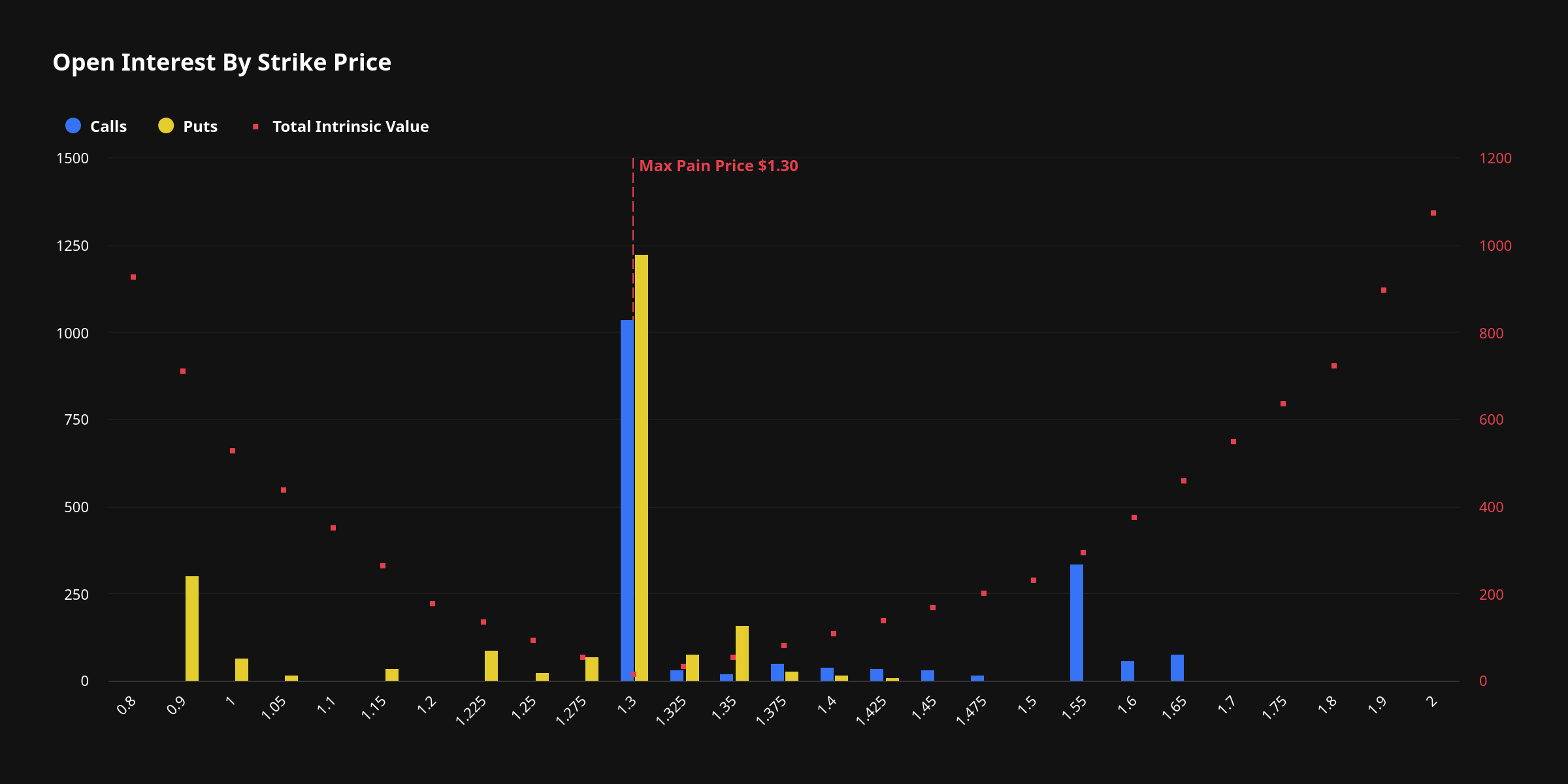
Deribit’s ‘max pain’ levels—prices at which option buyers collectively experience the largest losses at expiry—were estimated at $2,050 for Ethereum, $80 for Solana, and $1.30 for XRP. Max pain is closely watched because it can coincide with price ‘pinning’ near expiry when hedging flows intensify, though it is not deterministic and can be overwhelmed by broader market catalysts.
Strike-level positioning underscored the same divergence. Ethereum showed concentrated call interest around $2,050 and $2,300, consistent with expectations for an upside grind or rebound attempts, while a sizable pocket of puts at $2,000 signaled demand to defend a near-term floor. Solana displayed heavy put concentration around $76 and $80—levels that traders appear to be treating as a support band—while call positioning around $84 pointed to room for a tactical bounce. In XRP, both puts and calls clustered around $1.30, suggesting a contested battleground price, with additional call interest at $1.55 hinting at some residual rebound bets despite the broader defensive tilt.
Short-dated flow over the past 24 hours reinforced the risk-aware tone. Total options volume reached 104,049 contracts for Ethereum, 24,690 for Solana, and 1,499,000 for XRP. Put/call ratios based on trading volume were 1.06 for ETH and 1.03 for SOL—near neutral but slightly put-heavy—while XRP printed a markedly elevated 2.08, indicating outsized demand for downside exposure in recent trading.
The most actively traded contracts reflected tactical positioning around immediate expiries and nearby strikes. In ETH, flows concentrated in multiple April 10 expiries, including call strikes around $2,250–$2,300 and puts around $2,100, while longer-dated interest also appeared at the $2,000 put for September. Solana’s activity was led by puts near $80 for April expiries, alongside calls at $84 and $90, with some longer-dated upside interest extending to $160 calls for late June. XRP’s top volume clustered around puts between roughly $1.20 and $1.45 across April and May expiries, while a June $2.50 call also ranked among the most traded—an illustration of how hedging and high-upside positioning can coexist in the same book.
Spot prices were relatively steady at the time of the snapshot. According to TokenPost Market data at Thursday 12:05 a.m. ET (4:05 a.m. UTC), Ethereum traded at $2,188, down 0.06% on the day; Solana rose 0.84% to $83.25; and XRP was up 0.19% at $1.344.
Overall, the options market painted a nuanced picture: optimism remains more visible in ETH and SOL through call-heavy open interest, but short-term trading has shifted toward protection. XRP, meanwhile, showed the clearest signs of defensive positioning, with both open interest and recent volume signaling stronger ‘downside hedging’ demand ahead of expiry.
🔎 Market Interpretation
- Positioning split by asset: ETH and SOL open interest is call-heavy (bullish tilt), while XRP shows a put-heavy skew (defensive tilt), implying the market expects upside in majors but is increasingly pricing downside shocks in certain alts.
- Open interest put/call ratios (sentiment via held positions): ETH 0.77 and SOL 0.66 suggest preference for upside exposure; XRP 1.22 signals stronger downside protection or bearish speculation.
- Volume put/call ratios (sentiment via recent trading): ETH 1.06 and SOL 1.03 are slightly put-heavy (more hedging in short-dated flow), while XRP at 2.08 shows an outsized rush for downside exposure into expiry.
- Max pain watch: Estimated max-pain levels—ETH $2,050, SOL $80, XRP $1.30—could act as near-expiry “pin” magnets due to hedging flows, though macro/news catalysts can override.
- Key strikes reveal battlefield levels:
- ETH: calls clustered at $2,050 and $2,300; notable puts at $2,000 (near-term floor defense).
- SOL: puts concentrated at $76–$80 (support band); calls around $84 (bounce targeting).
- XRP: heavy clustering at $1.30 on both sides (contested level) with additional call interest at $1.55 (residual rebound bets despite defensive skew).
- Spot vs positioning snapshot: Prices were steady (ETH ~$2,188; SOL ~$83.25; XRP ~$1.344), suggesting options flows are more about risk management into expiry than chasing immediate spot momentum.
💡 Strategic Points
- ETH: “Bullish with insurance.” Call-heavy open interest points to an upside bias, but slightly put-heavy short-dated volume implies traders are adding protection into expiry. Watching $2,050 (max pain / key OI) and $2,000 (put floor).
- SOL: Support-defense strategy dominates. Strong call bias in OI, but strike distribution shows focus on defending $76–$80 rather than pure upside chasing; near-term tactical upside clusters around $84–$90.
- XRP: Highest downside alert. Put-heavy OI and very put-heavy volume indicate active hedging or pullback bets. The market is treating $1.30 as a pivotal level; further downside interest shows traders preparing for volatility around expiry.
- Expiry dynamics: If spot drifts toward max-pain levels, it may reflect hedging “pinning” flows; a sharp move away can trigger gamma-driven acceleration as dealers adjust hedges.
- Mixed books are normal: XRP’s simultaneous heavy put activity and occasional high-upside calls (e.g., longer-dated) highlights how traders can hedge downside while keeping convex upside exposure.
📘 Glossary
- Options Open Interest (OI): The number of outstanding option contracts that remain open (not closed/expired). High OI at a strike can amplify its importance near expiry.
- Put/Call Ratio: Puts divided by calls. < 1 typically implies call-heavy (more upside positioning); > 1 implies put-heavy (more downside hedging/bearish positioning).
- Notional Value: The dollar value represented by contracts (often option contracts × underlying reference price), used to compare the scale of positioning.
- Max Pain: A theoretical price level where option buyers collectively lose the most at expiration; sometimes associated with price “pinning,” but it is not a reliable predictor.
- Strike Price: The price at which an option can be exercised (buy/sell the underlying). Clusters of strikes often mark perceived resistance/support.
- Expiry (Expiration): The date/time an option contract settles or becomes invalid, often increasing short-term hedging flows and volatility.
- Hedging: Using options (often puts) to reduce downside risk in a spot or leveraged position.
- Price Pinning: A tendency for spot to gravitate toward certain strikes near expiry due to hedging flows from market makers and large positioning.



















Comment 0