

 News
News  Coin Information
  About us
  Customer Service



XRP is showing early signs of breaking a five-month downtrend, aided by a modest March rebound and a string of institutional integration headlines that could strengthen its medium-term fundamentals even as broader crypto markets remain highly sensitive to geopolitical risk.
As of March 25, 2026 (ET), XRP was changing hands around $1.419, up roughly 3% month-to-date. The move follows back-to-back monthly declines of about 10.6% in January and 16.2% in February, a stretch that had weighed on sentiment and placed XRP among the large-cap tokens struggling to regain traction amid persistent volatility across the sector.
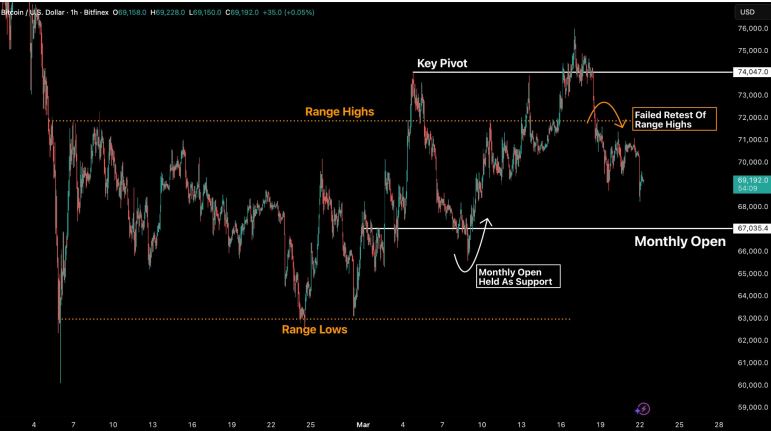
A sharp, news-driven spike earlier this week underscored how quickly risk appetite can flip. On Sunday ET, XRP jumped about 7% in a single session, climbing from roughly $1.36 to $1.46 as crypto prices broadly rallied in thin weekend liquidity. The move coincided with a market-wide upswing that also lifted Bitcoin (BTC) from around $68,000 to $71,000. XRP later gave back part of the gains, sliding toward $1.41 after conflicting signals emerged around Iran-related developments, highlighting that macro and geopolitical headlines continue to dominate short-term positioning.
Despite the bounce, near-term performance remains mixed. Over the past seven days XRP is still down about 7%, and it remains roughly 58% below its all-time high near $3.40. Technical signals tracked by market participants have not yet converged on a clear trend, with some analysts describing the bias as slightly bearish in the short run even as the token’s monthly return has turned positive.
Where the narrative is shifting is on the ‘institutional adoption’ front. Market participants have focused on Ripple’s Prime offering being recognized for use as 24/7 direct collateral in CME-linked activity, a development that could make XRP more usable for institutional workflows by improving capital efficiency and potentially reducing certain settlement and liquidation frictions. Analysts also point to a potential ‘lock-to-buy’ dynamic: as more XRP is held for collateral or operational purposes, the effective circulating float available for trading could tighten at the margin—even if that does not immediately translate into spot-market buying pressure.
Still, some observers argue that the same collateralization trend may help explain why price action has looked muted despite reports of record institutional accumulation. In this view, incremental demand expressed through treasury, custody, or collateral channels can reduce float without producing the kind of visible, aggressive spot bids that typically drive rapid rallies.
Another closely watched catalyst is Ripple’s integration with Mastercard ($MA), tying Ripple-linked rails into a payments network associated with roughly $9 trillion in annual volume. While the announcement has been framed as a meaningful step toward broader real-world utility, XRP’s price reaction has been limited so far, suggesting the market is waiting for clearer evidence of transaction throughput, fee flows, or measurable adoption metrics.
Attention is also increasingly shifting to Ripple’s U.S. dollar-pegged stablecoin, RLUSD, which some traders see as a potential wildcard. Bulls argue RLUSD could expand Ripple’s addressable market by offering ‘fiat-like’ settlement stability while allowing XRP to specialize as a liquidity and bridge asset. Skeptics counter that a stablecoin could reduce the need to hold XRP in certain payment corridors, potentially diluting token demand. Ripple has emphasized interoperability between RLUSD and the XRP Ledger ecosystem, but with limited public data on real settlement usage, many investors appear to be taking a wait-and-see stance.
Meanwhile, speculation around a BlackRock ($BLK) XRP ETF has circulated in parts of the social media and YouTube ecosystem, but as of March 25, it has not been corroborated by credible, primary-source reporting or official filings. Several crypto news outlets have described the claims as unsubstantiated, and no official Ripple roadmap update has validated an ETF partnership narrative. Market watchers caution that positioning based on rumor can amplify volatility, especially in large-cap tokens where leverage and headline sensitivity already run high.
By the latest available market data, XRP ranks as the fifth-largest cryptocurrency with a market capitalization of about $87.05 billion. Its 24-hour trading volume stands near $2.1 billion, with centralized exchanges accounting for the vast majority of activity and decentralized venues contributing a comparatively small share. Circulating supply is approximately 61.34 billion XRP—about 61% of the 100 billion maximum—with an estimated fully diluted valuation near $141.9 billion. XRP’s market dominance is around 3.58%, down over the past 60 and 90 days, though it has stabilized on a monthly view.
For now, XRP’s setup is defined by a tug-of-war between improving ‘regulated-market’ integration narratives and a macro backdrop that can reprice risk rapidly. If institutional use cases translate into observable increases in settlement activity or materially tighter liquid supply, the token could sustain its nascent rebound. If geopolitical tension intensifies or risk assets broadly weaken again, XRP may struggle to hold recent gains—even with stronger fundamentals in the background.
🔎 Market Interpretation
- Early trend shift attempt: XRP is showing initial signs of breaking a five-month downtrend, supported by a modest rebound in March, but confirmation is limited as weekly performance remains negative.
- Price snapshot & momentum: As of Mar 25, 2026 (ET), XRP trades near $1.419 (+~3% MTD) after steep pullbacks in January (-10.6%) and February (-16.2%). It is still ~58% below the ~$3.40 all-time high, signaling that the broader recovery is incomplete.
- Macro/geopolitics still dominate short-term: A weekend jump (~7%) in thin liquidity quickly faded as Iran-related headlines shifted risk sentiment—illustrating that headline risk is currently the primary driver of short-term volatility.
- Institutions may be “absorbing” supply without visible pumps: Institutional accumulation and collateral usage can tighten tradable float while producing muted spot bidding—potentially explaining why headlines haven’t translated into a sustained breakout yet.
- Key narrative tension: Upside depends on whether regulated-market integrations produce measurable settlement throughput; downside risk remains tied to renewed risk-off moves and geopolitical escalation.
💡 Strategic Points
- Watch for confirmation beyond price spikes: The Sunday rally showed reflexive upside, but follow-through was weak. Investors may look for higher highs/higher lows and sustained bid support rather than event-driven candles in low-liquidity windows.
- Institutional collateralization is a double-edged catalyst:
- Bull case: Ripple Prime being recognized for 24/7 direct collateral in CME-linked activity could increase institutional utility and capital efficiency, and gradually reduce floating supply (“lock-to-buy” effect).
- Neutral/bear case: If demand shifts into custody/collateral rather than open-market purchasing, price may remain constrained despite “accumulation” headlines.
- Mastercard integration needs metrics: Tying Ripple-linked rails into a network associated with ~$9T annual volume is strategically meaningful, but the market is waiting for proof—e.g., transaction volume on-chain, corridor expansion, fee/revenue signals, or publicly verifiable adoption KPIs.
- RLUSD is a wildcard for XRP’s role:
- Upside framing: RLUSD could expand Ripple’s addressable settlement market, while XRP specializes as a bridge/liquidity asset.
- Risk framing: A stablecoin could reduce the need to hold XRP in some corridors if counterparties can stay in stable value during settlement, potentially diluting token demand depending on design and adoption.
- What to monitor: Interoperability details, real settlement usage data, XRPL activity growth, and whether RLUSD increases or reduces XRP routing in practice.
- ETF rumor risk management: BlackRock XRP ETF chatter is described as unsubstantiated with no confirmed filings or official statements as of Mar 25. Trading on rumors can amplify volatility—particularly in large-cap assets with leverage and headline sensitivity.
- Market structure indicators: With XRP at ~$87.05B market cap (rank #5), ~$2.1B 24h volume, and CEXs dominating trading, near-term moves may remain liquidity- and narrative-driven. A durable shift would likely require sustained demand and/or meaningful float tightening.
📘 Glossary
- Downtrend (5-month): A prolonged period of lower highs/lower lows; “breaking” it implies price is attempting to reverse or at least stop declining.
- Thin liquidity: Periods (often weekends) when fewer orders are available, making prices more prone to sudden spikes or drops.
- Institutional integration: Adoption of crypto infrastructure by regulated entities (e.g., clearing, custody, collateral frameworks) that can influence long-term demand and legitimacy.
- Collateralization: Using an asset (here, XRP via Ripple Prime) as pledged value to secure trading/financing obligations; can reduce circulating float if held rather than traded.
- “Lock-to-buy” dynamic: When assets are held for operational/collateral purposes, reducing available supply for trading and potentially supporting price over time.
- Spot bids: Direct purchase orders in the spot market; typically needed for sharp, visible price appreciation.
- Bridge asset: A token used to facilitate conversions/liquidity between currencies or payment corridors.
- Stablecoin (RLUSD): A token pegged to the U.S. dollar designed to maintain stable value, often used for settlement and trading.
- Fully Diluted Valuation (FDV): Market cap if the maximum supply were circulating; used to gauge valuation assuming full token distribution.
- Market dominance: A token’s share of total crypto market value; falling dominance can mean others are outperforming, even if price is stable.
















Comment 0