

 News
News  Coin Information
  About us
  Customer Service



A fast, short-covering rally rippled through crypto derivatives markets on Thursday, helping lift headline prices even as U.S. spot ETF flows stayed negative—an unusual mix that suggests positioning, not fresh risk appetite, did much of the heavy lifting.
Over the most recent four-hour window, roughly $19.62 million in leveraged crypto positions were liquidated, with about $14.95 million of that total tied to shorts—around 76% of all liquidations in the period. The imbalance points to a classic 'short squeeze' dynamic, where bearish traders are forced to buy back into strength, accelerating upside moves even without a corresponding surge in new spot demand.
On a 24-hour basis, liquidations in major tickers totaled about $1.29 million, with long liquidations slightly leading at $708,400 (55%). That broader snapshot shows two-way churn, but the more telling signal for traders was the sharp shift in the last few hours toward short-side stress, implying a rapid repositioning after a modest rebound.
By venue, Binance led liquidation activity with $6.44 million, including $4.08 million in shorts. Hyperliquid saw $4.68 million liquidated, almost entirely short-side ($4.34 million), while Bybit posted $3.77 million with $3.42 million from shorts. The fact that the same pattern appeared across multiple derivatives hubs, rather than being concentrated on a single exchange, reinforces the view that a broad, marketwide unwind of bearish leverage was underway.
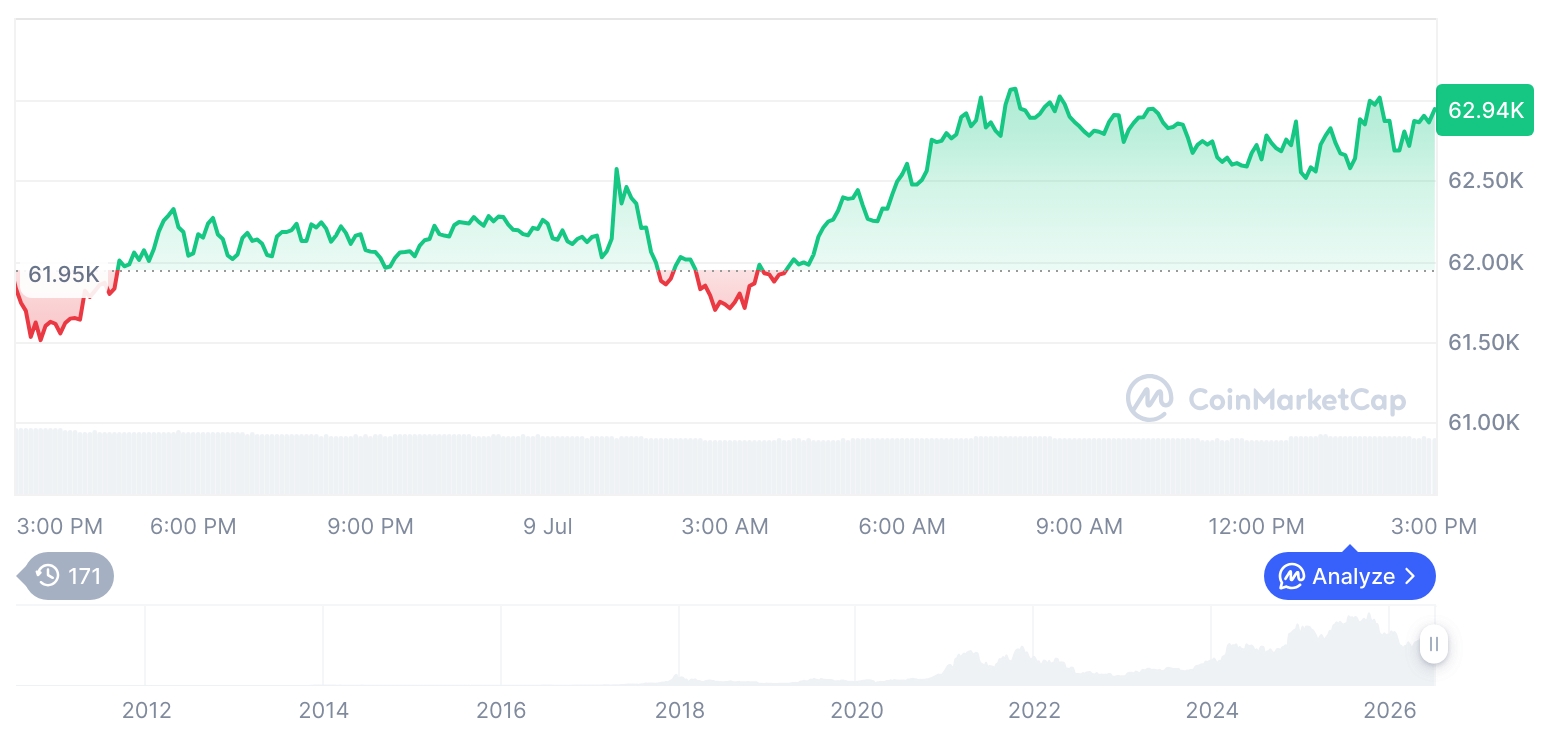
Prices rose in tandem, though the magnitude of the gains was less notable than their composition. Bitcoin (BTC) traded around $63,774, up 1.33% on the day, while Ethereum (ETH) climbed 0.92% to about $1,769. A rebound accompanied by heavy short liquidations is typically read as more fragile than one driven by accelerating spot volume—especially if follow-through buying fails to appear after the squeeze subsides.
Major altcoins were mostly higher but lacked a uniform breakout feel. XRP (XRP) gained 0.49%, Solana (SOL) rose 0.61%, Dogecoin (DOGE) added 1.34%, and TRON (TRX) increased 0.33%, while Hyperliquid’s token slipped 0.22%. The rotation looked selective rather than indicative of a broad 'alt season' ignition.
Market share data supported that interpretation. Bitcoin dominance rose to 58.45%, up 0.18 percentage points on the day, while Ethereum’s share ticked down to 9.75%. Even with prices firming, capital concentration in BTC suggests traders are still prioritizing perceived relative safety and liquidity over higher-beta exposure.
Liquidation heatmaps also showed leverage concentrated in the largest assets: Bitcoin accounted for about $92.33 million in liquidations over 24 hours, and Ethereum about $30.03 million. Such clustering means index-like moves in BTC and ETH can still dictate volatility across the broader market, as smaller tokens often react as a second-order effect.
Despite the price bounce, overall activity showed signs of consolidation rather than overheating. Total crypto market capitalization stood near $2.1887 trillion, with 24-hour spot trading volume around $65.4 billion—upward price action without a commensurate volume spike. Derivatives trading volume fell 15.48% day over day to roughly $609 billion, implying that the move may have been driven more by forced closing of existing short exposure than a wave of new leveraged longs.
On-chain-adjacent activity also cooled. DeFi volume declined 12.24% to about $8.48 billion, while stablecoin volume dipped 1.71% to roughly $68.15 billion. Those figures suggest that 'liquidity inflow' and risk-on deployment were not yet meaningfully accelerating, tempering the bullish read-through from prices alone.
ETF flows, in particular, sent a cautionary signal. For July 9 (U.S. time), U.S. spot Bitcoin ETFs recorded net outflows of about $95.3 million, while spot Ethereum ETFs saw roughly $52.08 million leave. The divergence—prices up, ETFs down—indicates institutional allocators may have been de-risking or taking profits into strength rather than chasing the rebound, complicating the narrative of a clean trend reversal.
Still, Ethereum saw a separate pocket of demand from a large buyer. A wallet suspected to be linked to Bitmine reportedly purchased an additional 20,500 ETH from Galaxy Digital, a transaction valued at approximately $35.92 million. Such targeted accumulation can offset broader fund-flow weakness on the margin, but it also makes near-term supply-and-demand signals more idiosyncratic and harder to generalize across the market.
In options markets, expiring contracts added another variable for short-term volatility. As of 16:00 KST (03:00 ET) on Thursday, about $1.907 billion worth of Bitcoin and Ethereum options were set to expire. The estimated 'max pain' levels were cited near $62,000 for BTC and $1,700 for ETH—below prevailing spot prices—raising the odds of choppier price action around settlement as hedges are adjusted.
Regulatory and policy developments also continued to pull crypto market structure into mainstream oversight. Prediction market Polymarket has initiated a U.S. regulatory approval process aimed at offering margin trading, while Hyperliquid and Phantom submitted comments to the U.S. Commodity Futures Trading Commission advocating for updates to rules governing on-chain trading infrastructure. The push signals a growing effort by crypto-native platforms to shape how the boundary between DeFi and derivatives is defined under U.S. regulation.
Meanwhile, longer-term accumulation trends remained intact at the corporate level. Public companies collectively bought roughly 110,000 BTC in the second quarter of 2026, bringing reported holdings to more than 1.26 million BTC—over 6% of total supply. That structural absorption can tighten circulating availability over time, even if it does not prevent sharper, leverage-driven swings in the short run.
Overall, Thursday’s move looked less like a decisive momentum breakout and more like a positioning event—a rapid unwinding of bearish leverage that lifted prices while ETFs bled and volumes softened. With outflows, subdued activity indicators, and options-expiry mechanics still in play, the rally’s durability will likely depend on whether spot demand and sustained 'institutional demand' emerge after the forced buying fades.


















Comment 0