

 News
News  Coin Information
  About us
  Customer Service


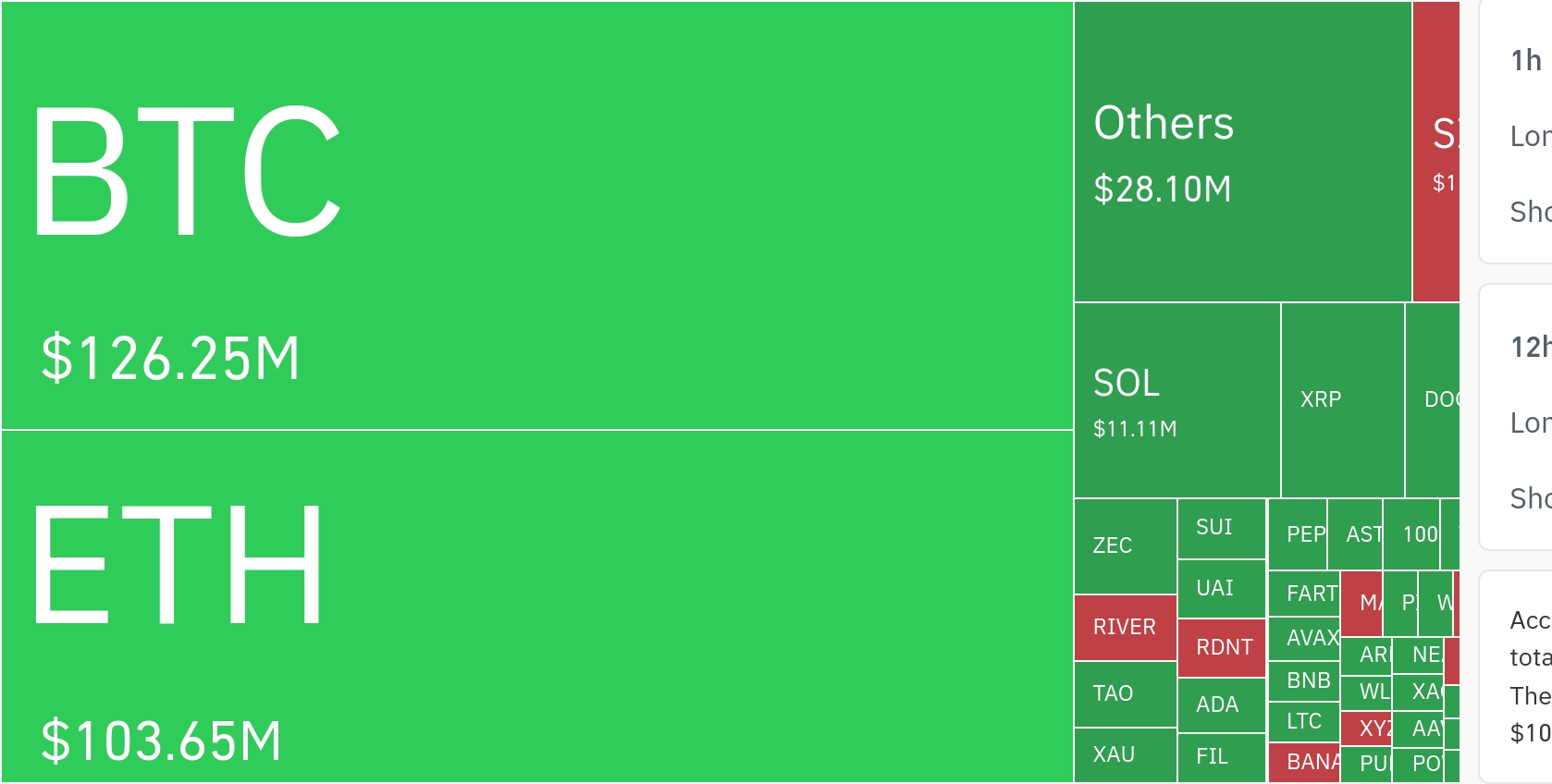
Cryptocurrency markets saw a sharp wave of forced deleveraging over the past day, with roughly $258.1 million in leveraged positions wiped out as prices drifted lower. The liquidation skew was overwhelmingly one-sided: long positions accounted for the majority of closures, underscoring how quickly bullish bets were punished during the pullback.
Data compiled by CoinGlass showed that about 78.68% of total liquidations over the last 24 hours came from longs—an imbalance that typically appears when traders remain positioned for upside even as spot prices soften and volatility rises.
In the most recent four-hour window, Binance led all venues in liquidation volume, with around $8.73 million in positions closed, representing 35.28% of the total tracked across major exchanges. Longs made up $6.72 million of that figure, or 77.06%. Bybit ranked second with $3.97 million (16.03%) liquidated, again dominated by long closures at $3.09 million (77.97%). OKX recorded approximately $2.85 million (11.54%) in liquidations, with an even higher long ratio of 81.6%.
Among notable outliers, Hyperliquid posted one of the most extreme long-heavy liquidation profiles: roughly $1.6 million in liquidations, with 96.25% tied to long positions. The imbalance suggests the platform’s users were positioned aggressively for a rebound, leaving them particularly exposed as prices slipped.
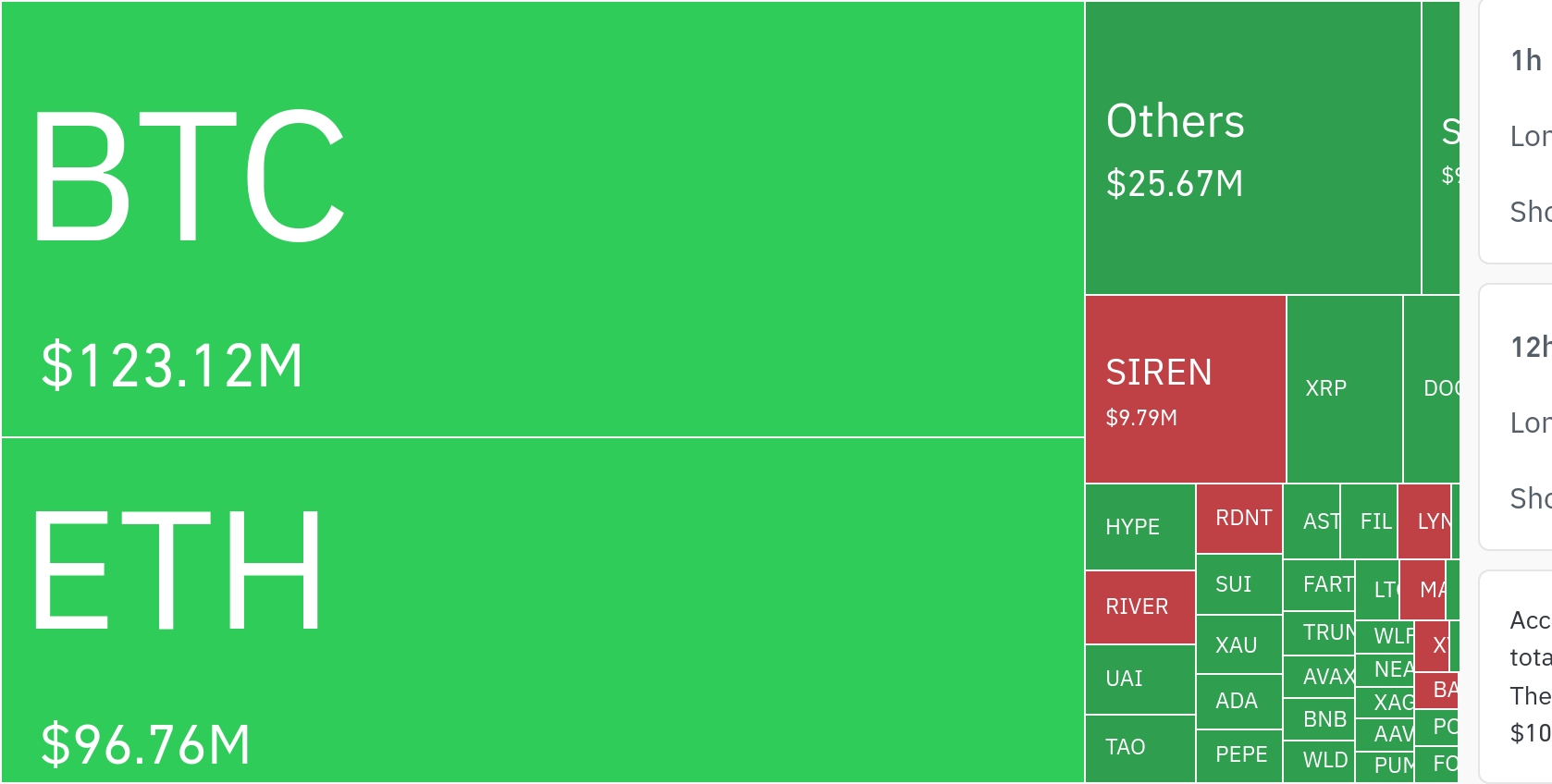
By asset, Bitcoin (BTC) was the epicenter of the unwind. BTC-linked liquidations totaled about $126.25 million over the past 24 hours, while the coin fell 2.81% to around $68,592. In the latest four hours alone, CoinGlass data indicated about $4.16 million in BTC longs were liquidated versus roughly $0.32 million in shorts—another sign that the market’s downside move had caught a larger share of traders leaning long.
Ethereum (ETH) followed closely, posting approximately $103.65 million in liquidations over 24 hours, placing BTC and ETH together at roughly nine-tenths of all liquidations during the period. That concentration highlights a familiar pattern in risk-off moments: leverage tends to cluster around the most liquid majors, and when those assets dip, the knock-on effect across derivatives accelerates quickly.
Altcoins also saw notable flushes, though on smaller dollar totals. Solana (SOL) recorded about $11.11 million in liquidations over 24 hours as the token fell 2.97% to roughly $87.24. Over the latest four hours, SOL absorbed around $1.12 million of long liquidations, making it one of the hardest-hit among large-cap alts during the short window.
XRP declined 3.53% and saw roughly $6.02 million in long liquidations over 24 hours. Hyperliquid’s HYPE token slid 4.46% alongside about $2.75 million in liquidations. Zcash (ZEC) stood out for outsized volatility, dropping 7.09% while registering approximately $2.64 million in liquidations—an abrupt move that may reflect thinner liquidity and heightened sensitivity to risk swings in the privacy-coin segment. Dogecoin (DOGE) fell 3.14% with about $0.29 million liquidated, while Cardano (ADA) slipped 3.41% and logged roughly $1.33 million in long liquidations.
In derivatives markets, a ‘liquidation’ occurs when an exchange forcibly closes a leveraged position after losses erode margin below required thresholds. When liquidations skew heavily toward longs, it generally signals that traders were positioned for price appreciation and were forced out as spot prices moved against them. Such episodes can exacerbate declines as cascading liquidations add market sell pressure, though they can also reduce leverage in the system and temporarily cool volatility once the flush is complete.
With liquidations concentrated in BTC and ETH and long positioning still dominating closures, the latest data points to a market that remained tilted bullish into a downturn—an imbalance that often leaves price action vulnerable to further rapid drawdowns if volatility persists. The scale and composition of the unwind will likely remain a key barometer for whether risk appetite stabilizes or whether additional rounds of ‘deleveraging’ emerge across major venues.
🔎 Market Interpretation
- Forced deleveraging event: About $258.1M in crypto derivatives positions were liquidated in 24 hours as prices drifted lower, reflecting a clear risk-off impulse.
- Longs were disproportionately punished: 78.68% of liquidations came from long positions, indicating traders stayed positioned for upside while spot weakened—an alignment that typically amplifies downside when volatility rises.
- Majors drove the damage: Liquidations were heavily concentrated in BTC (~$126.25M) and ETH (~$103.65M), together representing roughly ~90% of total liquidations—typical of broad market deleveraging that starts in the most liquid assets.
- Exchange distribution (recent 4 hours): Binance led liquidations with $8.73M (35.28% share), followed by Bybit $3.97M (16.03%) and OKX $2.85M (11.54%), each showing ~77%–82% long dominance.
- Notable extreme skew: Hyperliquid showed a very long-heavy profile (~96.25% longs), signaling unusually one-sided positioning and higher sensitivity to a downturn.
- Price action backdrop: BTC fell 2.81% to ~$68,592; ETH sold off alongside severe liquidations; select alts declined more sharply (e.g., ZEC -7.09%), consistent with thinner liquidity plus risk reduction.
💡 Strategic Points
- Positioning signal: A liquidation mix dominated by longs often implies the market was over-leaning bullish. If volatility persists, additional downside can occur as remaining leveraged longs get pressured.
- Watch for “flush completion” cues: After a long-liquidation cascade, leverage can reset and volatility may cool. Traders often monitor whether liquidation totals begin shrinking and whether funding/open interest normalize.
- BTC/ETH as risk barometers: Because liquidations clustered in BTC and ETH, the next directional move in majors may determine whether deleveraging spreads again into altcoins or stabilizes.
- Exchange-specific risk management: With Binance/Bybit/OKX leading the unwind, sudden moves can be exacerbated by cross-exchange hedging and automated risk engines—use tighter sizing and predefined invalidation levels during high-volatility windows.
- Altcoin vulnerability: Coins with thinner liquidity and higher beta (e.g., privacy/cohort names cited like ZEC) can experience outsized percentage drops even on smaller liquidation notional—appropriate for reduced leverage or spot-only exposure in unstable regimes.
- Near-term scenarios:
- Continuation risk: If price continues grinding lower, remaining long leverage may unwind further, creating another cascade.
- Relief bounce setup: If liquidation pressure subsides and spot demand returns, the reduced leverage environment can enable a sharper rebound—though this article’s data suggests the market was still long-tilted into the drop.
📘 Glossary
- Liquidation: Forced closure of a leveraged position by an exchange when losses reduce margin below required thresholds.
- Long / Short: A long profits if price rises; a short profits if price falls.
- Leverage: Borrowed exposure that magnifies gains and losses; increases liquidation risk during volatility.
- Margin: Collateral posted to maintain a leveraged position; if it falls too low, liquidation can occur.
- Deleveraging: Reduction of leveraged exposure (voluntary or forced) across the market, often during drawdowns.
- Liquidation cascade: A chain reaction where liquidations push price further, triggering more liquidations and accelerating the move.
- Risk-off: Market behavior characterized by reduced risk-taking, selling of volatile assets, and lower leverage.
- Volatility: The degree of price fluctuation; higher volatility increases liquidation likelihood for leveraged traders.

















Comment 0