

 News
News  Coin Information
  About us
  Customer Service


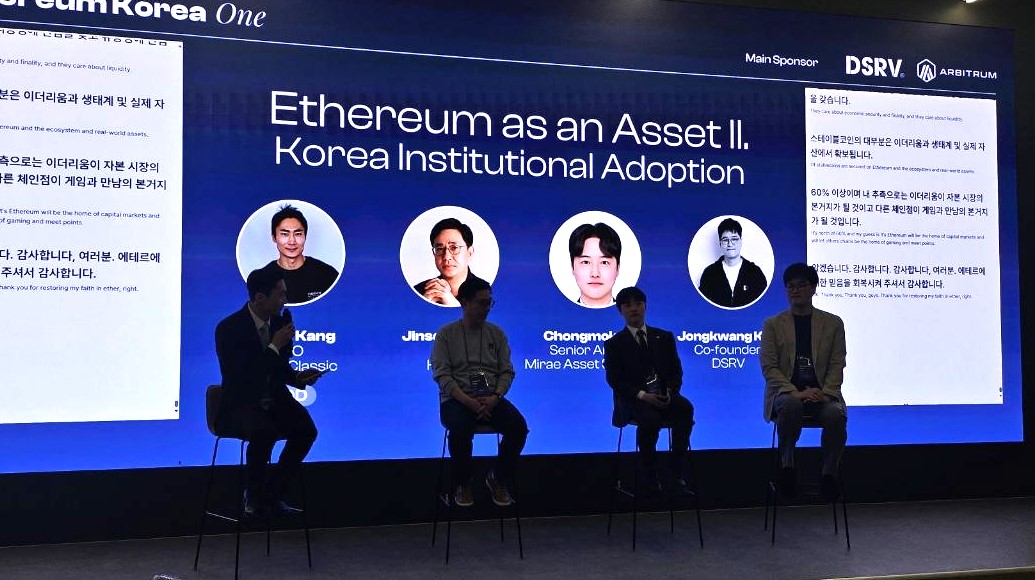
South Korean crypto and capital-market executives argued this week that while Ethereum’s on-chain activity is hitting record highs, its market price has yet to reflect those fundamentals—creating what they described as a rare window of opportunity as institutions and emerging ‘AI agent’ payment use cases converge on the network.
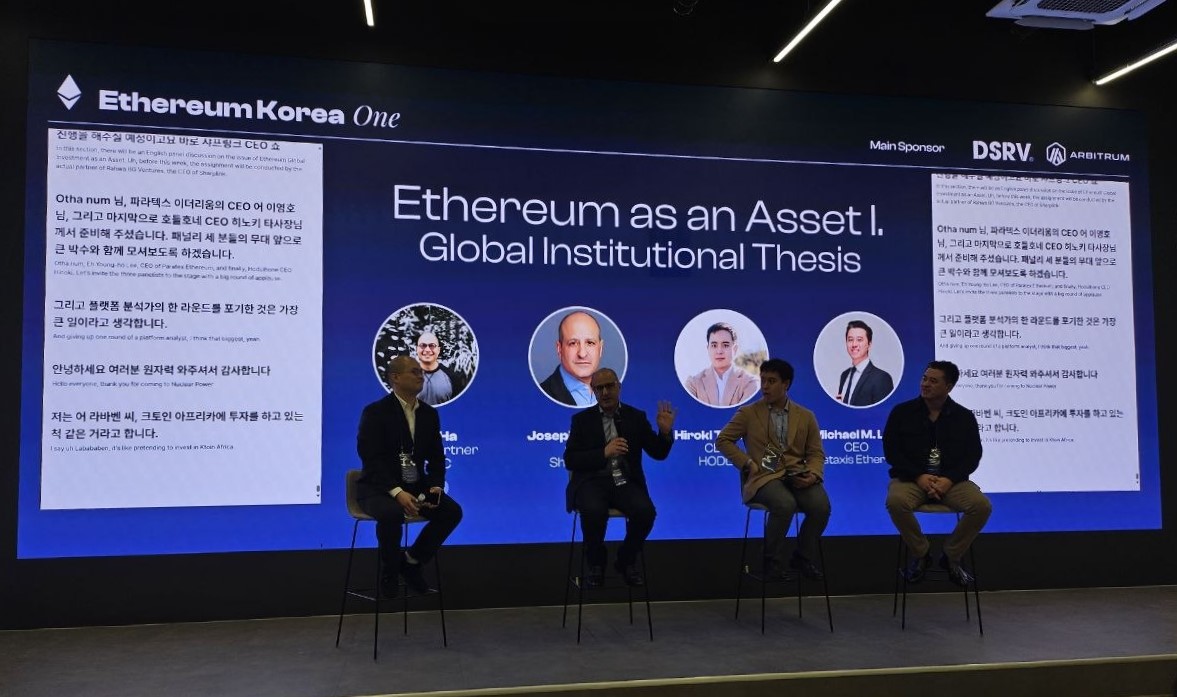
The discussion took place Tuesday ET (Wednesday in Seoul) at DSRV’s headquarters in Seoul during the second panel session of “Ethereum Korea One,” titled “Ethereum as an Asset II: Korea Institutional Adoption.” Panelists included Jongkwang Kim, co-founder of DSRV; Jinseok Cho, CEO of Korean Digital Asset (KODA), a major custody provider; and Jongmok Han, AI and digital-asset analyst at Mirae Asset Securities. The session was moderated by Youbin Kang, CEO of NonceClassic.
On-chain strength vs. price weakness
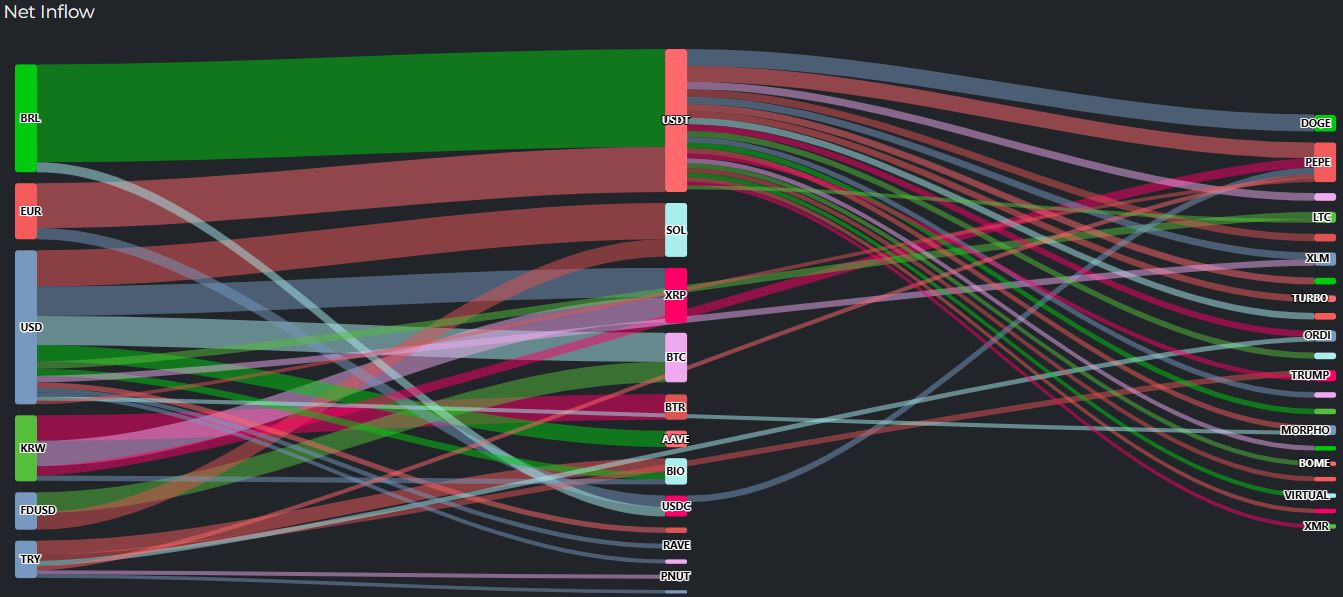
Han highlighted what he called a widening “price–fundamentals gap” for Ethereum (ETH), pointing to stablecoin activity and network usage as key indicators of structural demand. According to Han, Ethereum-based stablecoins saw $8.5 billion in net inflows over the past month, while Solana-based stablecoins posted net outflows over the same period. He also noted that Ethereum’s daily transactions reached an all-time high of 3.64 million on April 12, and that new user growth has increased fourfold on a quarterly basis over the last two years.
“From an analyst’s perspective, it takes time for the market to establish a valuation framework for Ethereum,” Han said, adding that demand continues to build even as price momentum lags. In his view, the mismatch is “one of the most interesting moments” for long-term observers because it suggests adoption is advancing faster than market narratives.
Kim took a blunter stance, arguing that Ethereum’s longevity and battle-tested security remain unmatched among smart contract platforms. “The direction is right, and there is no real competitor,” he said, describing Ethereum as the only chain with more than a decade of operational history at global scale. However, he cautioned that catalysts—particularly regulation and the rise of the ‘AI agent economy’—would likely determine how quickly the market closes the gap.
Custody alone isn’t enough for institutions
Cho, whose firm has met with more than 500 corporate and institutional clients since 2022, described the practical friction points behind slower institutional adoption of Ethereum relative to Bitcoin (BTC). While Bitcoin benefits from a straightforward ‘digital gold’ narrative, Cho said, Ethereum often requires deeper technical and operational understanding—reducing inbound demand from traditional institutions.
To move from curiosity to deployment, Cho argued, the market needs more than custody infrastructure. Institutions, he said, will require regulated pathways not only for storage but also for staking, lending, and ‘institution-grade DeFi’ services—areas where compliance, auditability, and counterparty risk controls become decisive.
Cho also urged policymakers to ensure South Korea’s proposed digital asset framework does not tilt too heavily toward Bitcoin alone. He said regulation should accommodate Ethereum’s smart contracts and DeFi ecosystem, which he views as critical for broader financial-sector experimentation. He added that Ethereum’s recent outreach to institutional audiences has been a “positive change,” but emphasized that adoption will accelerate only when case studies and reference implementations are presented directly to decision-makers.
Why panelists think ‘AI agents’ will need Ethereum
The most forward-looking portion of the session focused on whether AI agents—software systems that can browse, negotiate, and transact on a user’s behalf—will demand blockchain-native payments.
Han argued that, while the theme may look overhyped in the short run, it could be underestimated over longer time horizons. He cited the “router” feature introduced with GPT-5 as an example of how agents could orchestrate high-volume web activity, communicate with other agents, and trigger payments as part of automated workflows. In that environment, he said, transactions are likely to be ‘high-frequency’ and ‘micro-denominated,’ making them difficult to settle efficiently through card rails or bank transfers.
He pointed to the X402 protocol—described on the panel as a payments-related communication standard being developed by Coinbase ($COIN) and Cloudflare ($NET), with participation from the Ethereum Foundation and Google ($GOOGL)—as an indicator that large technology and crypto firms are exploring agent-native payment infrastructure. “In an agent commerce era, stablecoins and the Ethereum ecosystem could become unavoidable infrastructure,” Han said.
Kim echoed the point from an identity and access perspective: AI agents cannot hold bank accounts, he said, but they can hold Ethereum accounts—making on-chain wallets a natural settlement layer for autonomous commerce. He argued that the combination of microtransactions, rapid settlement, and composable financial logic leaves Ethereum as the most realistic backbone for payment flows between agents.
Broader implications
In closing remarks, panelists stressed that institutional adoption will hinge on operational requirements—‘stability,’ contractual assurance via smart contracts, transaction speed, and predictable fees—attributes they believe Ethereum is best positioned to provide at scale.
The debate underscored a growing thesis in South Korea’s crypto market: Ethereum’s immediate price action may be less informative than the steady expansion of its role as settlement infrastructure—particularly if regulators formalize institution-friendly frameworks and if AI-driven commerce makes programmable, low-friction payments a default requirement.















Comment 0