
 Add as a preferred source on Google
[Wall Street liquidity radar] Bitcoin’s US discount and bearish positioning persist as institutional volume drops
Bitcoin’s US spot discount narrowed, but Coinbase Prime volume fell sharply and CME leveraged funds held more shorts than longs, pointing to cautious institutional participation.


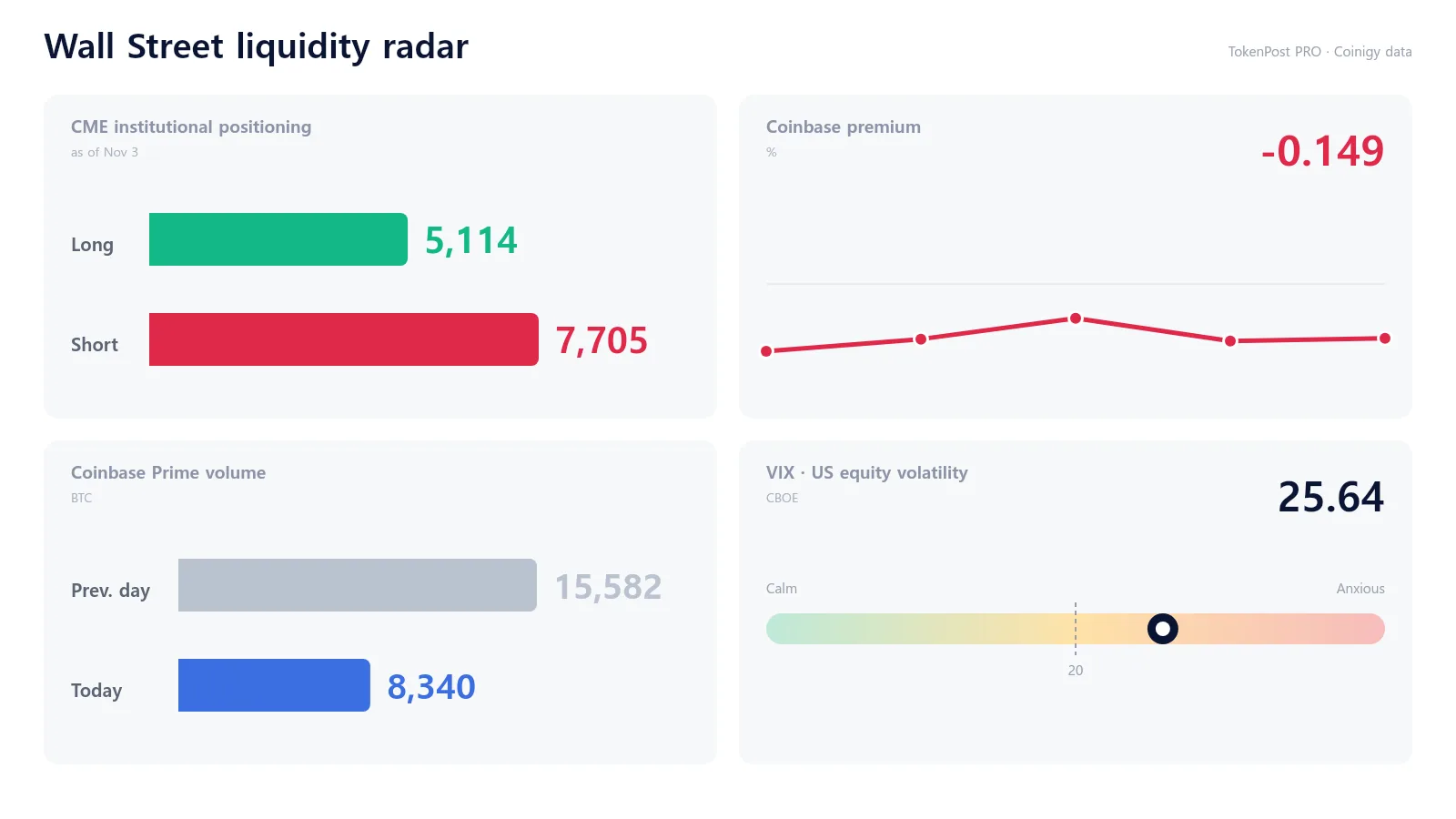
US bitcoin indicators point to caution as institutional trading volume contracts sharply. Bitcoin continues to trade at a discount in the US, while leveraged funds hold more short than long positions in futures.
The US spot discount narrowed in the latest completed session, but weaker institutional turnover offers limited evidence of a recovery in buying conviction. Futures positioning also remains tilted toward downside exposure.
CFTC disclosures show that leveraged funds held 5,114 long contracts and 7,705 short contracts on CME as of November 3.
The heavier short positioning suggests a defensive stance, although some positions may hedge other exposures rather than express an outright bearish view. The CFTC publishes these figures weekly, so they do not necessarily reflect current positioning.
The Coinbase premium stood at -0.18% on November 2, -0.15% on November 3 and -0.09% on November 4, before moving to -0.16% on November 5 and -0.15% on November 6. The discount narrowed in the latest completed session. A November 7 snapshot put the premium at -0.13%.
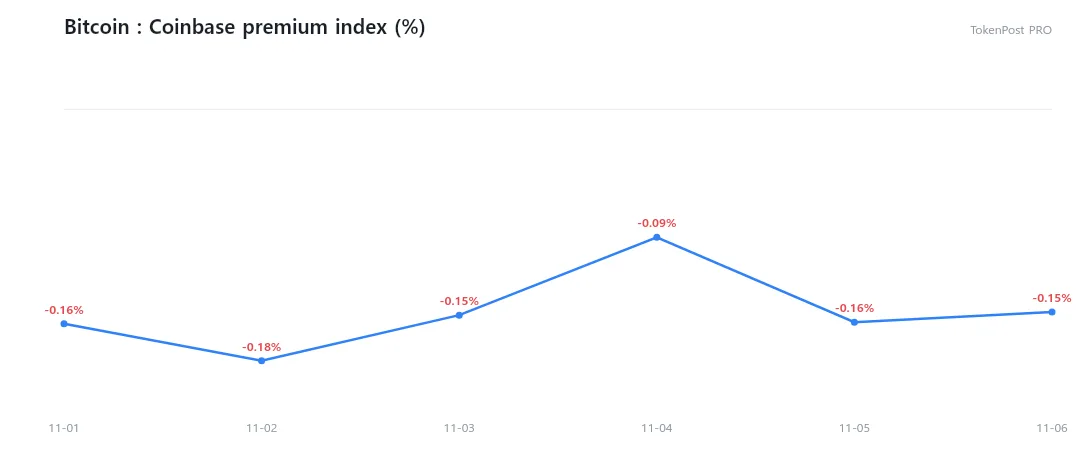
A positive premium means bitcoin trades at a higher price on Coinbase than on Binance; a negative reading means it trades at a discount. The narrower discount may indicate that relative US buying weakness eased, but readings remained negative throughout the supplied period.
Bitcoin: Coinbase premium (%)
Coinbase Prime, an institutional trading venue, recorded volume of 8,340.21 BTC on November 6, down sharply from 15,581.53 BTC on November 5. Valued at the November 6 closing price, that turnover amounted to approximately $631.61 million.
The decline indicates lower trading participation through the institutional venue. Volume includes both purchases and sales, however, so the drop alone does not establish that institutions sold bitcoin. The narrowing US spot discount was accompanied by weaker institutional activity.
The VIX closed at 25.64 on November 6, down 2.54 points from 28.18 on November 5.
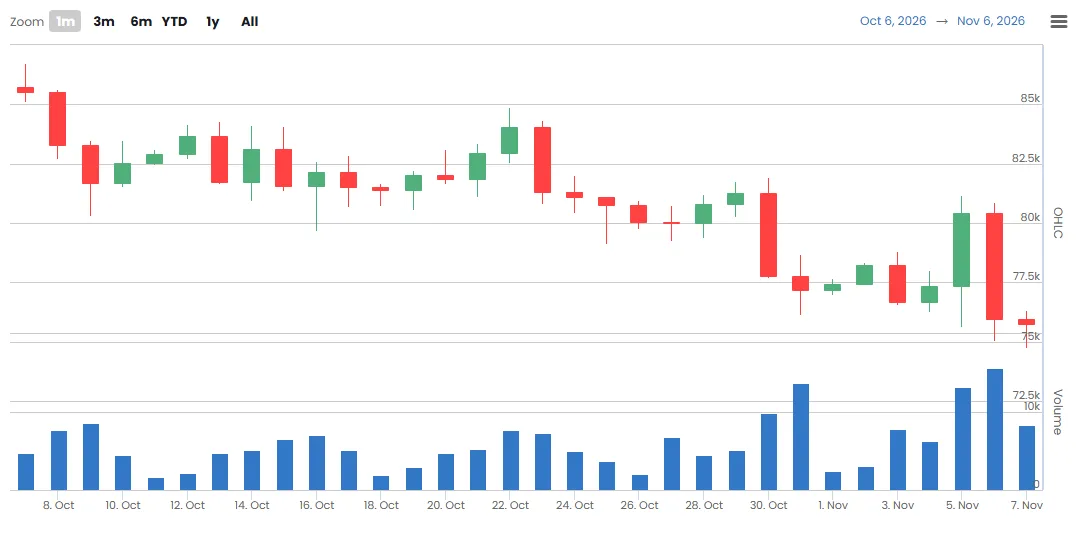
The index reflects expected volatility in US equities. Its decline suggests that market anxiety eased from the previous session, although uncertainty remains relevant to appetite for crypto assets.
The dollar index, which measures the dollar against major currencies, closed at 102.30 on November 6, up 0.75 from 101.55 on November 5. The US Treasury yield for the 10-year maturity stood at 4.84% as of November 5. A stronger dollar and elevated yields can weigh on demand for risk assets.
Taken together, the indicators suggest restrained US bitcoin demand and defensive futures positioning. A sustained narrowing of the spot discount alongside recovering institutional turnover would provide clearer evidence of improving participation, although higher volume alone would not establish buying dominance.
[Editor’s note] Wall Street liquidity radar examines US bitcoin sentiment through CME leveraged-fund positioning, the Coinbase premium, the VIX and Coinbase Prime trading volume. Together, these indicators provide context on futures exposure, relative spot demand, equity-market uncertainty and institutional participation.
This column is based on market data and analysis and does not constitute investment advice.
Enna Lee
ReporterEnna Lee reports on investing and digital-asset markets for TokenPost. Send corrections or tips to info@tokenpost.com.