
 Add as a preferred source on Google
Bitcoin tests $77,000 support as spot selling and ETF outflows weigh
Bitcoin’s $77,000–$80,000 support zone relies heavily on futures buying, Bitfinex said, as holders continue selling and US spot ETFs record $1.16 billion in outflows over three sessions.


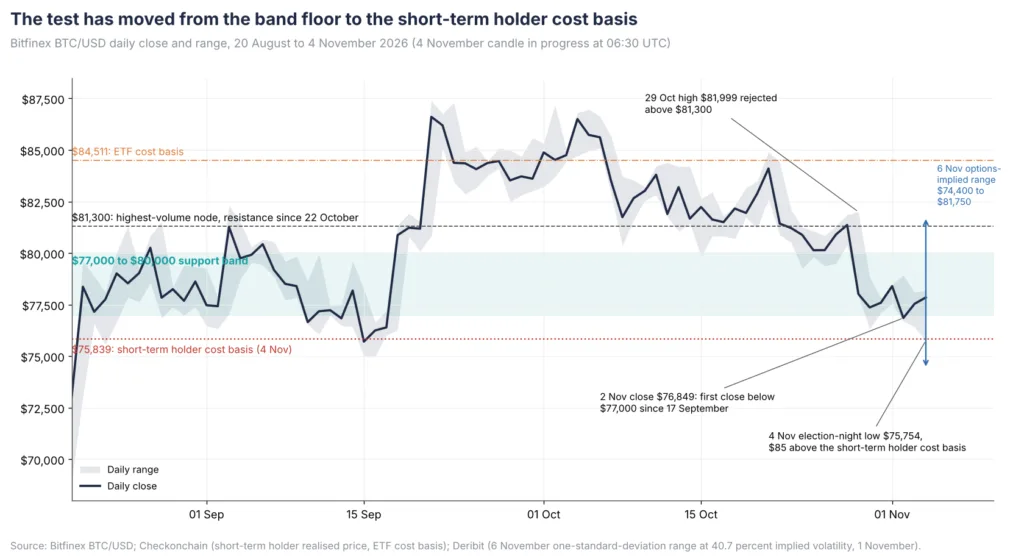
Bitcoin has regained its key support zone, but subdued spot buying and continued selling are raising questions about the recovery’s durability. Perpetual futures positions appear to be providing much of the support, leaving the rebound dependent on derivatives demand.
In its “ETF Outflows And Spot Selling Test Bitcoin’s Recovery” report published on November 4, 2026, Bitfinex said bitcoin briefly fell to the short-term holder cost basis of $75,839 after the US mid-term elections before recovering into the $77,000–$80,000 support range. The report said identifying the buyers behind that recovery matters: historically, floors supported mainly by perpetual futures buying have not lasted long.
Futures buying supports rebound as spot demand stays weak
Aggregate bitcoin futures open interest, measured in bitcoin, reached 701,548 BTC on November 3, its highest since September 22. Perpetual funding rates remained near an annualised 11% over the past two weeks despite the price correction, while spot buyers showed little aggression. Bitfinex said these readings suggest buying below $77,000 relies primarily on perpetual futures positions.
Both short-term and long-term holders continued selling spot holdings, although more slowly than at the early October highs above $80,000. The short-term holder Spent Output Profit Ratio, which measures whether coins held for less than 155 days are sold at a profit or loss, stayed below 1 for six consecutive trading sessions and reached 0.994 on November 4. That signals selling at a loss and marks the longest such run since the eight days ending August 17.
Net realised losses across all holders widened to 24,600 BTC on November 4 from 13,000 BTC on November 2, the largest since August 7. According to Bitfinex, holders who bought between $77,000 and $84,000 in October sold whenever prices approached their cost basis instead of buying to defend it. Every recovery since October 30 was driven by short covering rather than fresh investor demand.
Holdings build within support zone, with a thin cushion below
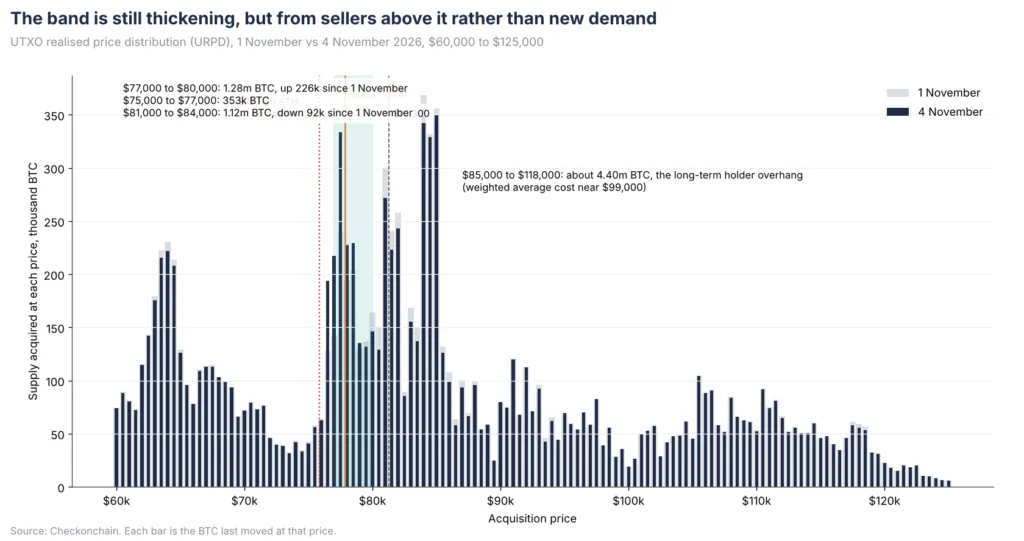
The UTXO Realised Price Distribution, or URPD, which tracks the prices at which bitcoin last moved, also showed the shift. Supply acquired between $77,000 and $80,000 increased to 1.28 million BTC on November 4 from 1.05 million BTC on November 1. Over the same period, supply acquired between $81,000 and $84,000 declined by 92,000 BTC to 1.12 million BTC.
Bitfinex said coins were passing from October buyers above the support band to new holders within it, increasing the concentration of holdings there without adding net demand. Only about 353,000 BTC was acquired between $75,000 and $77,000. The report said a sustained move below the short-term holder cost basis would encounter little support before the $70,000–$75,000 range.
Spot ETFs shed $1.16 billion over three sessions
Corporate treasury accumulation of bitcoin has slowed from earlier in the year. Bitfinex said weaker ETF demand is removing another important source of buying.
US spot bitcoin ETFs recorded $1.16 billion in net outflows over three trading sessions between October 30 and November 2, the largest since the end of June. That left cumulative flows for 2026 slightly negative, with net outflows of $60 million. BlackRock’s IBIT accounted for $405.3 million of outflows on November 2 alone, its largest daily withdrawal since June 26, although the fund retained about $3.7 billion in net inflows for the year.
The report said the key question is how the outflow streak resolves after the election. A single day of inflows on November 4 would offer little evidence of a recovery in demand. Three consecutive days of inflows comparable in size to the recent withdrawals would provide the first evidence that institutional demand had returned, Bitfinex said.
John Kim
John Kim reports on the digital-asset business for TokenPost. Send corrections or tips to info@tokenpost.com.