
 Add as a preferred source on Google
Ripple keeps XRP at center of strategy as RLUSD expands
Ripple CEO Brad Garlinghouse said RLUSD’s expansion supports XRP, with about half of the stablecoin issued on the XRP Ledger. Integration and institutional adoption remain priorities.


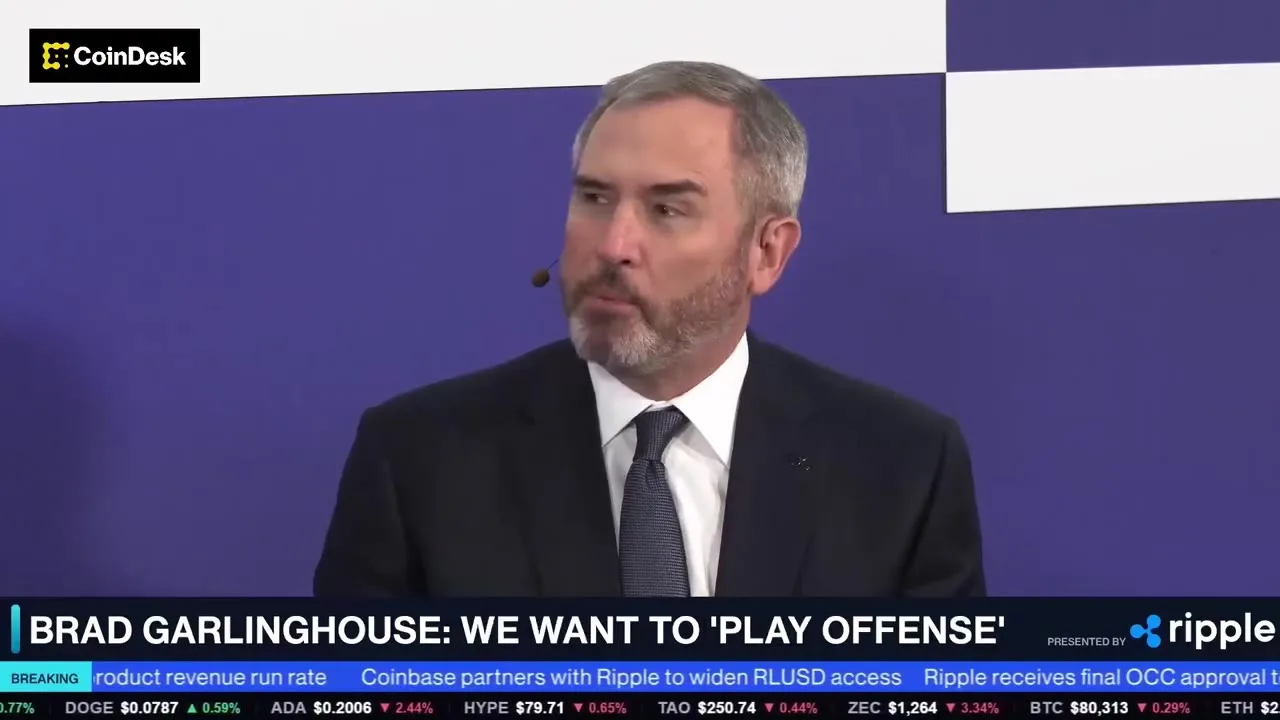
Ripple’s expansion of RLUSD is intended to deepen liquidity and increase XRP’s use across its ecosystem. The company plans to route payments through either asset according to the payment corridor and currency pair.
In a CoinDesk interview on November 4, Ripple CEO Brad Garlinghouse said a series of RLUSD announcements had drawn attention to the stablecoin, while XRP remained the company’s guiding priority. He said the RLUSD business supported that objective.
About half of all RLUSD is now issued on the XRP Ledger, adding liquidity to the network, Garlinghouse said. Ripple aims to bring more payments through its business and improve the customer experience, directing transactions toward RLUSD or XRP where appropriate. He described the broader goal as increasing liquidity, trust and utility around XRP.
Ripple made $2.5 billion in acquisitions last year, Garlinghouse said. Its Treasury business was delivering record growth and bringing more payments into the ecosystem, creating opportunities to shift transactions from traditional fiat infrastructure to on-chain payments. He added that roughly 20% of the Prime business had already been digital, a share Ripple wants to increase.
The company has focused this year on integrating those acquisitions, with plans to pursue opportunities more actively next year. Garlinghouse said the growing convergence of traditional and decentralized finance put Ripple in a favorable position.
Addressing concerns about centralization, Garlinghouse rejected the claim that Ripple controls the XRP Ledger. He said the company operates only a low single-digit percentage of its validators. Although Ripple contributes heavily to the code base and invests in ecosystem companies, the ledger does not use proof of stake, and XRP ownership does not confer authority over the network.
Holding XRP gives its owner no authority to act on the XRP Ledger, he said, identifying the perceived link between Ripple’s token holdings and control of the network as a persistent misunderstanding.
Garlinghouse cited an institutional focus and regulatory compliance as RLUSD’s competitive strengths. He pointed to news involving the OCC and Ripple’s work with the New York DFS. He also said RLUSD had received the highest safety rating among the stablecoins assessed by Moody’s, supporting its positioning for institutional use.
On regulation, Garlinghouse expressed disappointment that the Clarity Act had not completed the legislative process. However, he said the SEC and CFTC had filled part of the gap through rulemaking within their authority. The longer those rules remain in place, he argued, the stronger the precedent they establish for future agency leadership.
Garlinghouse also said decentralization and compliance should advance together. Giving individuals greater control over their financial affairs matters, he said, but the industry must respect financial-services laws and licensing frameworks for its technologies to flourish.
He expects crypto and blockchain to become underlying technologies within financial services. Describing Ripple as a financial-services and financial-infrastructure company, Garlinghouse said the distinction between crypto businesses and other companies could fade, much as the label “internet company” had become less meaningful.
Riza Dagoc
Riza Dagoc reports on regulation, investing and the digital-asset business for TokenPost. Send corrections or tips to info@tokenpost.com.